Northern regions of Saudi Arabia experienced a noticeable drop in temperatures, with Tabuk recording the lowest temperature of the day on Wednesday at 3 degrees Celsius, a clear indication of the deepening cold air mass affecting the Kingdom. The city of Tarif came in second with a low of 4 degrees Celsius, followed by Arar, where the minimum temperature reached 6 degrees Celsius. This necessitates caution from residents and those traveling on highways.
Details of the National Center for Meteorology report
The National Center for Meteorology, in its weather forecast for January 14, indicated that weather maps show a continued drop in temperatures across most regions of the Kingdom. This decrease will be accompanied by a noticeable increase in surface winds, stirring up dust and sand, which may significantly reduce horizontal visibility, especially on highways and in open areas in parts of Tabuk, Al-Jawf, the Northern Borders, Hail, and extending to the Madinah region.
Rain and fog
In a related context, the report indicated that the sky will be partly to mostly cloudy, with a chance of light rain that may refresh the atmosphere in parts of the Makkah, Al-Baha, Asir, and Jazan regions. This chance extends to parts of the northern and eastern regions of the Kingdom. The center also warned of the possibility of dense fog forming during the night and early morning hours, which may reduce visibility in parts of the highlands in the west and southwest of the Kingdom.
The climatic and geographical context of cold waves
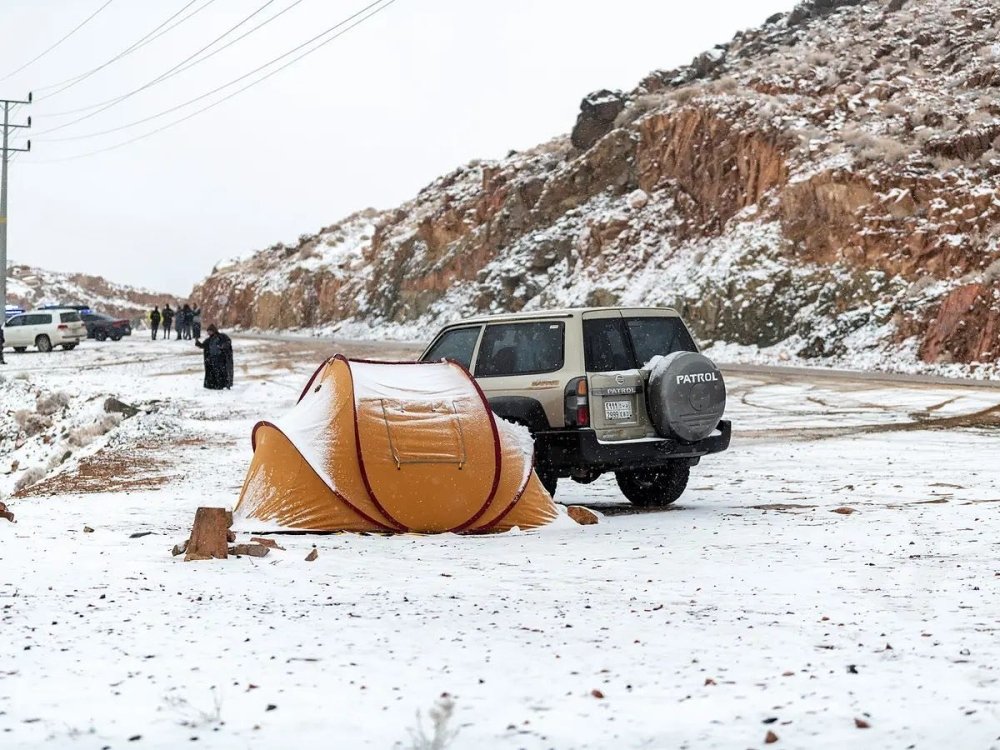
This cold wave is typical of the winter climate in northern Saudi Arabia, where the Tabuk region and border areas serve as the Kingdom's northern gateway for polar air masses originating from the Northern Hemisphere and Europe. These areas are characterized by a geography and topography that contribute to sharply lower temperatures, particularly in January and February. Historically, the region experiences temperatures that can reach or even drop below freezing in some seasons, occasionally resulting in snowfall on the highlands of Jabal al-Lawz and other areas.
State of the Red Sea and the Arabian Gulf
Regarding maritime navigation, the report indicated that surface winds over the Red Sea will be northwesterly to northerly in the northern and central parts, and southeasterly to southerly in the southern part, with speeds ranging between 25 and 45 km/h, and wave heights reaching up to 2.5 meters, resulting in moderate to rough sea conditions. In the Arabian Gulf, winds will shift to northwesterly in the evening, potentially reaching speeds of up to 50 km/h with the formation of thunderstorms, raising wave heights to 2.5 meters. Caution is advised for fishermen and other seafarers.
Monitoring these weather reports is of paramount importance to vital sectors in the Kingdom, particularly the agricultural sector, which may be affected by frost waves, and the transportation sector, given the impact of dust and fog on road safety. This reflects the important role played by the National Center for Meteorology in providing accurate and up-to-date information.