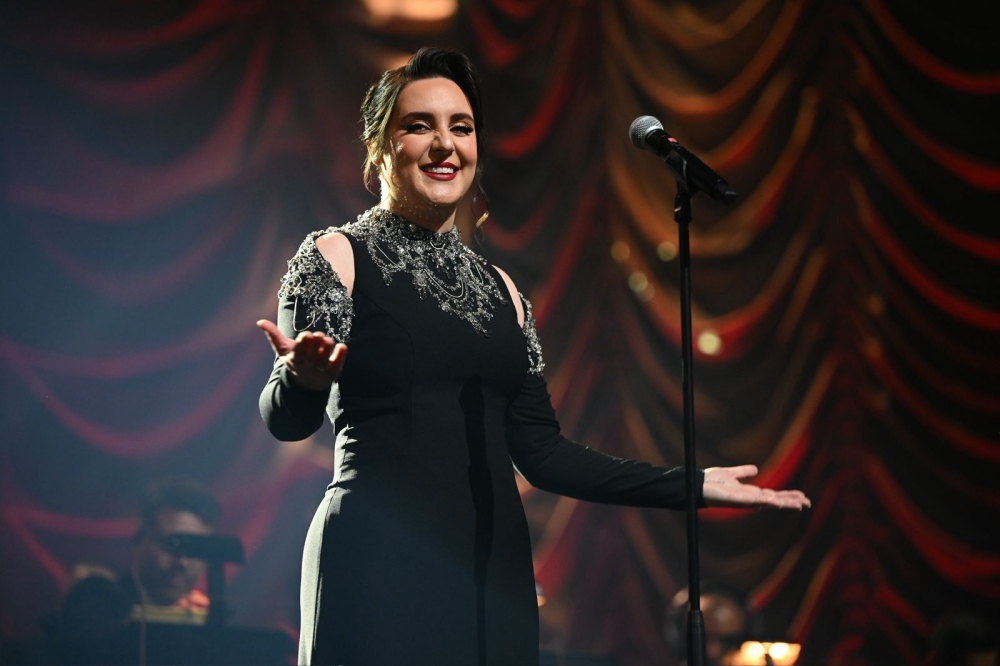
The brilliant Lebanese artist Walaa Al-Jundi expressed her immense pride and joy at performing for the second time on the stage of the King Abdulaziz Center for World Culture (Ithra) as part of the "Singing in Classical Arabic" festival. In her remarks during the press conference following her performance, Al-Jundi emphasized that this participation was a great honor and a testament to the confidence placed in her by the organizers of this prominent cultural event, which she described as a valuable artistic and cultural addition to any artist's career.
A festival celebrating the aesthetics of the Arabic language
The “Singing in Classical Arabic” festival, organized by Ithra, is a unique platform in the region, aiming to revive and celebrate sung Arabic poetry. The festival seeks to re-highlight the beauty of Classical Arabic and its ability to express the most refined emotions and ideas through music. This event comes within the context of a broad cultural movement in Saudi Arabia, aimed at strengthening Arab cultural identity and presenting high-quality arts to local and international audiences, in line with the ambitious goals of Saudi Vision 2030 to enrich the quality of life and develop the cultural sector.
An extension of a great artistic legacy
Singing in Classical Arabic is not a new art form, but rather an extension of a great musical heritage that has shaped the consciousness of the Arab nation for decades. Giants of Arab art, such as Umm Kulthum, Mohammed Abdel Wahab, Fairuz, and Abdel Halim Hafez, built their legacies on songs sung in Classical Arabic by great poets like Ahmed Shawqi, Ibrahim Naji, and Nizar Qabbani. These works have become timeless icons in the history of Arabic music, making festivals like "Singing in Classical Arabic" essential for preserving this heritage and transmitting it to new generations in a contemporary way.
Authentic artistic origins
Walaa Al-Jundi explained that her deep connection to classical Arabic was not accidental, but rather the product of a genuine artistic upbringing. She said, "We were raised from a young age on traditional songs, muwashahat (a type of Andalusian strophic poem), and classical Arabic songs, so this appreciation grew naturally with us." She added that her passion for this genre of singing was further strengthened after her participation in a talent show where she performed classical works such as the poem "Madnak Jafah Marqaduh" (Your Suffering Has Been Forsaken by Sleep). She witnessed the audience's connection to her voice in this artistic form, which encouraged her to continue her journey in it.
Classical Arabic: The language that unites Arabs
Al-Jundi emphasized the pivotal role of Classical Arabic as a fundamental link uniting Arab peoples from the Atlantic to the Gulf. She stated, "Our Arabic dialect is one of the greatest and most complex in the world, and unfortunately, we are witnessing a growing trend towards other dialects for ease of communication. However, Classical Arabic remains the language understood by all." She stressed the importance of preserving it and strengthening its presence in all educational, cultural, and media platforms, as it represents the essence of identity and a symbol of unity for the Arab world.
Public reaction reflects success
Regarding her experience with the audience in the Eastern Province, Al-Jundi expressed her deep appreciation for the enthusiastic response, saying, “The audience was amazing, as always. This is my second time performing at the Ithra stage, and I’ve previously given two successful concerts here. The audience’s interaction, singing along, and warm applause are the most important indicators of success for me.” This positive response reflects the Saudi and Arab audience’s thirst for authentic art and refined lyrics, and confirms the festival’s success in achieving its goals.