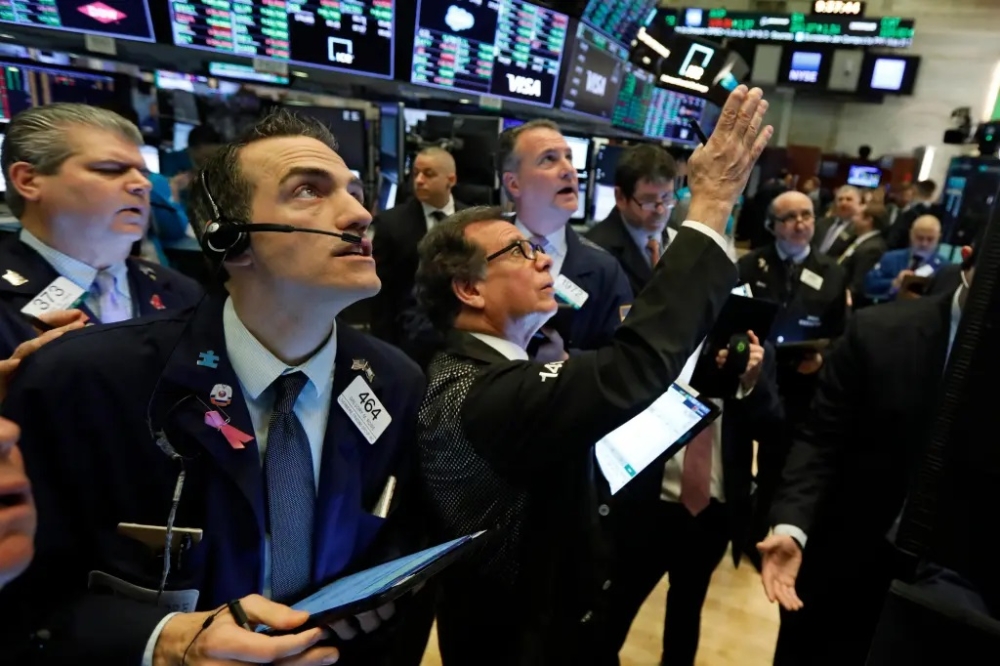
Wall Street experienced a sharp decline on Thursday, with major indices closing significantly lower. The drop in US stocks amid ongoing economic volatility, raising concerns among investors about the near-term outlook for financial markets and its potential impact on the global economy.
Details of the decline in US stocks and the performance of major indices
Major Wall Street indices posted mixed losses at the close of trading on Thursday. The broader Standard & Poor's 500 (S&P 500) index fell 114.79 points, or 1.74%, to settle at 6476.89.
In related news, the Dow Jones Industrial Average fell 481.68 points, or 1.04%, to close at 45,955.00. The Nasdaq Composite, dominated by technology stocks, was the hardest hit, dropping 2.34%, or 513.56 points, to close at 21,416.27. Notably, the Nasdaq closed more than 10% lower than its record closing high on October 29, officially entering a price correction zone.
The economic context behind Wall Street's volatility
Historically, this downturn is not an isolated event, but rather part of an economic cycle influenced by numerous macroeconomic factors. US markets often react sensitively to the Federal Reserve's (the US central bank) interest rate decisions, as well as inflation and unemployment data. The technology sector, which drives the Nasdaq, has experienced tremendous growth in recent years thanks to the artificial intelligence revolution and digital innovations. However, the high valuations of these companies make them vulnerable to rapid profit-taking and sharp price corrections when investor sentiment shifts or signs of an economic slowdown emerge.
Global and local repercussions of market declines
This decline on Wall Street carries significant implications that extend far beyond the geographical boundaries of the United States. Internationally, US markets are considered a compass for the global economy; any major downturn there often casts a shadow over European and Asian stock exchanges, driving global investors toward safe havens such as gold and government bonds.
At the regional and local levels, the global market downturn could impact Middle Eastern stock markets, particularly with regard to commodity prices such as oil, which are closely linked to global economic growth prospects. Furthermore, sovereign wealth funds and regional investors with substantial portfolios in US equities may experience volatility in the value of their assets, necessitating a reassessment of risk management strategies and asset allocation to ensure stable returns amidst these financial uncertainties.
Future outlook
In conclusion, the global financial landscape remains focused on the release of further economic data that could determine the direction of markets in the coming period. Despite the current losses, some financial analysts believe that periods of correction may create new investment opportunities for long-term investors, provided they exercise caution and closely monitor macroeconomic indicators to avoid unforeseen risks.