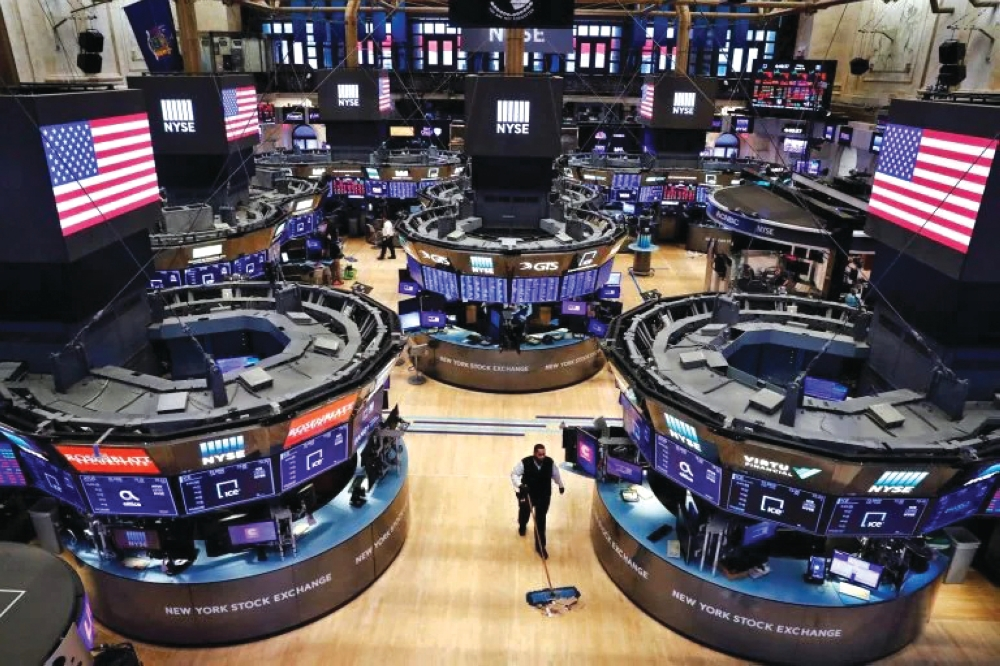
Major US stock indices closed mixed on Friday, reflecting investor caution and anticipation amid volatility across various sectors. The session saw a split between industrial and technology stocks, resulting in the indices closing in opposite directions.
Details of US indices performance
At the close of trading, the broader S&P 500 index edged up slightly, gaining 2.23 points, or 0.03%, to settle at 6915.16. This modest rise reflects relative stability among the index's major companies despite market pressures.
The technology sector led the gains, with the Nasdaq Composite Index, dominated by technology stocks, rising 62.51 points, or 0.27%, to close at 23,498.53. This rise indicates continued investor appetite for growth and technological innovation stocks.
In contrast, the Dow Jones Industrial Average bucked the overall upward trend, losing 288.51 points, or 0.58%, to close at 49,095.50. This decline was attributed to the poor performance of some of the major industrial companies included in the index, which weighed on its overall performance.
Signs of divergence in financial markets
The divergence in the closing of US indices is a natural phenomenon in financial markets, and often indicates a "sector rotation" process, where investors move their capital from traditional and industrial sectors (often represented by the Dow Jones) to growth and technology sectors (represented by the Nasdaq), or vice versa, based on economic data and interest rate expectations.
The economic importance of the Wall Street stock exchange
The movements of Wall Street are of paramount importance not only to the US economy but to the global economy as a whole. The US market is considered the primary driver of global financial markets, with stock exchanges in Asia, Europe, and the Middle East often following US market closes in subsequent trading sessions. Economists monitor these three indices (the Dow Jones, Nasdaq, and S&P 500) as a barometer for measuring the health of the global economy, inflation rates, and monetary policy trends.
Historically, the Dow Jones Industrial Average is one of the oldest indices and includes 30 major industrial companies, while the Standard & Poor's 500 is the best benchmark for measuring the performance of the market as a whole because it covers 500 major companies, while the Nasdaq focuses intensively on the technology and internet sector, making it more volatile but also the highest-yielding during periods of technological boom.