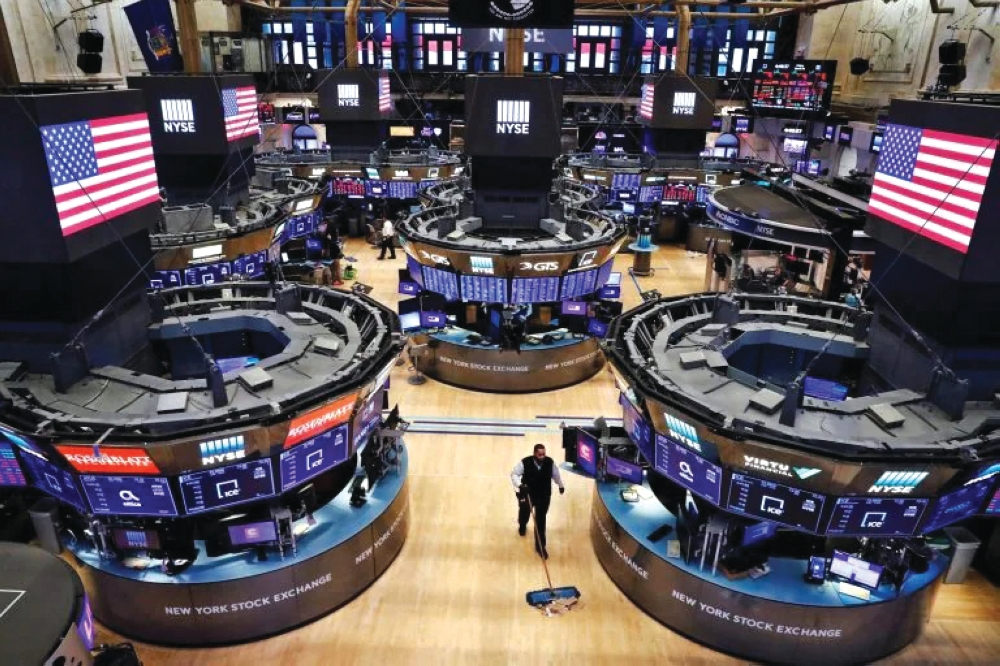
US stock indices opened lower across the board on Wall Street on Monday, with red dominating trading screens at the start of the session, reflecting a cautious and watchful stance among investors. The decline affected all three major indices, amid close monitoring of economic data and market movements.
Key indicators performance details
According to opening data, the Dow Jones Industrial Average , which measures the performance of major US industrial companies, recorded a slight decline of 4.4 points, or 0.01%, settling at 49,499.67 points. Although the drop appears small, it reflects pressure on leading stocks.
Meanwhile, the broader Standard & Poor's 500 index saw a more pronounced decline, falling 22.2 points, or 0.32%, to 6,944.12. The Nasdaq Composite, dominated by technology stocks, suffered the biggest loss of the three, dropping 94.5 points, or 0.40%, to 23,576.877.
Background on financial markets and the importance of indices
The New York Stock Exchange (Wall Street) is the world's most important financial center, and the movements of its indices serve as a compass for the global economy. The Dow Jones Industrial Average represents established and stable companies, while the Nasdaq Composite reflects investors' risk appetite due to its focus on the technology sector and rapid growth. These indices are typically influenced by multiple factors, including the Federal Reserve's (the US central bank) interest rate policies, inflation rates, and periodic corporate earnings reports.
Economic impact and analyst forecasts
A lower market opening often indicates profit-taking after previous gains or a preemptive reaction to upcoming economic data releases. Economic analysts closely monitor these movements, as a continued decline could negatively impact investor sentiment in other global markets, given the close link between the US economy and European and Asian markets.
Despite the negative start, the trading session remains open to all possibilities until the closing bell, as buying forces could return to reduce losses or reverse the trend based on the flow of economic news during the coming hours.