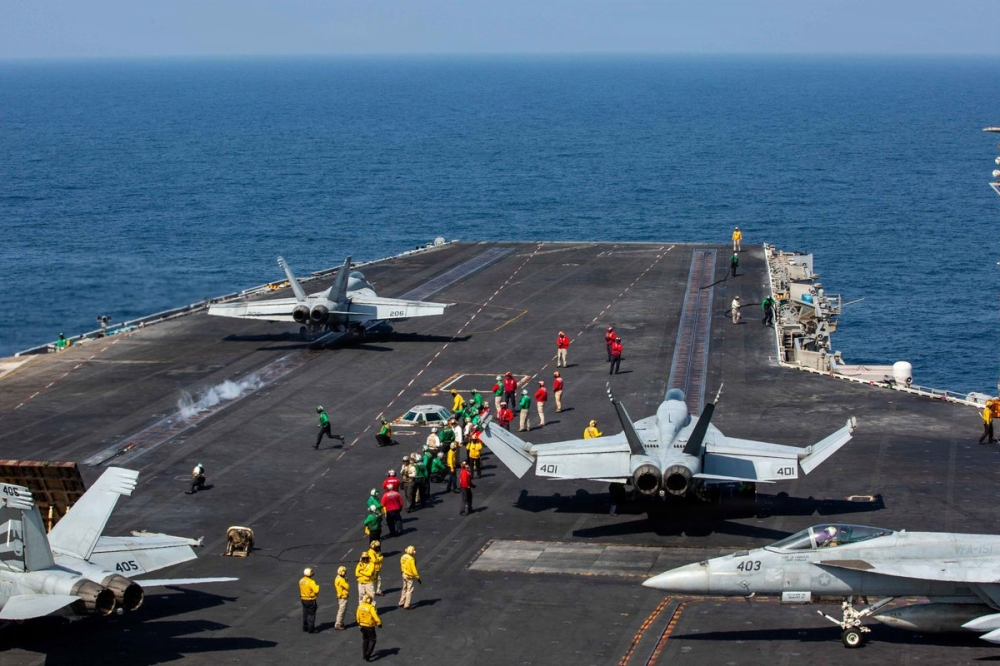
In a move reflecting escalating regional tensions, US media outlets reported that Washington has decided to bolster its military presence in the Middle East by deploying additional Marines and warships. These strategic military deployments come roughly two weeks after the recent military escalation and exchange of strikes between Israel and Iran. The Wall Street Journal quoted US officials confirming that the amphibious assault ship USS Tripoli, which had been based in Japan, is currently en route to the region carrying Marines. Meanwhile, The New York Times reported that approximately 2,500 US Marines are heading to the region aboard at least three warships, demonstrating the seriousness with which the US administration is addressing the current developments.
The historical context of the US military presence in the Middle East
The increased US military presence in the Middle East is not a recent development, but rather an extension of a long-standing US strategy dating back decades. Historically, the United States has maintained a strong military presence in the region to ensure the stability of global energy markets and to protect vital waterways such as the Strait of Hormuz, the Bab el-Mandeb Strait, and the Suez Canal. US Central Command (CENTCOM) is based in the region to manage military operations and coordinate with strategic allies.
Over the years, the region has seen troop levels rise and fall depending on the level of threats. From the Gulf War through the invasion of Iraq to the international campaign against ISIS, U.S. forces have played a pivotal role in shaping the security landscape. Today, with the growing influence of some regional powers and escalating geopolitical tensions, Washington is once again bolstering its deterrent capabilities, reaffirming its commitment to the security of its allies and its vital interests.
The strategic importance and expected impact of the new reinforcements
The deployment of these military reinforcements carries profound implications and far-reaching consequences at the local, regional, and international levels. Regionally, this move aims to send a clear deterrent message to any parties that might seek to exploit the instability to escalate the conflict. The increased presence of warships and marines acts as a buffer against sliding into a full-blown regional war, particularly given the ongoing tensions between Israel, Iran, and various armed factions in the region.
Internationally, securing maritime navigation is a top priority for the global economy. Any disruption to the movement of commercial ships or oil tankers in the Middle East immediately impacts global energy prices and inflation rates. Therefore, the US move reassures international markets and European and Asian partners that Washington will not allow freedom of navigation to be threatened. Domestically, this presence provides logistical and security support for US diplomatic missions and military bases in several Arab countries, ensuring Washington's ability to respond quickly to any emergencies or potential evacuations.
Rapid deterrence capabilities: The role of the ship “Tripoli” and the Marines
The current reinforcements are distinguished by their high quality; the USS Tripoli is not just a conventional ship, but an amphibious assault ship designed to support Marine Corps operations and transport fighter jets and helicopters. Having 2,500 Marines aboard three ships gives the U.S. military exceptional flexibility in carrying out diverse missions, from special operations and amphibious landings to providing humanitarian relief or securing critical infrastructure. This combination of naval and land power enhances the United States' ability to adapt to a rapidly changing and complex security environment.