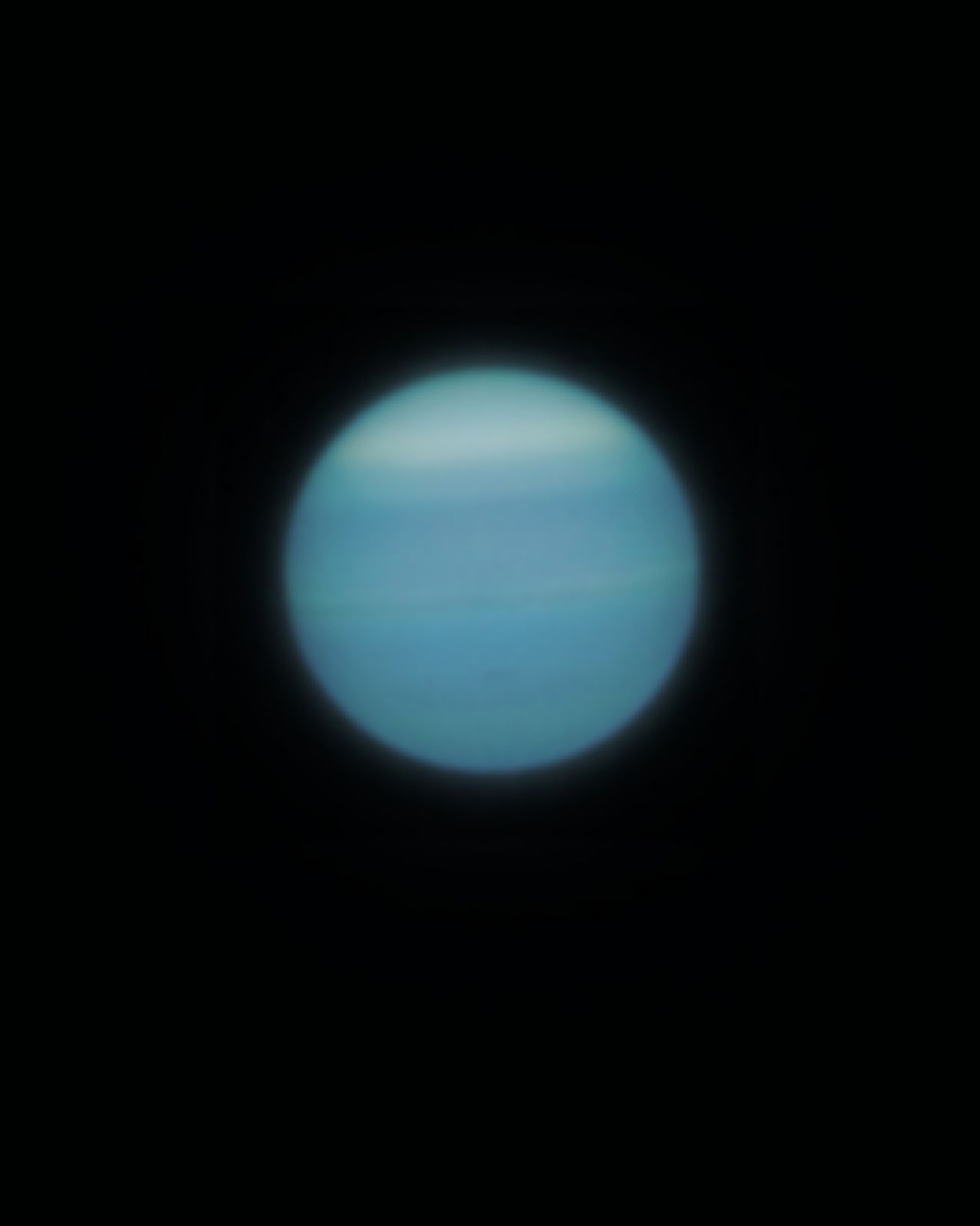
The end of an optical illusion in the sky: Uranus resumes its normal motion
The Jeddah Astronomical Society announced that Uranus, the seventh ice giant in our solar system, will reach the end of its apparent retrograde motion on Wednesday, February 4, 2026. After months of moving westward across the sky, the planet will resume its usual eastward motion among the stars. The society's president, Engineer Majid Abu Zahra, explained that this phenomenon is not a true change in the planet's orbit, but rather a stunning optical illusion resulting from the orbital interaction between Earth and Uranus.
What is a retrograde movement and why does it occur?
The retrograde motion of the outer planets, such as Mars, Jupiter, Saturn, Uranus, and Neptune, occurs when Earth, in its closest and fastest orbit to the Sun, passes these planets. It can be likened to a fast car on an inward lane overtaking a slower car on an outward lane; from the perspective of the fast car, the slower car appears to be reversing for a moment. Similarly, when Earth passes between the Sun and Uranus, the blue-green planet appears to us to be temporarily reversing direction. This latest retrograde motion began on September 6, 2025, and culminated when the planet reached opposition on November 21, 2025, at its closest point to Earth and its brightest point, making it an ideal target for astronomers.
Uranus: An Unseen Discovery and Astronomical History
Uranus was not as well-known to ancient civilizations as the other five planets (Mercury, Venus, Mars, Jupiter, and Saturn) due to its extreme faintness and immense distance. It was formally discovered in 1781 by the astronomer William Herschel, who initially mistook it for a comet. This discovery doubled the size of the known solar system at the time and revolutionized astronomy. Historically, the retrograde motion of the planets had puzzled scientists for centuries, and ancient astronomical models, such as Ptolemy's geocentric system, attempted to explain it with complex orbital motions. However, with Copernicus's heliocentric model, the explanation for this phenomenon became simple and logical, providing strong evidence that the planets revolve around the Sun.
One last chance to observe before disappearing
As Uranus's retrograde motion ends, the best time to observe it begins to wane. Engineer Abu Zahra explained that the planet will reach its highest point in the sky four minutes earlier each night. This means it will gradually approach the western horizon after sunset, disappearing into the evening twilight over the coming weeks. Therefore, this period represents a final opportunity for amateur astronomers to point their telescopes at this distant celestial body before it vanishes from the night sky for several months. The Jeddah Astronomical Society emphasizes that observing this cosmic dance is not only an enjoyable hobby but also a practical way to deepen our understanding of the dynamics of the solar system and promote scientific literacy within the community.