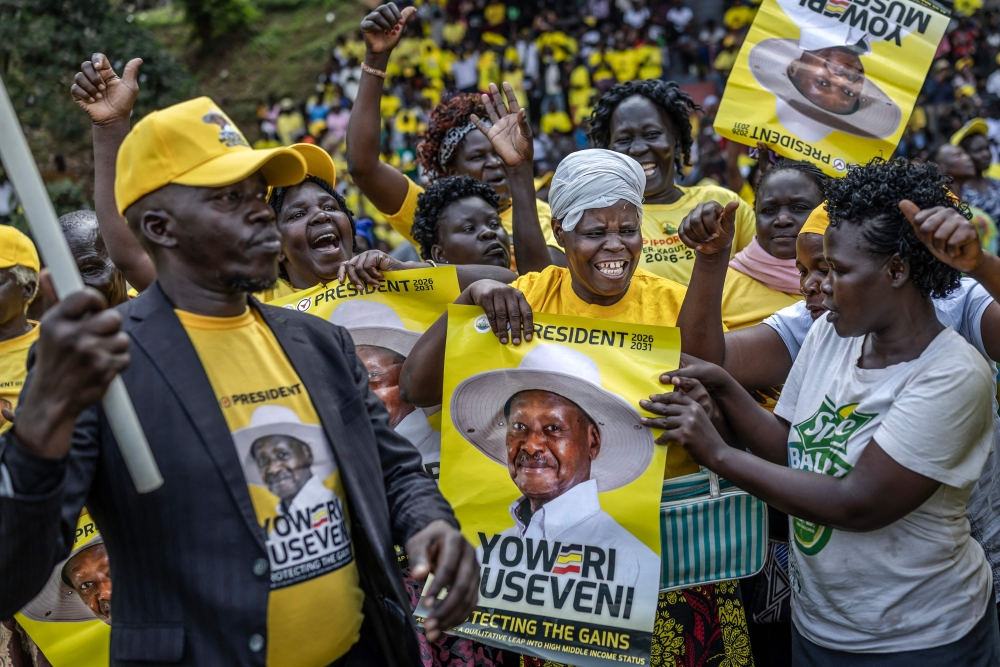
Uganda's electoral commission announced on Saturday that President Yoweri Museveni had won a seventh five-year term, extending his decades-long rule of the country. The announcement concludes an election marked by tension and fierce competition between the old guard and the rising generation of young leaders.
The official committee reported that Museveni secured the presidential election in his favor after obtaining a majority of votes with a percentage of (71.65%), far ahead of his closest rival, the opposition candidate and former singing star Bobi Wine, who obtained (24.72%) of the voters’ votes, according to the announced figures.
Historical background: Decades of rule
Yoweri Museveni, who has been in power since 1986, is one of the longest-serving leaders on the African continent. He came to power through an armed rebellion and was initially considered by the West to be part of a new generation of reformist African leaders. Over the years, the Ugandan constitution has been amended twice in ways that have allowed him to remain in power; first, by removing term limits, and second, by removing the age limit, thus paving the way for his candidacy for this seventh term.
Generational conflict and the political landscape
These elections were unique, reflecting a generational struggle in Uganda. While Museveni (76 years old) relied on a popular base that saw him as a guarantor of stability and security after years of civil war, his rival, Bobi Wine (38 years old), represented the aspirations of the younger generation in a country where 80% of the population is under 30. Wine succeeded in garnering widespread support in urban areas and among young people frustrated with unemployment and corruption, making this election one of the most challenging to Museveni's authority.
Strategic importance and regional influence
Museveni’s re-election carries significant implications both regionally and internationally. Uganda is a key security ally of the United States and Western countries in the volatile East African region, with Ugandan troops playing a pivotal role in the African Union Mission in Somalia (AMISOM) in the fight against the extremist group al-Shabaab. Museveni is expected to continue his approach of promoting regional security, despite growing international criticism of the country’s human rights and political freedoms record. Domestically, the re-elected president will face numerous economic challenges, most notably creating jobs for the country’s growing youth population and maintaining internal stability amidst rising opposition voices.