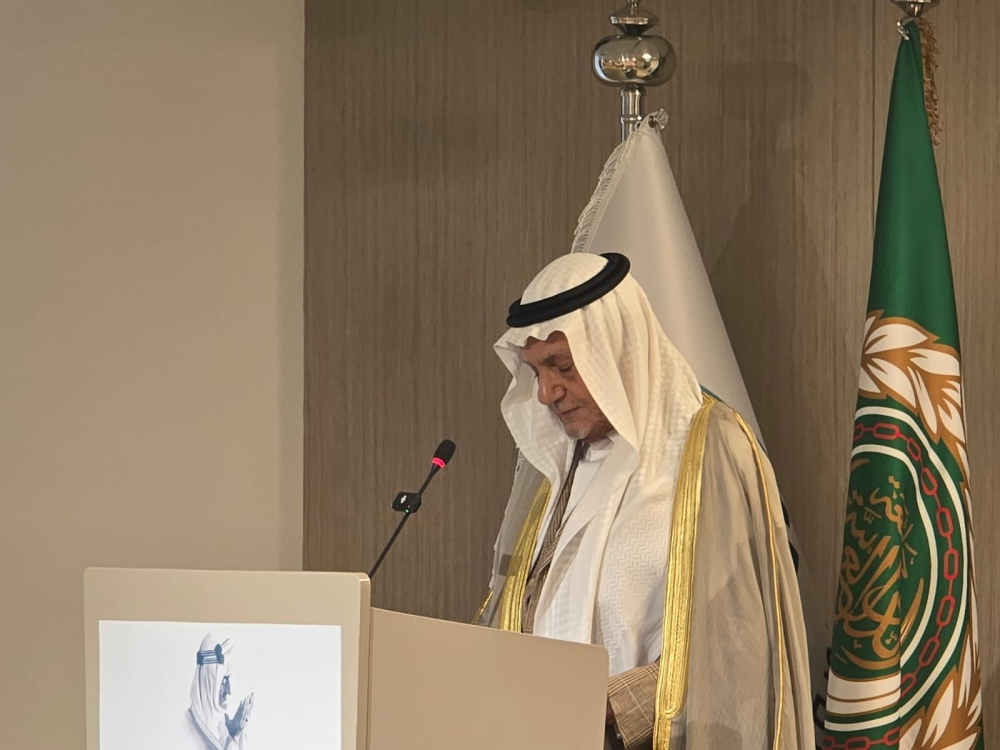
In a significant cultural event reflecting the depth of intellectual activity in the Kingdom of Saudi Arabia, His Royal Highness Prince Turki Al-Faisal, Chairman of the Board of Directors of the King Faisal Center for Research and Islamic Studies, inaugurated the third edition of the “Arab Narrative Days.” This event, organized by the Center in cooperation with regional cultural institutions, underscores the Center’s ongoing mission of enlightening the Arab and Islamic heritage through modern critical methodologies.
The philosophy of beauty in Arab consciousness
In his opening remarks, Prince Turki Al-Faisal delved into the aesthetic essence of the Arab character, noting that the “silence of the desert” was not a void, but rather the cradle that sharpened the senses and refined taste. His Highness emphasized that the pivotal moment in the history of Arab arts was the revelation of the Holy Quran, which transformed language from a means of communication into a sacred vessel of beauty and majesty, leading to an unprecedented artistic renaissance manifested in the development of Arabic calligraphy and Islamic ornamentation.
His Highness cited the noble verse {We have certainly created man in the best of forms}, considering it the aesthetic charter that governed Islamic arts, as the Muslim artist always sought to find proportion and harmony, transforming lines and geometric shapes into a visual language that glorifies the Creator and embodies the values of monotheism in its most splendid form.
Cultural openness and global influence
Within the context of the historical expansion of Islamic arts, the events addressed the remarkable capacity of Islamic civilization to assimilate neighboring cultures. Arab arts embraced the heritage of Persian, Roman, and Byzantine civilizations, but did not dissolve into them; rather, they reshaped them within the "Islamic crucible." This fusion produced a unique artistic style that combines local diversity with spiritual unity, a characteristic clearly evident in Islamic architecture from Andalusia in the west to the borders of China in the east.
This approach is of paramount importance at the present time, as the King Faisal Center for Research and Islamic Studies seeks to correct misconceptions about Islamic art, and to highlight it as a living and renewed art that has contributed to shaping global taste, and not merely artifacts placed in museums.
Strategic partnership for heritage preservation
For his part, Dr. Mohamed Ould Amar, Director-General of the Arab League Educational, Cultural and Scientific Organization (ALECSO), praised the pioneering role played by the King Faisal Center as a global research beacon. He emphasized that “Arab Narrative Days” is not merely a fleeting event, but a strategic project aimed at documenting and protecting Arab narratives from distortion, and connecting new generations to their cultural roots through the mediums of knowledge and art.
A continuous path of knowledge
It is worth noting that this edition builds upon the efforts of the previous two; the first, in 2023, focused on the movement of science and knowledge, while the second, in 2024, explored the memory and culture of the desert. This third edition further develops this intellectual framework through the arts, reinforcing the Kingdom's position as a leading center for Arab and Islamic heritage and supporting its objectives within the framework of Vision 2030, which places great emphasis on culture and the arts as elements of soft power.