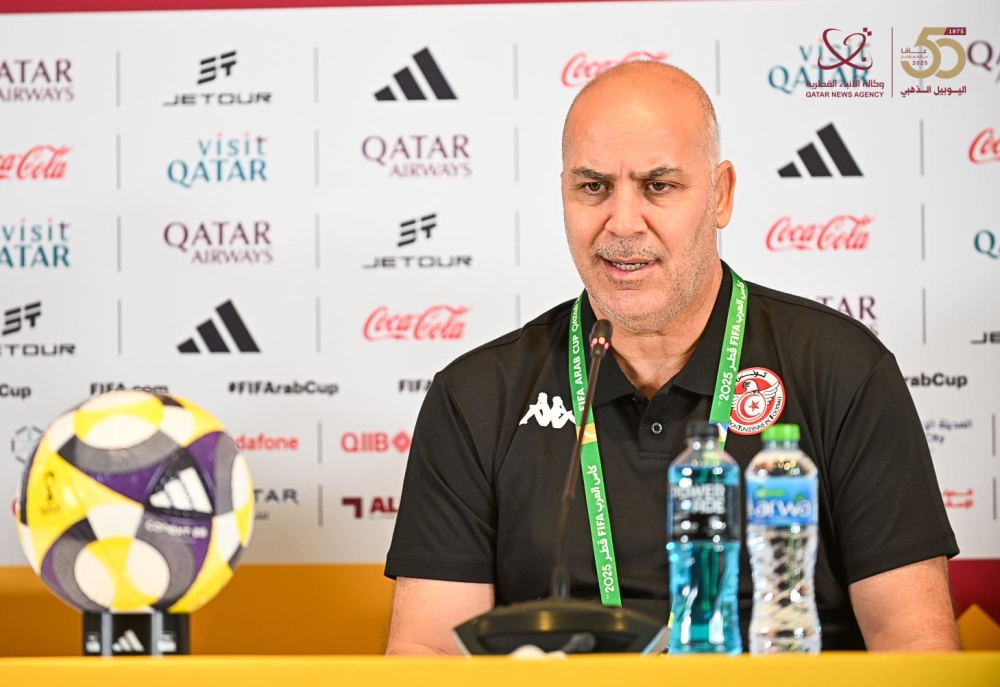
Tunisian national team coach Sami Trabelsi expressed his complete confidence in his players' ability to overcome their initial setback and go far in the 2021 Arab Cup being held in Qatar. Trabelsi's remarks came during the press conference preceding the crucial second-round group stage match, in an attempt to boost the morale of the team and fans after their unexpected loss to the Syrian national team.
The shock of the opening and the historical background of the tournament
The Tunisian national team, known as the "Eagles of Carthage," entered the tournament as one of the top contenders for the title, given its rich footballing history and high ranking. However, the team suffered a major setback in its opening match in Group B, losing 2-0 to Syria in what was considered one of the biggest surprises of the first round. This defeat put the Tunisian team in a precarious position and raised concerns among fans about the team's prospects in the tournament, which is of great importance as it is being held under the auspices of FIFA for the first time with such scale and is considered a mini-dress rehearsal for the 2022 World Cup.
Al-Tarabulsi's statements: Self-correction and confidence in the future
Speaking to the media, Trabelsi didn't deny the shock, saying, "The first half against Syria was a shock. We didn't see the opponent in front of our goal, and they didn't pose a threat." He explained that the Syrian goal came as a result of an individual error, considering that "this is the nature of football." However, he emphasized the positive aspect, saying, "The preparation for the Syria match was under difficult circumstances, and the negative result caused regret and disappointment for the players. During these two days, we addressed the issue psychologically and mentally." He added confidently, "Physical and mental readiness will be present, God willing, in the next match.".
The importance of the upcoming confrontation and its regional impact
Tunisia's next group stage match became a "bottleneck" encounter, with only a win to keep their hopes of reaching the quarterfinals alive. Any other result would mean an early and disappointing exit for one of the giants of African and Arab football. Regionally, all eyes were on the performances of major teams like Tunisia, Algeria, Egypt, and Morocco, as the tournament served as a platform to showcase the strength and development of Arab football on the international stage, especially given that it was being held in World Cup stadiums.
A forward-looking perspective and an emphasis on capabilities
Trabelsi concluded his remarks on an optimistic note, emphasizing that the prevailing sentiment within the team camp was one of resilience. He said, “All the players feel capable of winning and going far in the tournament. We must overcome this loss, forget it, and focus on the future.” Trabelsi’s vision proved accurate later on, as the Tunisian national team successfully bounced back, achieving consecutive victories that propelled them to the tournament final, demonstrating the true mettle of the Carthage Eagles and their ability to transform challenges into triumphs.