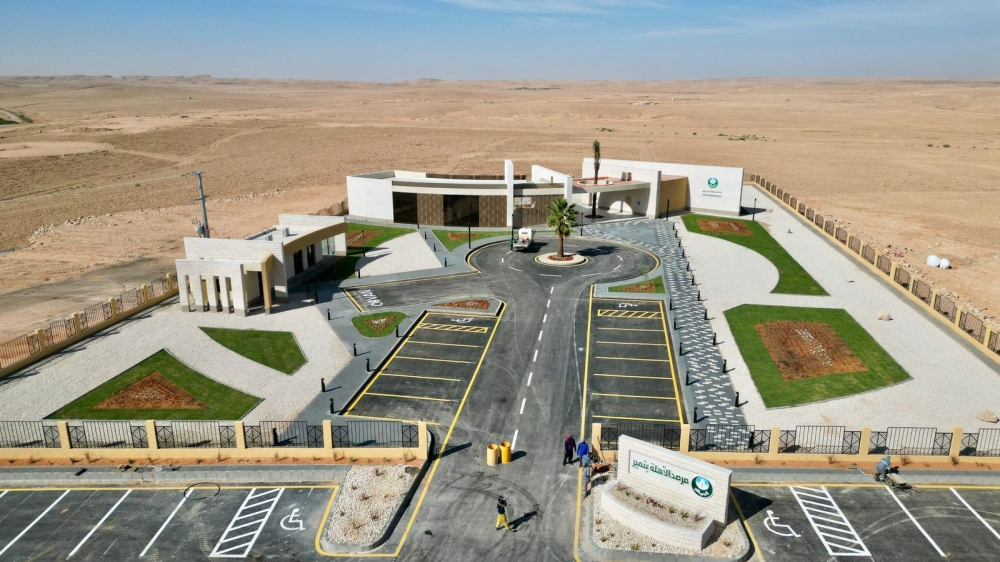
Every year, Muslims turn their eyes to the heavens in anticipation of the great joy. In this spirit, the Tumair Crescent Observatory in Tumair Governorate is preparing today to welcome crowds of observers and astronomy experts to sight the crescent moon of Shawwal, heralding the arrival of Eid al-Fitr. These preparations are taking place amidst comprehensive facilities and extensive on-site arrangements that ensure accurate observation and easy access to the site, reflecting the great importance that the Kingdom of Saudi Arabia places on religious observances and Islamic occasions.
Astronomical legacy illuminates the Kingdom's skies
The Tumair Observatory holds historical roots spanning over 100 years, as the city of Tumair has been associated with the observation of the new moon since ancient times. At the beginning of each lunar month, local observers would ascend to the mountain heights to sight the crescent with the naked eye, a deeply rooted tradition passed down through generations with passion and precision. This historical legacy did not arise in a vacuum; rather, it is an extension of the Islamic civilization's interest in astronomy and its close connection to religious observances such as fasting, pilgrimage, and the determination of holidays. Over time, this individual and community effort has transformed into a structured, institutional endeavor supported by government entities.
The importance of the Tumair Observatory in unifying the vision of the Islamic world
The importance of moon sightings extends far beyond the local level, encompassing a broad regional and international impact. As the heart of the Muslim world, Saudi Arabia serves as the primary reference point for many Islamic countries and Muslim minorities worldwide in determining the beginnings of the lunar months and the dates of religious holidays. Based on the observations recorded by accredited observatories, the Supreme Court issues its official rulings. Hence, the paramount importance of accurate sightings, as the success of those observing contributes to the unified joy of Muslims in celebrating Eid al-Fitr, thus strengthening the bonds of unity and solidarity among the peoples of the Islamic nation.
Stages of development and modern technologies
The site's rich history hasn't been confined to the past; it has kept pace with modern developments. In 1436 AH (2014/2015 CE), the city's first official lunar observatory was established under the supervision of the Tamir Municipality. This observatory supports observation efforts and organizes the work of astronomers. As a culmination of these efforts, the observatory underwent a significant transformation with the development and construction of a modern, fully equipped facility. It has become a leading center that blends the authenticity of the past with the technology of the present, contributing to raising public awareness of astronomy. This follows the inauguration of the newly renovated observatory by His Highness the Mayor of Riyadh last Sha'ban, as part of the municipality's efforts to enhance the readiness of observation sites and provide an ideal environment for those interested in astronomy.
Geographical factors that enhance visual accuracy
The site is distinguished by several geographical and environmental features that have made it one of the most prominent and important astronomical observation sites in the Kingdom. Among these features are:
- Its high location, approximately 678 meters above sea level, gives observers an advantage in tracking the horizon.
- Its desert geography provides a wide horizon and exceptional visual clarity, suitable for observation.
- A quiet environment with minimal light, pollution, and dust, which greatly enhances visual acuity.
- It provides modern facilities and equipment and integrated support services to support those who are seeing.
These efforts come within the framework of the Riyadh Region Municipality’s support for community and scientific initiatives, and the promotion of a culture of sighting the crescent moon in accordance with precise Sharia and scientific principles, in line with the objectives of developing infrastructure and services in the region.