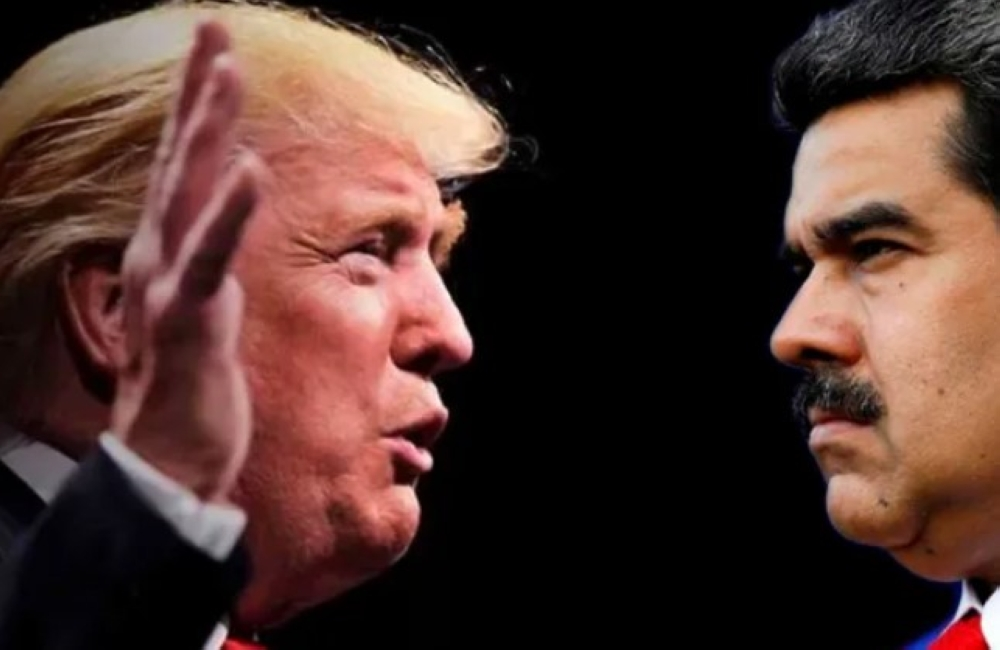
In a move that sparked widespread international controversy, US President Donald Trump justified the arrest of Venezuelan President Nicolás Maduro, describing it as a practical application of what he called the "Donroe Doctrine," a modernized and personalized version of the historic "Monroe Doctrine." This development is redrawing the map of influence in the Western Hemisphere, amid fears of geopolitical repercussions that could extend to Taiwan and Ukraine.
Reviving the Monroe Doctrine: Historical Context and New Transformation
The Monroe Doctrine dates back to 1823, when US President James Monroe declared that any European intervention in the affairs of the Americas would be considered an act of aggression against the United States. The aim at the time was to prevent neo-colonialism. Today, Trump is reinterpreting the doctrine, merging his name into the "Donroe Doctrine," suggesting that the United States has moved beyond the traditional concept of defending the region to establishing absolute control that precludes any presence of rival powers.
In his press conference, Trump confirmed that the military operation in Caracas falls within the new national security strategy, which aims to transform Latin America into a purely American sphere of influence, completely off-limits to foreign powers, specifically China and Russia, to ensure the stability of the region and prevent the flow of mass migration.
Geopolitical repercussions: Will the scenarios be repeated in Asia and Europe?
Observers and political analysts believe that this assertive American approach in its "backyard" could set a dangerous precedent in international relations. By establishing the principle of closed spheres of influence, other major powers might find justification for adopting similar behavior in their immediate geographic vicinity.
It is anticipated that China may exploit this precedent to justify more assertive actions toward Taiwan, viewing it as an internal matter within its sphere of influence, especially given Beijing's recent simulation of a blockade of the island. Similarly, Russia may find in American behavior political cover to bolster its influence in Ukraine and Eastern Europe, threatening to undermine the rules-based international order.
Strategic resources and allied concerns
Concerns were not limited to Washington's adversaries; they extended to US allies as well. The new strategy, which includes the "Trump Annex," clearly hints at a desire to control strategic resources and locations. This approach has brought to mind Trump's previous statements about his desire to annex the Danish territory of Greenland.
In this context, Jennifer Kavanagh, director of the Defense Priorities Center, warned that overthrowing a head of state and changing the system of government on the grounds of illegitimacy opens the door to international chaos, asking, "What's to stop other countries from doing the same?" This was echoed by UN Secretary-General António Guterres, who described the process as a "dangerous precedent.".
The end of the unipolar era?
The new US strategy, with its intense focus on the immediate regional environment and its relatively calm tone towards the expansion of Chinese and Russian influence in their respective regions, may indicate an implicit recognition by the Trump administration of a new multipolar world reality, where the great powers share spheres of influence instead of the overall US hegemony that prevailed during the past two decades.