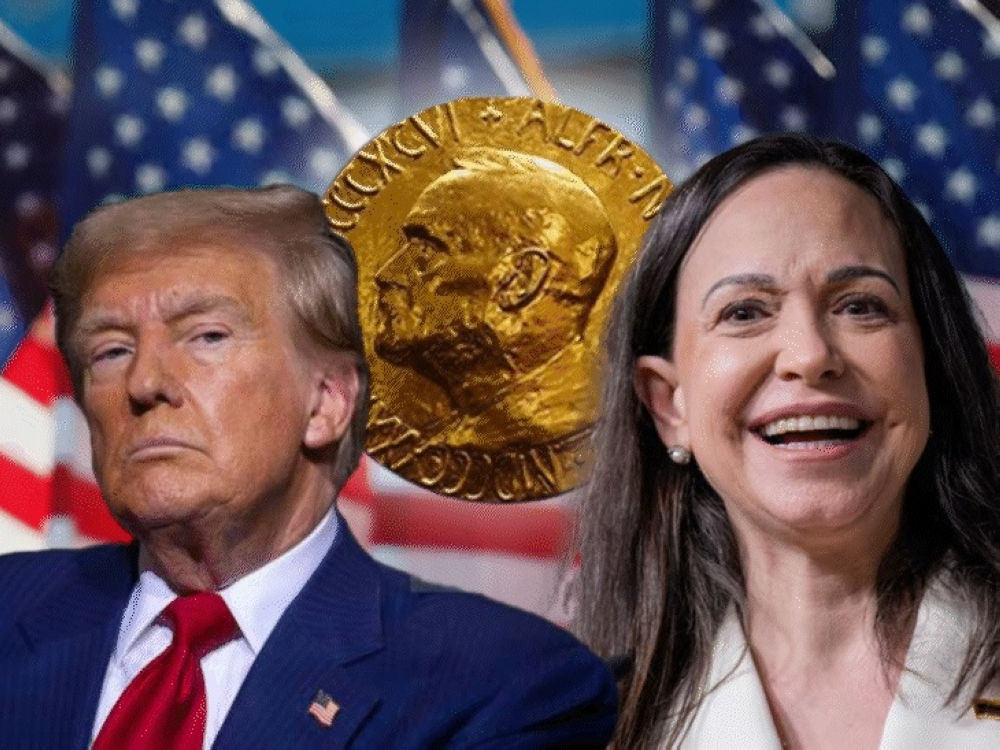
In a significant development regarding Venezuela, a senior US official announced that President Donald Trump will hold a crucial meeting next Thursday with Venezuelan opposition leader and Nobel Peace Prize laureate María Corina Machado. This meeting comes at a time of dramatic shifts in US-Venezuelan relations following recent events in Caracas.
Nobel Prize controversy and Trump's statements
The announcement of the meeting was not without the controversial tone characteristic of the US president's pronouncements, as Trump hinted at the possibility that Machado might present him with her Nobel Peace Prize. Washington had previously excluded Machado from holding leadership positions, but the US president stated, "I heard she would like to give me her prize; it would be a great honor." This comes in the context of Trump's repeated assertion that he is more deserving of the Nobel Peace Prize than other world figures due to his efforts to end wars.
Realpolitik: Dealing with Delcy Rodriguez
On the official political front, White House spokeswoman Caroline Leavitt defended the current U.S. strategy of dealing with the ruling team in Venezuela, led by interim President Delcy Rodríguez, following the arrest of former President Nicolás Maduro. In an interview with Fox News, Leavitt asserted that this decision stemmed from a “realistic assessment” conducted by the president and his national security team regarding the situation on the ground.
The spokeswoman noted that there is tangible cooperation from the current Venezuelan side, which justifies keeping diplomatic channels open with the Rodriguez government, despite previous reservations.
Historical background: The power crisis in Venezuela
To understand the depth of this transformation, one must consider the historical context of the Venezuelan crisis, which has lasted for more than a decade. Venezuela, which possesses the world's largest oil reserves, has suffered a severe economic collapse and hyperinflation under Nicolás Maduro's rule, leading to the displacement of millions of its citizens. Machado has long been a prominent voice in the opposition, facing political repression, travel bans, and restrictions on her participation in elections, making her a symbol of democratic resistance in the eyes of the international community.
The implications of Maduro's arrest and the future of relations
The arrest of Nicolás Maduro, currently imprisoned in the United States, represents a pivotal turning point in the region's history. While Trump had previously declared Machado unfit to lead the country after her flight in December, the US administration appears to be adopting a pragmatic approach, balancing support for democratic figures (like Machado) with ensuring security and economic stability by engaging with the de facto authorities (Rodriguez). This delicate balancing act could shape the energy and political landscape of Latin America for years to come.