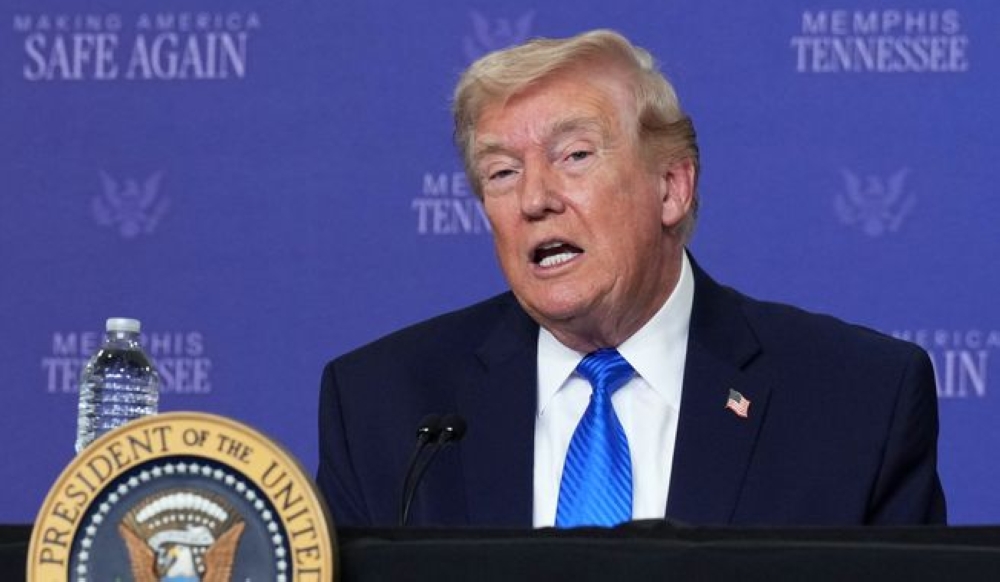
US President Donald Trump announced a new strategic decision to postpone targeting Iranian energy facilities , a move reflecting rapidly evolving political and military developments. Trump explained that he would not launch military strikes at this time against the Iranian power plants he had previously threatened to attack, noting that this postponement came in response to a direct request from the government in Tehran. The US president affirmed that talks with the Islamic Republic were progressing very positively, opening the door to new possibilities for de-escalation.
In a post on his Truth Social platform on Thursday, Trump stated: “At the request of the Iranian government, please consider this statement an announcement that I am extending the deadline for the destruction of the power plants by 10 days, until Monday, April 6, 2026, at 8:00 PM Eastern Time.” He added, criticizing some media coverage: “Talks are going very well, contrary to what the Fake News Media and others are reporting.”.
Roots of tension: A history of escalation and extreme pressure
The roots of this complex tension lie in years of back-and-forth between Washington and Tehran. During his first term, Trump adopted a policy of “maximum pressure” after unilaterally withdrawing from the Iran nuclear deal in 2018. This policy focused primarily on crippling the Iranian economy by imposing harsh sanctions on its oil and energy sector, the lifeblood of the Iranian economy. The threat of targeting critical infrastructure is not a recent development; it is an extension of a long-standing US strategy aimed at forcing Tehran to make substantial concessions regarding its nuclear program and regional influence. Historically, Iranian infrastructure has always been at the heart of the potential target bank for any possible military escalation, making any threat or postponement of such an attack a pivotal event in the course of international relations.
Military progress exceeding time expectations
In a related development, the US president had previously stated that military operations against Iran were progressing significantly ahead of schedule. During a high-level meeting at the White House, attended by senior administration officials, including Secretary of State Marco Rubio and Secretary of Defense Pete Hegseth, Trump described the Iranians as “bad fighters, but great negotiators.” He indicated that the Iranian leadership was desperately seeking and pleading for an agreement to end the ongoing conflict.
#Trump : The Iranians are beginning to admit defeat and are begging for a deal #Iran | #Today https://t.co/eXcZo22GOf
— Al-Youm Newspaper (@alyaum) March 26, 2026
Trump added, explaining the progress of the operation: “We estimated that completing our mission would take between four and six weeks, and after 26 days, we are far ahead of schedule.” He continued, asserting that “the Iranian regime is now beginning to acknowledge that it has suffered a decisive defeat.”.
Regional and international repercussions of the decision to postpone targeting energy facilities in Iran
for targeting Iranian energy facilities carries profound strategic importance that extends beyond the borders of the two countries, encompassing broad regional and international repercussions. Regionally, this postponement offers Middle Eastern states, particularly those in the Arabian Gulf, a temporary reprieve from the potential outbreak of a full-scale war that could disrupt maritime traffic and destabilize the entire region. Internationally, global energy markets are closely monitoring these developments, as any military strike against Iranian oil infrastructure would likely trigger a shock to global oil prices, impacting inflation and the global economy as a whole. Therefore, the success of these negotiations could avert a new energy crisis and reshape the geopolitical alliances and balances in the Middle East, demonstrating that diplomacy continues to play a crucial role in shaping global events.