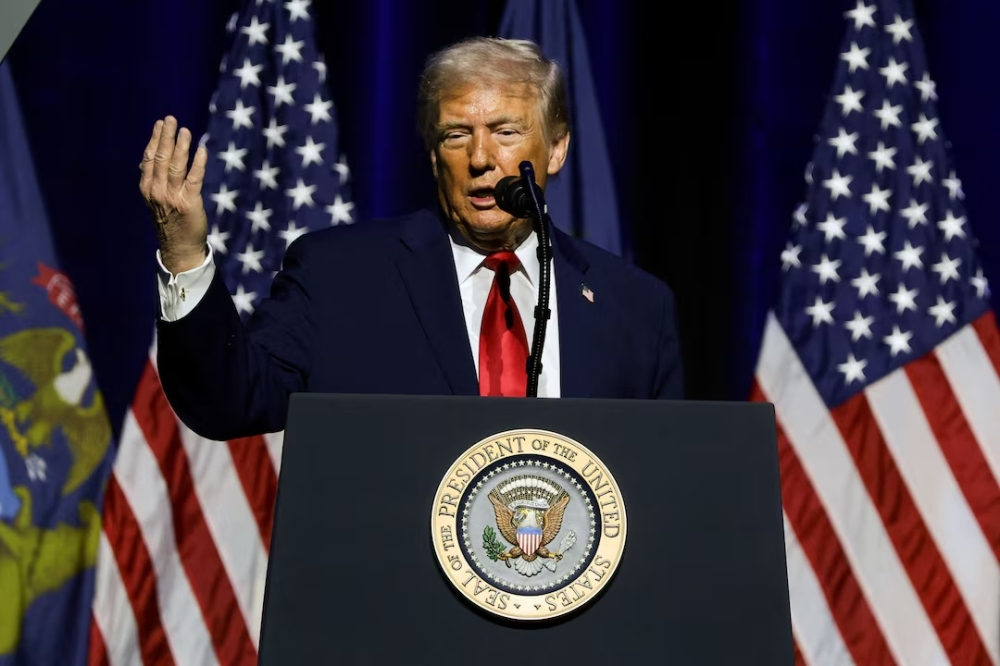
On an occasion that was supposed to be a celebration of the first anniversary of his return to the White House, US President Donald Trump held a lengthy press conference, but instead of showcasing achievements in an optimistic spirit, his speech was dominated by a gloomy tone, as he repeated his usual complaints that have characterized his political career, turning the event into a platform for settling scores rather than presenting a vision for the future.
A charged political context
This speech comes in the context of a hypothetical second presidential term for Trump, who returned to power on January 20 of last year after winning the 2024 election against his Democratic opponent, Kamala Harris. This return followed a first term (2017-2021) marked by controversy and division, centered on the slogan "America First," and witnessing significant changes in domestic and foreign policy, including tax cuts, the appointment of conservative judges, and withdrawal from international agreements. However, it ended with his defeat to Joe Biden in the 2020 election, a result Trump has never conceded, thus establishing a political discourse based on questioning the integrity of the democratic system.
The content of the speech: a repetition of previous grievances
Trump began his press conference with a sharp attack on immigration policies, a cornerstone of his campaign, before rambling on about a range of issues. He touched on a hypothetical U.S. military operation in Venezuela and fraud cases in Minnesota, launching scathing attacks on his predecessor, Joe Biden. But the most striking point was his insistence on repeating his baseless claim that he was the true winner of the 2020 election, a claim that has become a cornerstone of his political movement. “We have accomplished more than any other administration,” he said, adding, “Nobody has ever seen anything like it.”.
Importance and expected impact
Trump’s focus on personal grievances and purported victories, rather than on concrete policies for the future, reflects his usual political strategy. Domestically, this rhetoric deepens political polarization; it energizes his base, which embraces his narrative, while alienating his opponents, who see him as a threat to democratic institutions. Internationally, this approach worries traditional US allies, who fear an unpredictable and erratic foreign policy, while rival states may exploit it as evidence of internal instability in America.
Economic claims and foreign policy
During the speech, Trump again described himself as a “financial genius” and made a series of outlandish or previously debunked claims, such as reducing drug prices by mathematically impossible percentages. On foreign policy, he hinted at a willingness to cooperate with the Venezuelan opposition following the alleged military operation against President Nicolás Maduro, and reiterated his frustration at not being awarded the Nobel Peace Prize, reflecting his obsession with personal recognition on the world stage. Ultimately, the press conference resembled more of a campaign rally than a presidential address, underscoring that Trump’s style and personality remain the primary drivers of his policies.