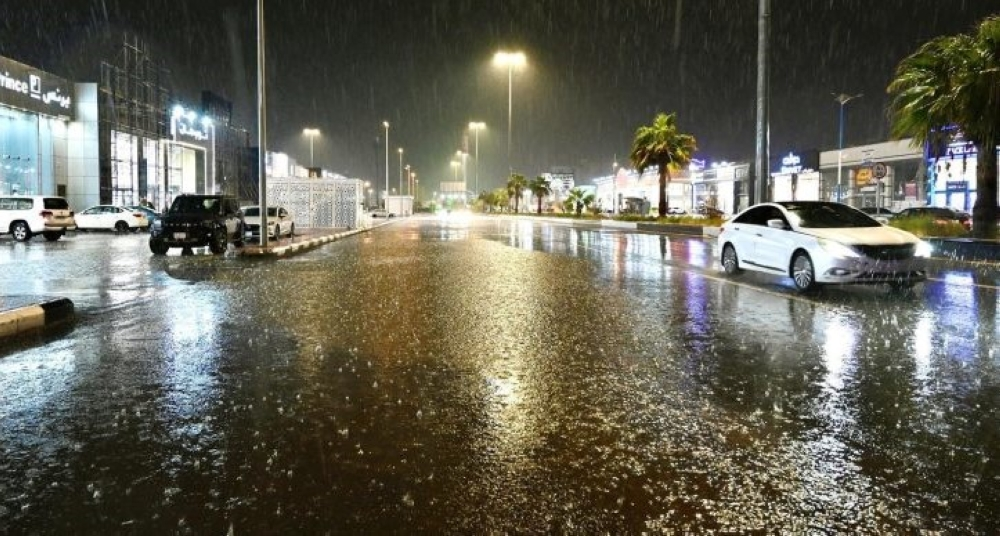
The National Center for Meteorology announced details of Sunday's weather forecast for Saudi Arabia, warning of significant weather fluctuations including heavy thunderstorms, flash floods, and hail across large parts of the country. These warnings are issued as part of the authorities' commitment to the safety of citizens and residents. The expected weather conditions will affect 11 administrative regions, necessitating caution and adherence to established safety guidelines.
Climate change and the history of rainfall events in the Kingdom
The Arabian Peninsula, and Saudi Arabia in particular, is characterized by a dry desert climate for most of the year, but the transitions between seasons often witness sharp weather fluctuations. Historically, the Kingdom experiences periods of heavy rainfall resulting from the convergence of moist air masses from the Arabian Sea and the Red Sea with dynamic low-pressure systems. These natural phenomena are not new; rather, they are part of the climatic cycle that contributes to groundwater replenishment and the flourishing of vegetation in desert regions. With the increasing pace of global climate change, these weather events have become more frequent and require close monitoring, which explains the precision and detail of the warnings issued by official authorities.
Expected effects of the weather on public life
These weather alerts are of paramount importance at both the local and regional levels. Locally, heavy rainfall and flash floods directly impact transportation and traffic, necessitating the activation of emergency plans by civil defense and municipal authorities to ensure smooth traffic flow and drainage of rainwater. These forecasts also play a vital role in the agriculture and education sectors, as severe weather conditions may require the suspension of in-person classes in some governorates to ensure student safety. Regionally, these changes reflect the extension of weather systems affecting neighboring Gulf countries, requiring ongoing coordination in the field of meteorology.
Details of the areas covered in Sunday's weather forecast
According to the official statement issued by the Meteorology Department, the chance of thunderstorms ranging from moderate to heavy remains, potentially leading to flash floods. This weather pattern will be accompanied by hail and strong winds that will stir up dust and reduce horizontal visibility. These warnings cover parts of the Eastern Province, Riyadh, Makkah, Al-Baha, Asir, Jazan, and Najran regions. The effects will also extend to parts of Tabuk, Hail, Al-Jawf, and the Northern Borders regions. Experts do not rule out the formation of dense fog in the early morning and late evening hours over the highlands of these areas.
The expected weather for Sunday, March 22, 2026 https://t.co/9xSOsnfFPu #KeepingYouKnowTheWeatherInformation pic.twitter.com/wvOTM2S36F
— National Center of Meteorology (NCM) (@NCMKSA) March 21, 2026
The weather conditions in the Red Sea and the Arabian Gulf for Sunday, March 22, 2026. #KeepingYouUpdated pic.twitter.com/IGcUUDGMR4
— National Center of Meteorology (NCM) (@NCMKSA) March 21, 2026
Maritime navigation conditions in the Red Sea and the Arabian Gulf
The warnings were not limited to land but also included sea conditions, which is of concern to fishermen and coastal residents. For the Red Sea, surface winds are expected to be southerly to southeasterly at speeds ranging from 10 to 35 km/h, gradually shifting to northerly or northeasterly in the afternoon over the northern part, with speeds potentially reaching 50 km/h accompanied by thunderstorms and rain, particularly over the southern part and towards the Gulf of Aqaba. Wave heights are expected to range from half a meter to one and a half meters, and may exceed two meters in areas of thunderstorms, resulting in sea conditions ranging from slight to moderate, occasionally becoming rough.
In the Arabian Gulf, forecasts indicate easterly to southeasterly surface winds at speeds of 12-35 km/h, increasing to over 50 km/h during thunderstorms. Wave heights will be similar to the Red Sea, ranging from half a meter to one and a half meters, and reaching over two meters with rain clouds. This will result in calm to moderate sea conditions, potentially becoming rough, requiring extreme caution for maritime navigation.