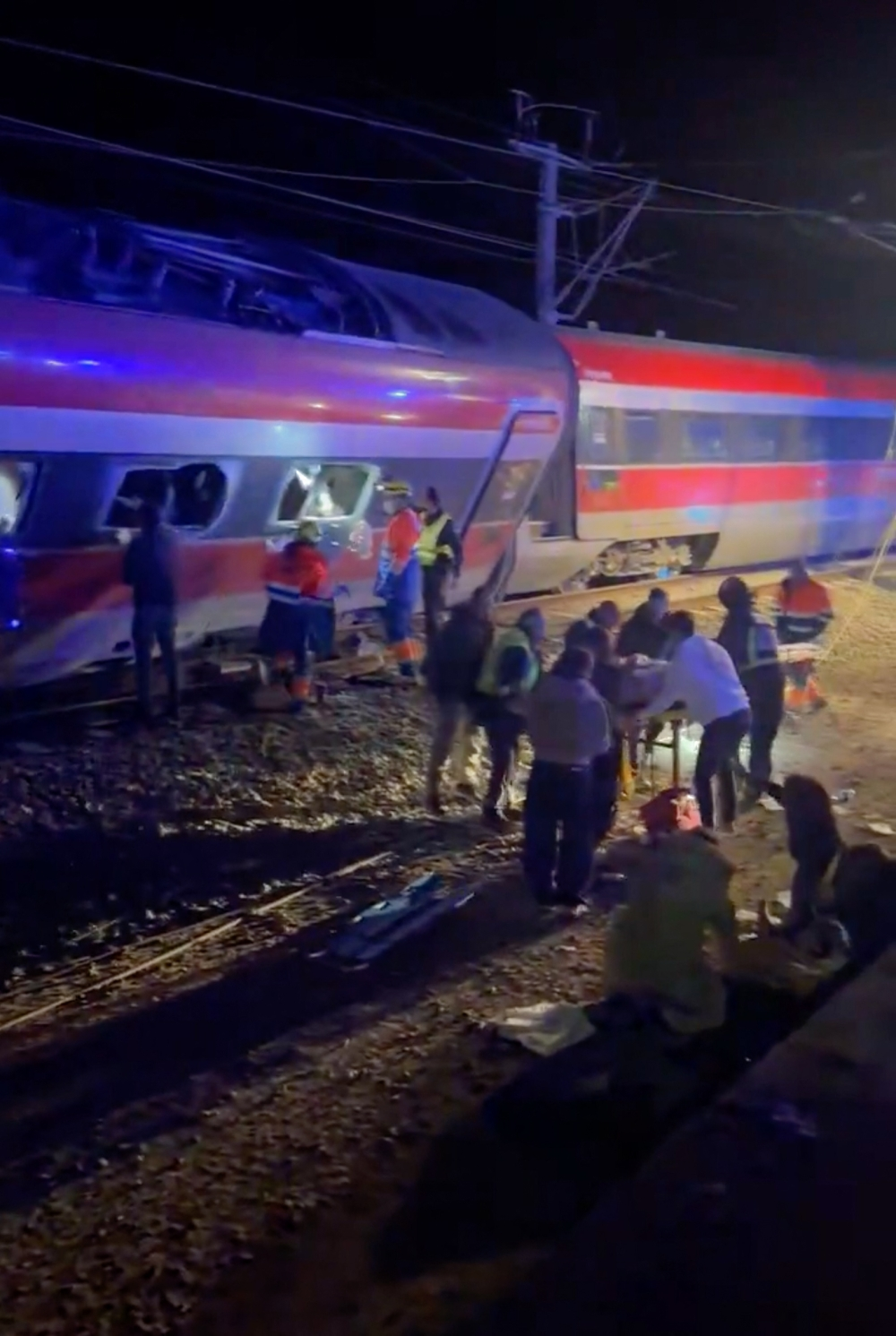
In a tragic new development in the disaster that has rocked southern Europe, the Spanish Interior Ministry announced Monday morning that the death toll from the collision of two high-speed trains in Spain has risen to at least 39. These new figures revise the initial count of 24 fatalities, reflecting the immense devastation caused by the accident in the Andalusia region.
Details of the terrifying moments
The horrific accident occurred on Sunday evening at 7:45 PM local time, approximately 200 kilometers north of Malaga. According to initial investigations and statements by Transport Minister Oscar Puente, the disaster began when an Iryo train traveling from Malaga to Madrid suddenly derailed. This derailment resulted in a violent collision with a Renfe train traveling in the opposite direction on an adjacent track towards Huelva.
The minister noted that the impact was so severe that it caused the first two carriages of the Renfe train to completely derail, turning the site into a scene of wreckage.
Medical and military mobilization
The losses were not limited to fatalities; the accident also left approximately 123 people with injuries of varying severity. Emergency services in Andalusia confirmed that there were 5 critical cases and 24 serious injuries, suggesting the possibility of a higher death toll. The injured were quickly transported to hospitals in the cities of Córdoba and Andújar for treatment.
In a swift response to the disaster, the Spanish Army's "Military Emergency Unit" (UME) was deployed to the scene to support the civil defense and ambulance teams. A field hospital was also set up near the crash site to triage cases and provide first aid to the injured before they were transported.
The Spanish railway network: context and challenges
Spain is one of the world's leading countries in rail transport, boasting the second-largest high-speed rail (AVE) network globally after China. The sector has recently undergone radical transformations following the opening of the market to competition, allowing new operators such as Italy's Aereo and France's Wego to join the national operator Renfe. While this move has contributed to lower prices and increased the number of journeys, it has also led to increased traffic congestion on the network.
This incident brings back painful memories from the history of Spanish transportation, specifically the 2013 Santiago de Compostela train disaster, which claimed 80 lives and was the worst in the country in decades. This latest accident is expected to spark a broader debate about safety standards and automated signaling systems, given the increasing number of operators and daily journeys.
The Spanish authorities are continuing their meticulous technical investigations to analyze the black box data of the two trains to determine the exact reasons that led to the derailment of the "Irio" train, and whether the cause was a technical malfunction or human error.