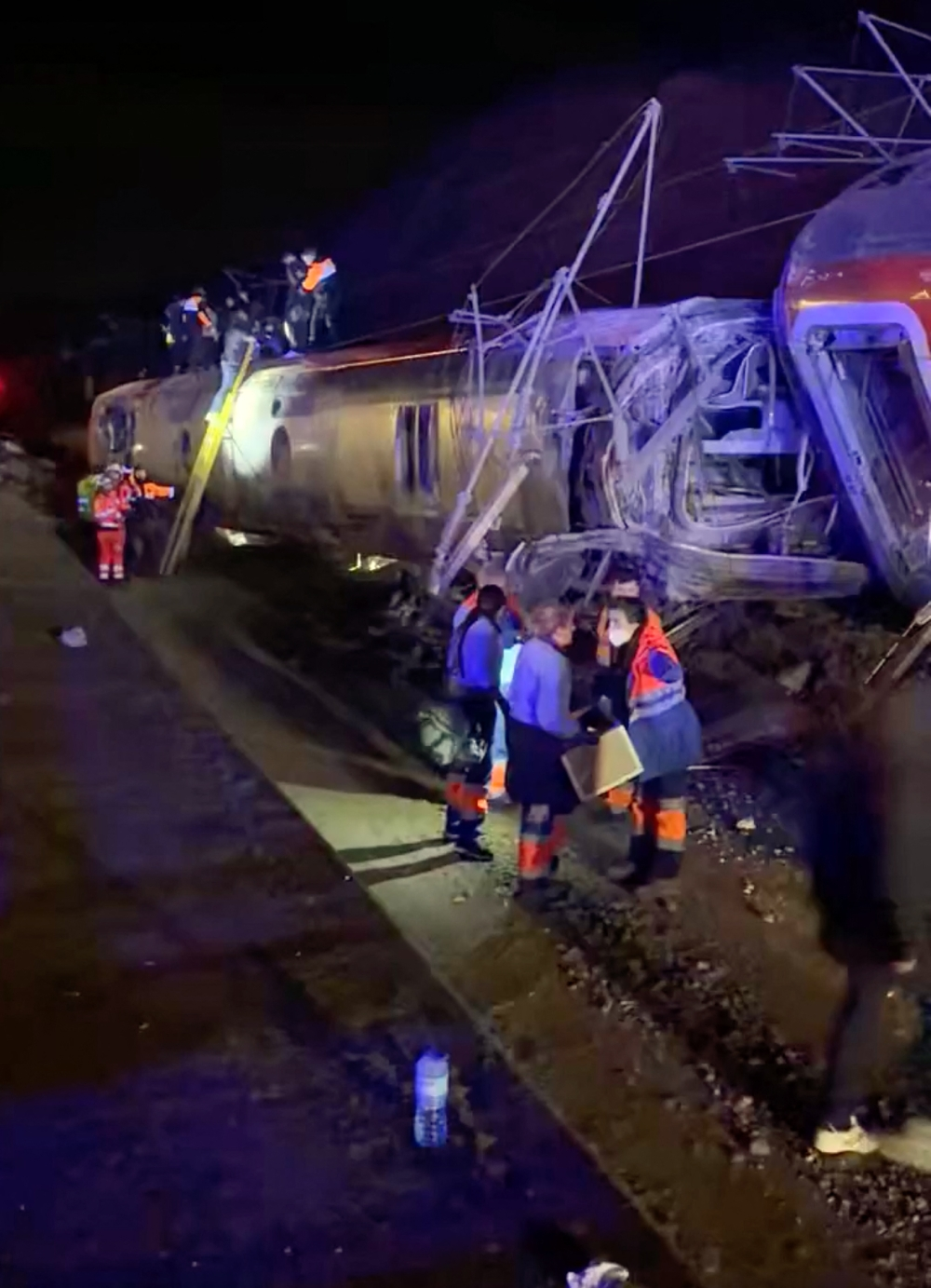
Spain has entered a period of deep mourning as it began three days of national mourning on Tuesday to honor the victims of the horrific disaster that struck the southern region of Andalusia. The collision of two high-speed trains on Sunday evening killed at least 41 people, in one of the worst rail accidents the country has seen in recent years.
Details of the disaster and the royal visit
In a scene reflecting the magnitude of the tragedy, King Felipe VI and Queen Letizia of Spain, dressed in black, traveled to the site of the crash near Adamoús. The royal couple inspected the disaster area and greeted the rescue teams working tirelessly day and night before visiting the injured at the Reina Sofia Hospital in Córdoba. This visit served as a powerful message of support to the families of the victims and the survivors during this difficult time.
According to official data from the Andalusian regional government, 39 people are still receiving treatment in hospitals, including four children, while 13 adults are in critical condition in intensive care units, raising concerns that the death toll could rise.
Context of the accident and the history of railways in Spain
Spain boasts one of the most advanced and efficient railway networks in the world, with its high-speed rail network (AVE) a source of national pride and a global model. However, this incident brings back painful memories of past accidents, most notably the 2013 Santiago de Compostela train crash, which marked a turning point in safety procedures.
This incident is particularly noteworthy because it involved a train belonging to the national company Renfe and another belonging to the private company Aereo, a move that comes amidst Spain's recent liberalization of the railway sector to foster competition. This interaction between operators puts shared coordination and safety protocols under intense scrutiny.
Investigations and proposed hypotheses
The tragic accident occurred when an Elliott train bound for Madrid derailed and collided with a Renfe train traveling in the opposite direction. Transport Minister Oscar Puente confirmed that the accident took place on a recently renovated section of track, describing the incident as "extremely strange," especially since other trains had passed safely just minutes before.
Initial investigations rule out human error or sabotage, with the current focus being on whether a break in the railway track was the cause or the result, or whether there was a technical malfunction in the train cars.
Expected repercussions of the incident
This incident is expected to have far-reaching consequences on several levels:
- Locally: A state of shock in the Andalusia region and popular demands for a comprehensive review of safety procedures on lines that experience high operational density.
- Economically: The incident may temporarily affect passenger confidence in high-speed trains, prompting swift action from operators to reassure the public.
- Internationally: Given Spain’s leading position in this field, global transport authorities will be closely monitoring the results of the investigation, as the findings could lead to an update of international safety standards for high-speed trains, particularly in countries that rely on multi-company operating systems.
Authorities are racing against time to complete the identification of all victims, with expectations that the final count of the dead will be completed within the next few hours.