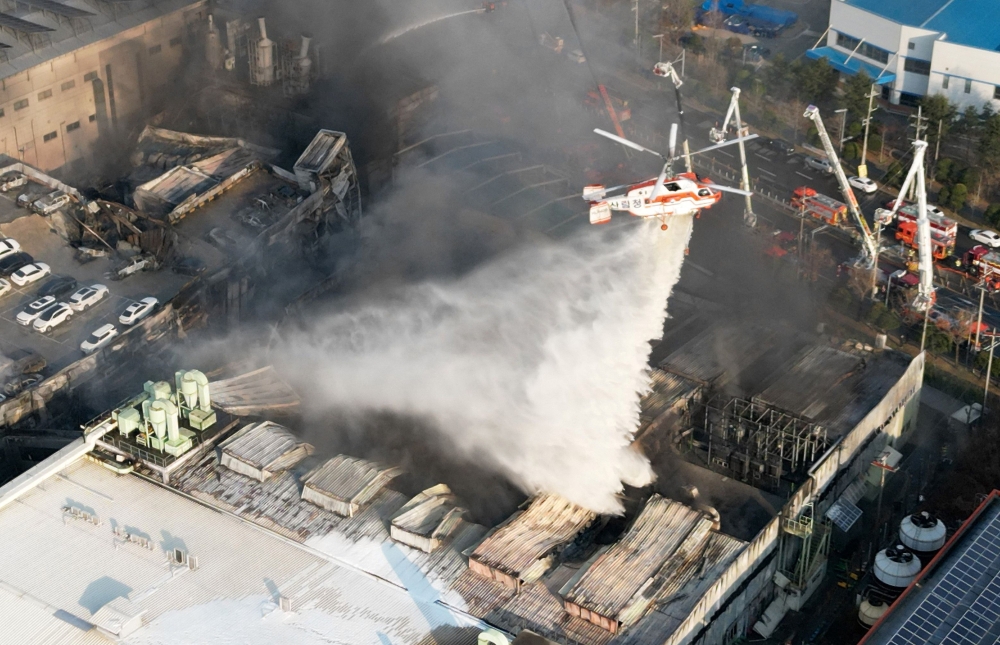
The world awoke to a tragic disaster following a factory fire in South Korea , specifically in the city of Daejeon, located in the central part of the country. This horrific incident resulted in the deaths of at least 10 people, whose charred bodies were recovered from the wreckage of the auto parts factory early this morning by rescue teams. The losses were not limited to those killed; at least 59 people were injured, and intensive search operations continue for four others still missing under the rubble.
Rescue efforts and details of a factory fire in South Korea
The South Korean Ministry of the Interior and Safety explained that the fire, likely caused by a massive explosion on Friday afternoon, prompted a large-scale security and medical mobilization. More than 500 firefighters, police officers, and emergency personnel were deployed to control the blaze and conduct complex rescue operations. Official reports indicated that 25 of the injured suffered critical injuries, while medical officials have not yet confirmed whether any of these cases are life-threatening, leaving the families of the victims and the local community in a state of anticipation and anxiety.
Industrial context and occupational safety challenges
South Korea is one of the world's major industrial powers, heavily reliant on heavy manufacturing and precision industries. Historically, the country has experienced a massive industrial boom since the late 20th century, making it a global hub for automobile and electronics production. With this rapid growth, persistent challenges have emerged regarding occupational safety standards in industrial facilities. Despite stringent laws enforced by the South Korean government to improve working conditions and reduce accidents, industrial incidents, such as explosions and fires in large factories, still occur from time to time, raising serious questions about the effectiveness of strict safety protocols and the need to modernize the infrastructure of older factories to meet current international standards.
Economic repercussions and the impact of the incident on supply chains
The impact of this tragic incident extends beyond the devastating loss of life, encompassing significant economic repercussions both domestically and internationally. The affected factory in Daejeon is a crucial link in the automotive parts supply chain, a vital sector that supplies major Korean automakers exporting their products worldwide. The sudden production halt at this facility is expected to cause temporary disruptions in regional supply chains, potentially impacting the manufacturing schedules of some prominent brands. Internationally, this incident underscores the fragility of global supply chains and their heavy reliance on specific production hubs, potentially prompting major companies to reassess their risk management strategies and diversify their supply sources to avoid similar crises in the future.