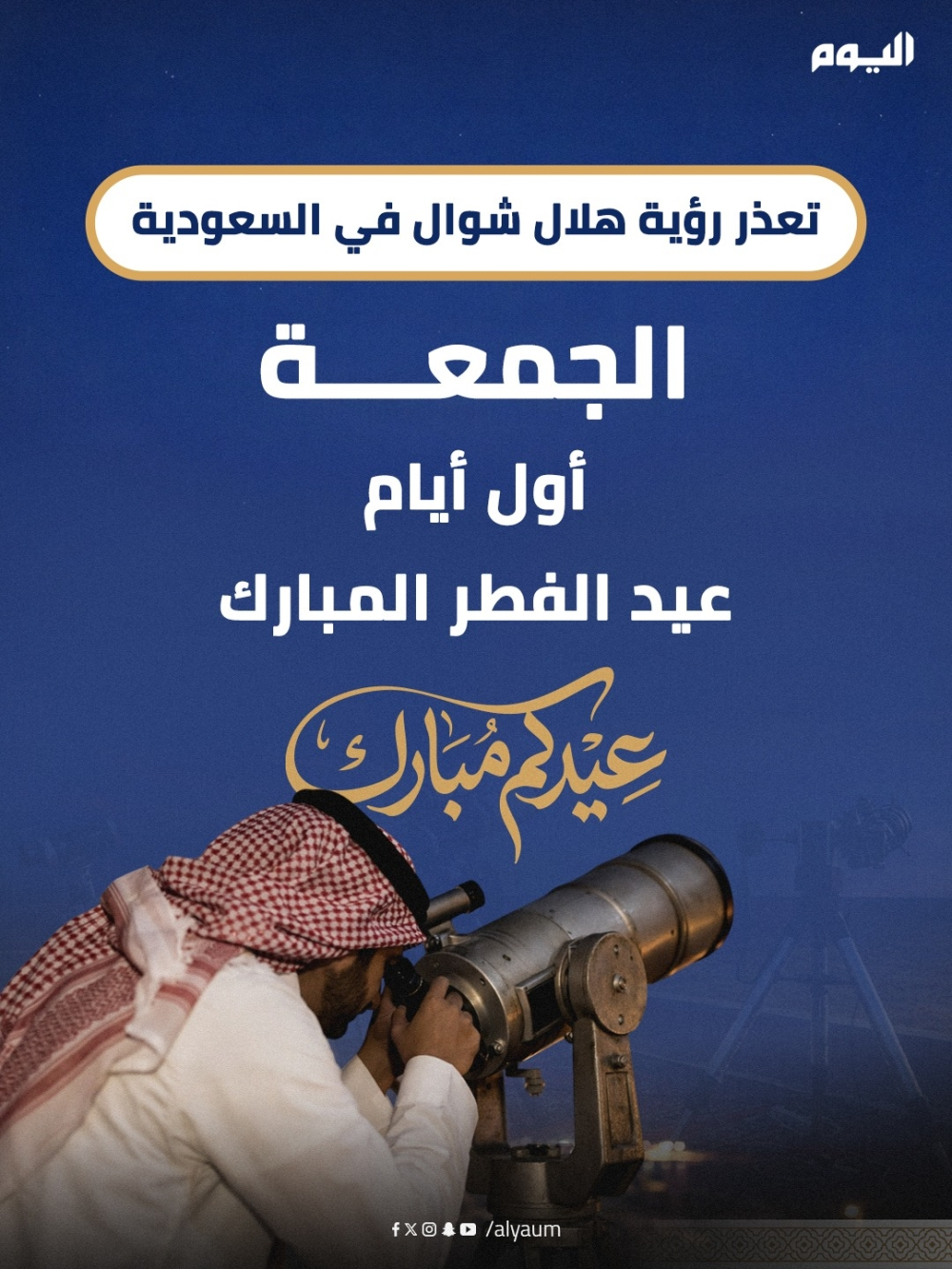
The Royal Court of Saudi Arabia, based on a decision by the Supreme Court, announced that the crescent moon of Shawwal was not sighted on Wednesday evening. Therefore, it was decided that Thursday would be the 30th and final day of Ramadan for the year 1447 AH, and that Friday, March 20, 2026, would be the first day of Shawwal and the first day of Eid al-Fitr. This announcement came after the Supreme Court's Crescent Sighting Committee convened to review reports received from courts and astronomical observatories regarding the sighting of the crescent moon in various regions of the Kingdom.
The statement issued by the Supreme Court explained that, due to the lack of confirmed sighting of the crescent moon, and in accordance with the Prophet Muhammad's (peace and blessings be upon him) saying, "If the crescent is obscured from you, then complete thirty days," it has been decided to complete the month of Ramadan as thirty days. The Supreme Court extended its congratulations to the Custodian of the Two Holy Mosques, His Royal Highness the Crown Prince, and to all citizens, residents, and the entire Muslim Ummah on the occasion of Eid al-Fitr, asking God to accept everyone's fasting, prayers, and good deeds, and to perpetuate the security and stability of the country.
The historical and legal legacy in investigating and sighting the crescent of Shawwal
The Kingdom of Saudi Arabia relies on the sighting of the new moon with the naked eye and binoculars to determine the beginning of the Islamic months, a practice that has been in place for centuries and is based on clear religious texts. The process of sighting the new moon is a deeply rooted Islamic tradition that combines precise astronomical science with adherence to Islamic law. Every year, as the month of Ramadan draws to a close, Muslims turn their attention to astronomical observatories strategically located, such as those in Sudair and Tumair, where experts and certified observers gather to document the moment of the new moon's birth. This integration of modern technology, represented by advanced telescopes, and direct human observation reflects the official authorities' commitment to the utmost accuracy in determining the religious seasons, which are linked to the rituals and worship of hundreds of millions around the world.
The social and economic dimensions of the Eid announcement
The announcement of the date of Eid al-Fitr has far-reaching social and economic implications, both locally and internationally. Locally, it signals the start of festive celebrations, stimulates commercial activity in markets, and facilitates the scheduling of official holidays for both the public and private sectors, thus strengthening family and community bonds. Regionally and internationally, many Muslim countries and Muslim minorities in the West await the statement from the Saudi Supreme Court as a primary and reliable reference for unifying their celebrations and rituals. This global anticipation underscores the Kingdom's leading role in guiding the Muslim world and affirms the importance of this event in fostering unity and solidarity among Muslims on this great occasion, which embodies the values of tolerance, mutual support, and joy.