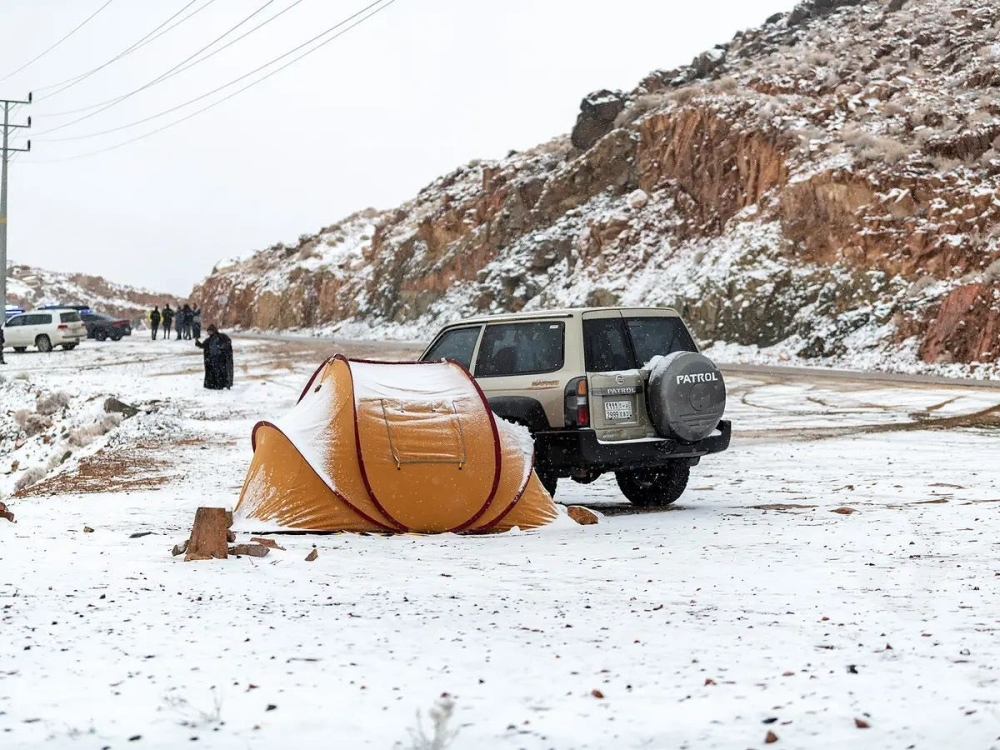
Several regions in Saudi Arabia experienced a noticeable drop in temperatures on Tuesday, January 6th, with weather observatories recording a significant decrease in minimum temperatures, particularly in the northern regions. This report is part of the National Center for Meteorology's ongoing monitoring of weather conditions, which indicates the continuation of typical winter weather fluctuations for this time of year.
A sharp drop in temperatures
In terms of weather details, the governorates of Qurayyat and Rafha recorded the lowest temperatures of the day at just 2 degrees Celsius, reflecting the severity of the cold wave affecting northern Saudi Arabia. Hafar Al-Batin was not far behind in this cold weather, recording 3 degrees Celsius, while the minimum temperature in Arar, Sakaka, and Tarif reached 4 degrees Celsius. In the central regions and some highlands, the capital Riyadh, Abha, Buraidah, and Hail recorded minimum temperatures that reached 5 degrees Celsius.
Climate context and the impact of cold waves
These temperature drops are a natural part of Saudi Arabia's winter climate during January, which is typically one of the coldest months of the year. The northern and northeastern regions are directly affected by cold air masses from the north, resulting in the lowest temperatures compared to other areas. This climatic diversity reflects the Kingdom's varied geography, with contrasting conditions between the humid coastal regions, the cold mountain highlands, and the arid desert areas, which experience significant temperature variations between day and night.
Accompanying weather phenomena: rain and dust
The National Center for Meteorology clarified that there is still a chance of light rain in parts of the Madinah region. Meanwhile, the impact of active winds stirring up dust and sand continues, which may lead to reduced horizontal visibility in parts of Madinah, as well as the eastern parts of the Makkah, Al-Baha, and Asir regions. The center urged drivers to exercise caution, especially given the possibility of fog formation during the night and early morning hours in the southern parts of the Eastern Province.
State of the Red Sea and the Arabian Gulf
In terms of maritime navigation, the Red Sea is experiencing surface winds ranging from 20 to 40 km/h, northeasterly to northwesterly in the northern and central parts, and southeasterly to southerly in the southern part, with wave heights between one and two meters. As for the Arabian Gulf, surface winds are active, sometimes reaching speeds of 45 km/h, with the formation of thunderclouds and rain in the southern part, which may raise waves to two meters and create rough sea conditions. This necessitates caution for seafarers and fishermen.