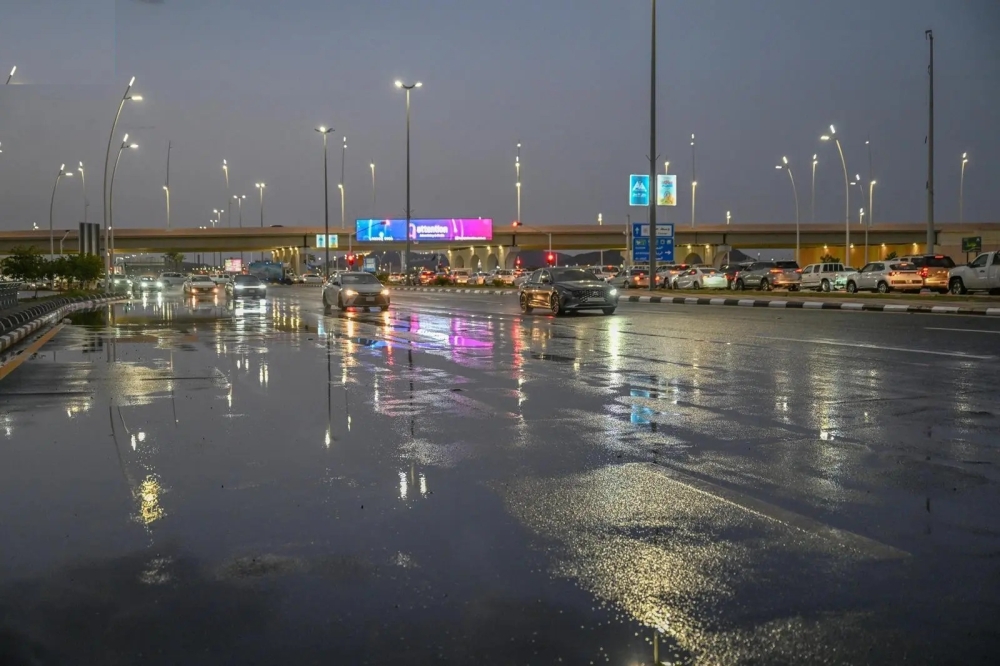
The National Center for Meteorology issued a detailed report on the expected weather conditions in the Kingdom of Saudi Arabia, indicating that most regions will be affected by an unstable weather system starting on Friday and continuing until Sunday (January 23-25, 2026). This system is characterized by thunderstorms ranging from moderate to heavy, accompanied by various weather phenomena that require caution.
Climatic context and weather conditions
These weather fluctuations are occurring within the context of the Kingdom's winter season, during which the region is typically affected by the passage of low-pressure systems originating from the Mediterranean Sea or the expansion of thermal lows, leading to the formation of cumulonimbus clouds. This particular weather pattern is of special significance due to its widespread impact across a broad area stretching from north to south and east to west, potentially disrupting transportation and travel between cities, as well as causing flash flooding in valleys and ravines in sloping areas.
Details of affected areas and timing of the event
According to the center's statement, the rainfall schedule is as follows:
- Northern regions (Tabuk, Al-Jawf, Northern Borders): will experience moderate to heavy rain on Friday and Saturday, including major governorates such as Tabuk, Neom, Sakaka, and Arar.
- Hail and Qassim region: will be affected by moderate to heavy rain, starting in Hail on Friday and Saturday, and extending to Qassim from Saturday until Sunday morning.
- Eastern Province and Riyadh: The Eastern Province is experiencing heavy rain in Hafr Al-Batin and Al-Khafji, while the capital Riyadh and its governorates are affected by light to moderate rain from Saturday until Sunday morning.
- Medina and Mecca: Medina will experience heavy rain on Saturday, while the holy capital and Jeddah will be affected by light to moderate rain on the same day.
Rainfall intensity classification and potential hazards
The report clarified the technical criteria for expected rainfall intensity, classifying heavy rainfall as exceeding 10 mm/hour and potentially reaching 50 mm/hour or more. These amounts are usually accompanied by strong downdrafts that may stir up dust and sand, with speeds exceeding 60 km/h, in addition to the possibility of hail and high waves in coastal areas.
The importance of adhering to safety instructions
Due to the potential for flash floods and water accumulation, especially in open areas and valleys, citizens and residents are advised to monitor real-time alerts via the "Anwaa" app and official platforms. It is also crucial to stay away from floodplains and low-lying areas during rainfall and to drive with extreme caution due to reduced visibility expected from dust or heavy rain.