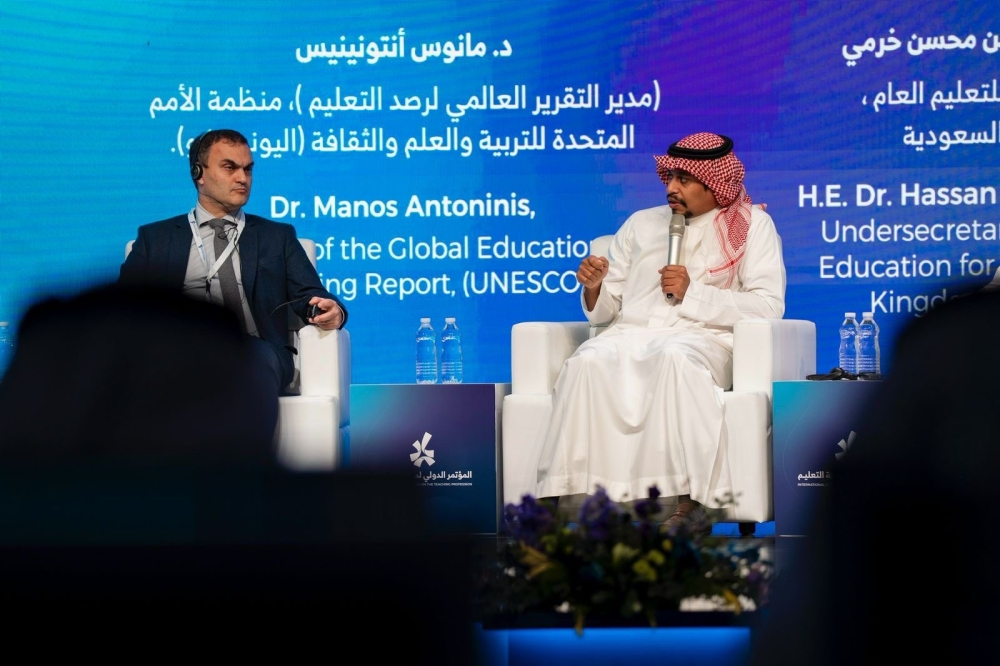
Reaffirming the pivotal role of human resources in the educational process, the Saudi Ministry of Education participated in the International Conference on the Teaching Profession hosted by the Sultanate of Oman. The Ministry emphasized that teachers remain the cornerstone of educational impact and the guarantee of quality learning. It clarified that modern technologies, particularly artificial intelligence, are merely enabling tools that cannot replace the human and guiding role of the teacher.
Global context and digital transformation in education
This conference, held under the theme “Sustainable Education in the Age of Artificial Intelligence,” comes at a time when the global education sector is undergoing a radical transformation. For years, the integration of technology into classrooms has been accelerating, a pace that has increased significantly since the COVID-19 pandemic, which forced education systems worldwide to adopt distance learning solutions. This shift has sparked a broad global debate about the future of the teaching profession and the role of the teacher in light of AI tools capable of personalizing content and automating certain tasks. This makes the Saudi presentation at the conference an important voice advocating for a balance between technological innovation and preserving the essence of humanistic education.
The Kingdom's experience and Vision 2030
During his participation, the Deputy Minister of Education for Public Education, Dr. Hassan Khurami, reviewed the Kingdom's experience in developing the teaching profession and educational leadership. He pointed out that the national education system is based on building sustainable education that enhances the quality of outcomes and keeps pace with rapid technological advancements. These efforts align with the Human Capability Development Program, one of the most important programs of Saudi Vision 2030, which aims to prepare globally competitive citizens. Khurami explained that the Saudi experience places particular emphasis on instilling essential skills in students, promoting positive values and behavior, and developing psychological resilience and social and emotional intelligence—skills that cannot be instilled by machines but require direct interaction with an exemplary and influential teacher.
The importance of the event and its expected impact
This participation is of paramount importance on several levels. Domestically, this vision reflects the Kingdom's clear strategy of investing in teachers and their continuous professional development, recognizing them as the cornerstone of any successful educational transformation. Regionally, the Saudi experience offers a balanced model for neighboring countries seeking to modernize their education systems, emphasizing that adopting technology does not mean marginalizing teachers. Internationally, the Kingdom contributes to the global dialogue on the ethics of using artificial intelligence in education and supports the approaches advocated by international organizations such as UNESCO, which stress the need for AI to serve humanity and promote equity and inclusion in education.
Recommendations for a sustainable future
The international conference concluded with several key recommendations, most notably the need to develop sustainable national education policies aligned with international frameworks, to employ artificial intelligence responsibly to improve learning outcomes, to support inclusion and equity, and to build resilient education systems capable of adapting to future crises. The recommendations reaffirmed that the successful integration of these technologies depends primarily on preparing and training teachers to be leaders in this transformation, not merely users of new tools.