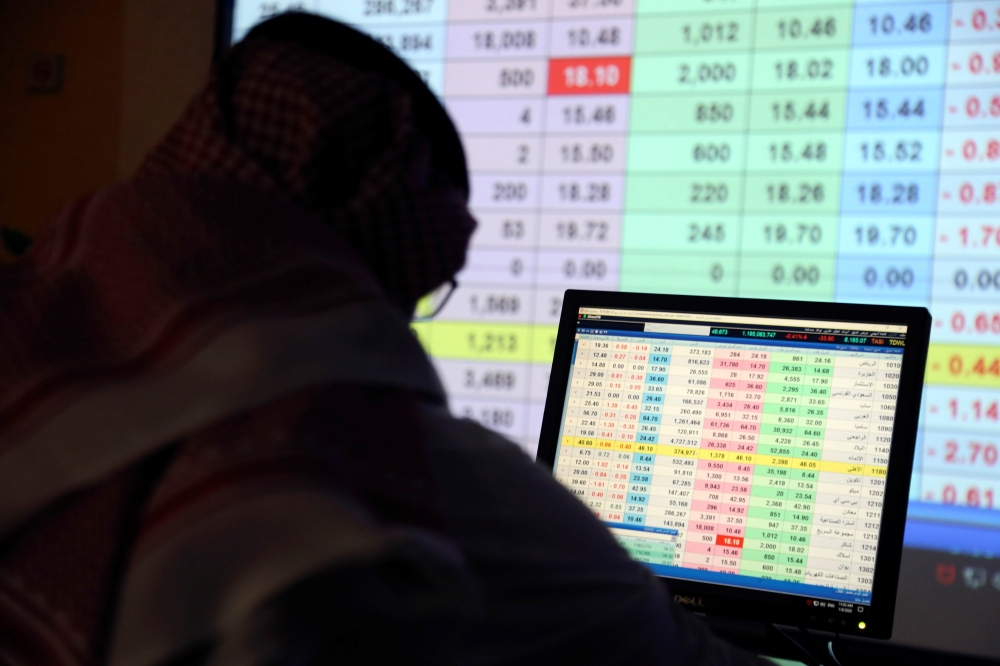
The Saudi Stock Exchange's main index (TASI) closed in the red on Monday, declining 0.4% to settle at 10,325 points. This drop came amid mixed performance across leading sectors, with total trading volume reaching approximately SAR 4 billion, reflecting a cautious and watchful stance among market participants.
Market performance and liquidity details
The session witnessed active buying and selling, with approximately 243.3 million shares traded across various listed sectors. According to data from the Saudi Stock Exchange (Tadawul), the market capitalization of listed shares remained stable at SAR 8.701 trillion. This performance comes as the market strives to maintain its levels above the 10,000-point mark, a significant psychological and technical threshold for investors.
Top performing and worst performing companies
In terms of company performance, the market was predominantly red, with 191 companies closing lower, putting significant pressure on the overall index. The biggest losers included Bahri, Burgerizer, ACWA Power, Intaj, and Naseej. Conversely, 61 companies bucked the market trend, posting gains. The top performers were Sadq, Al Yamamah Steel, Shari, Sanayaat, and Al Kathiri, out of a total of 266 companies listed on the main market.
Parallel market performance (growth)
The parallel market (Nomu) was not immune to the declines, with its index closing down 0.6% at 23,226 points. Trading volume on Nomu reached approximately SAR 24.9 million, with 2.8 million shares traded, while the market capitalization of the parallel market stood at SAR 42 million. Shares of 30 companies rose, while those of 40 companies declined, out of a total of 126 listed companies.
Economic importance and general context
The movements of the Saudi stock market are of particular importance as it is the largest financial market in the Middle East and North Africa region and a true reflection of the performance of the Saudi economy within the framework of Vision 2030. The market plays a pivotal role in the Financial Sector Development Program, which aims to diversify sources of income and attract foreign investment. The market is typically influenced by several factors, including global oil prices, interest rates, and macroeconomic data, making monitoring the index crucial for analysts and investors both locally and internationally.
Analysts point out that the current volatility in the index is part of the normal economic cycles of financial markets, as investor sentiment is influenced by global and regional economic events. However, the long-term outlook for the market remains positive, supported by the strength of the Saudi economy and the mega-projects currently underway, which are expected to boost the profitability of listed companies and deepen the financial market.