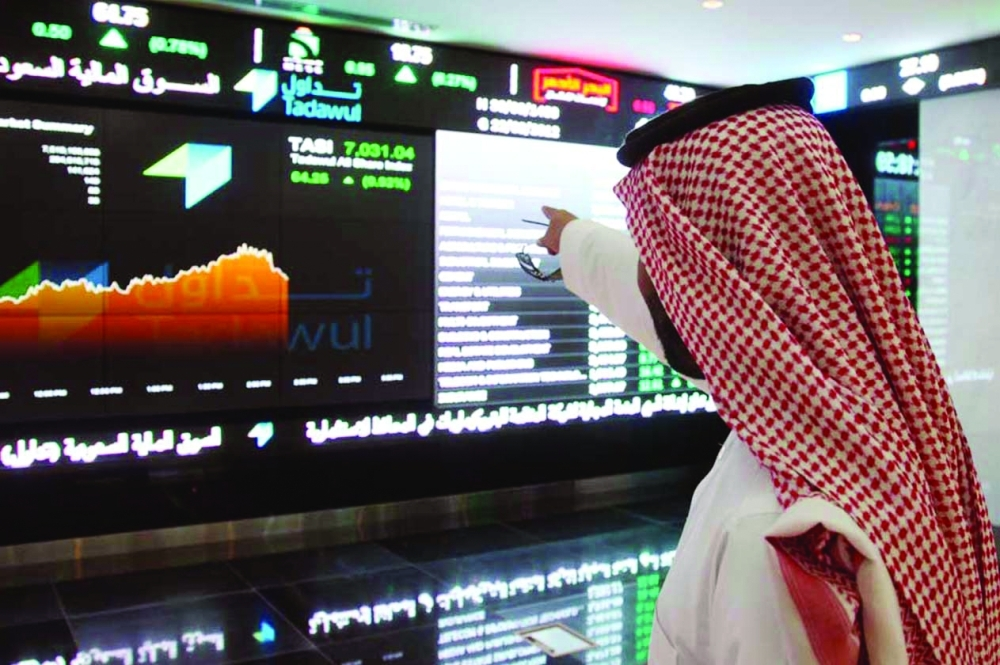
The Saudi Stock Exchange's main index (TASI) opened trading on Sunday, the first session of the week, with a notable decline of 0.7%, falling to 10,469 points. The first few minutes of trading saw a turnover of approximately 200 million Saudi riyals, reflecting a cautious and watchful attitude among traders at the start of the week.
According to data released by the Saudi Stock Exchange (Tadawul), the volume of shares traded at the start of the session reached approximately 14 million shares, while the total market capitalization of listed shares remained stable at SAR 8.846 trillion. This performance comes at a time when investors are focusing on global and local economic indicators that directly influence investment portfolio decisions.
Company and sector performance
The market experienced widespread selling pressure, with shares of 190 listed companies declining at the start of trading, compared to only 33 rising out of a total of 266 companies listed on the main market. This stark contrast reflects the dominance of losses across most of the market's key sectors.
In terms of stock performance details, the top performing companies were:
- Burgerizer
- Equipment House
- abundance
- Lubric
- Abu Mu'ti
Conversely, the following companies were among the biggest losers and had the greatest impact on the index's decline:
- Reconstruction
- amenities
- East Pipes
- Arabian Cement
- Flynas
The status and regional importance of the Saudi market
The Saudi Stock Exchange (Tadawul) is the largest financial market in the Middle East and North Africa region, and plays a pivotal role in the Saudi economy within the Kingdom’s Vision 2030. The vision aims to diversify sources of income and attract foreign investments, which has made the Saudi market the focus of attention for global financial institutions, especially after its inclusion in global emerging market indices.
The general index movements are usually affected by several fundamental factors, most notably the fluctuations in oil prices in global markets due to the weight of the energy and petrochemical sector in the market, in addition to central bank decisions on interest rates that affect the cost of financing and the liquidity available in financial markets.
The parallel market (growth) is bucking the trend
Contrary to the overall trend of the main market, the parallel market index (Nomu) recorded a slight increase of 0.1% at the start of trading on Sunday, reaching 23,542 points. Trading volume in Nomu reached approximately one million riyals, with 253,000 shares traded, for a total market capitalization of 42.4 million riyals.
The parallel market, which represents an alternative platform for companies wishing to list with more flexible requirements, saw the shares of 13 companies rise compared to the shares of 8 companies falling out of 126 listed companies, indicating that there are selective opportunities for investors in the small and medium-sized enterprises sector.