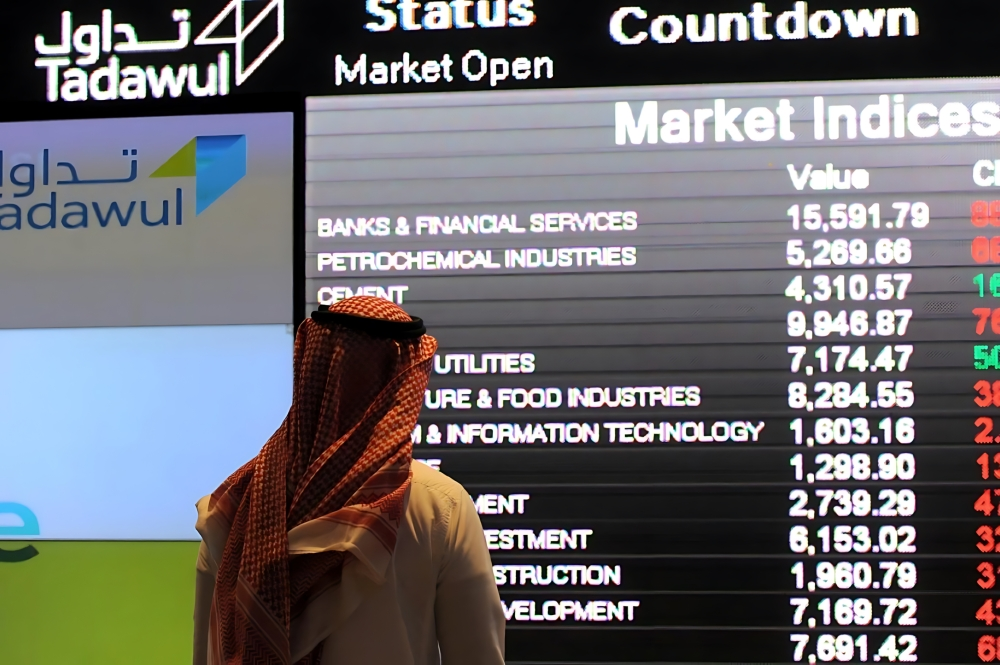
The Saudi Stock Exchange's main index (TASI) closed Wednesday's trading session on a positive note, posting a notable increase of 0.5% to close at 10,945 points. The session witnessed active trading from investors, with total trading value reaching approximately SAR 6.8 billion, reflecting continued buying momentum in the region's largest financial market.
According to data released by the Saudi Stock Exchange (Tadawul), the session saw a significant trading volume of approximately 373.6 million shares, distributed across various listed sectors. The total market capitalization of listed shares remained stable at a substantial SAR 9.2 trillion, reaffirming the leading position of the Saudi market among emerging and global markets.
Company and sector performance
Despite the overall index's rise, individual stock performance was mixed, with most companies closing in the red. Shares of 171 companies declined by the end of trading, while only 90 out of the 266 listed on the main market managed to close in positive territory. This disparity suggests that the overall index's rise may have been primarily driven by the leading companies with significant weighting in the index.
In terms of company performance, the top gainers were Al Kathiri, Wafrah, Al Ramz, SABIC Agri-Nutrients, and Al Jouf. Conversely, the biggest losers were Sadarat, United Insurance, Thimar, Abu Moati, and Gulf National Insurance.
Parallel market (growth)
In contrast, the parallel market index (Nomu) moved in the opposite direction to the main market, closing down 0.5% at 23,551 points. Trading volume in this promising market reached approximately SAR 16 million, with 2.3 million shares traded. The market capitalization of companies listed on Nomu reached SAR 42.6 billion. Of the 127 listed companies, 42 saw their share prices decline, while 36 saw their share prices rise.
Economic importance and general context
The performance of the Saudi stock market is of particular importance given the major economic transformations underway in the Kingdom as part of Vision 2030. The financial market is a true reflection of the growth of the non-oil private sector, as the Kingdom seeks to deepen its financial market and attract more foreign and domestic investment. Maintaining high liquidity levels (above 6 billion riyals) is a healthy indicator of the market's attractiveness and reflects investor confidence in the strength of the Saudi economy.
Furthermore, the massive market capitalization exceeding 9 trillion riyals places the Saudi market among the world's major markets, enhancing its weight in global indices such as MSCI and FTSE Russell. Economic analysts closely monitor these daily movements, as they provide early indicators of future economic prospects and company performance in light of global economic variables, oil prices, and interest rates.