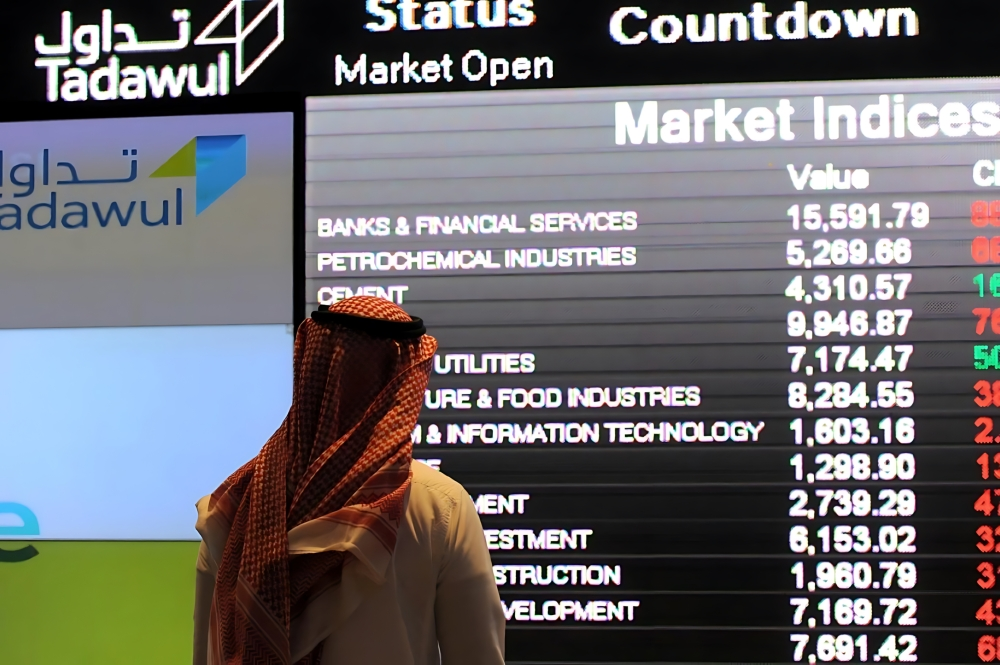
The Saudi stock market index recorded a slight decline of 0.1% at the close of trading on Sunday, settling at 10,886 points. Total trading value on the main market reached approximately 2.9 billion Saudi riyals, reflecting continued strong investor activity despite the minor drop in the overall index.
According to official data released by the Saudi Stock Exchange (Tadawul), the volume of shares traded during the session reached approximately 152.5 million shares, executed through multiple transactions across various sectors. Meanwhile, the total market capitalization remained stable at a robust level of around SAR 9.6 trillion, confirming the strength of the Saudi financial market and its ability to absorb daily fluctuations.
Analysis of the performance of the Saudi stock market index and listed companies
The session saw mixed performance among listed companies, with 148 companies' shares declining by the end of trading, while 109 companies' shares achieved varying gains, out of a total of 269 companies listed on the main market. The top gainers included the Saudi Pharmaceutical Industries Company (SPIMACO), Kemanol, Shaker Group, Abu Moati Company, and Dar Al-Madaen Company.
On the other hand, some companies recorded notable declines, with the following stocks leading the list of the biggest losers: Modern Mills, Fish, Manufacturing, Amiantit, and Emaar, reflecting profit-taking or reactions to news specific to those companies.
Economic context and history of trading on the Saudi market
The Saudi stock market is a reflection of the largest economy in the Middle East and North Africa region. Historically, the market has undergone radical transformations, particularly with the launch of Vision 2030, which aimed to diversify income sources and reduce dependence on oil. This structural shift has made the market more mature and attractive to investors. Minor fluctuations, such as the decline in the index today, are a natural part of the dynamics of financial markets, which are typically influenced by multiple factors including global oil prices, interest rates, and the monetary policies of major central banks.
Economic importance and expected impacts
The performance of the Saudi financial market is of paramount importance that extends far beyond its borders. Domestically, market stability impacts the confidence of individual and institutional investors and supports companies' expansion and growth plans. Regionally, any movements in the Saudi market often affect investor sentiment in neighboring Gulf Cooperation Council (GCC) markets due to close economic interdependence.
Internationally, the Saudi market has become a focus of attention for global investment funds, especially after its successful inclusion in emerging market indices such as MSCI and FTSE Russell. Consequently, maintaining high liquidity levels and a market capitalization of approximately SAR 9.6 trillion reinforces the Kingdom's position as a safe and stable investment destination amidst global economic challenges.
A look at the performance of the parallel market (growth)
In contrast, the parallel market index (Nomu) showed positive performance today, closing 0.3% higher at 22,438 points. Trading value in the parallel market reached approximately SAR 24 million, with a volume of nearly 1.2 million shares traded. The market capitalization of the parallel market remained stable at SAR 38.5 billion.
In terms of the performance of companies in the “Nomu” market, the shares of 34 companies rose by the end of trading today, while the shares of 32 other companies declined, out of a total of 125 companies listed in this market, which aims to provide additional financing opportunities for emerging and medium-sized companies, thus supporting the national economy system in general.