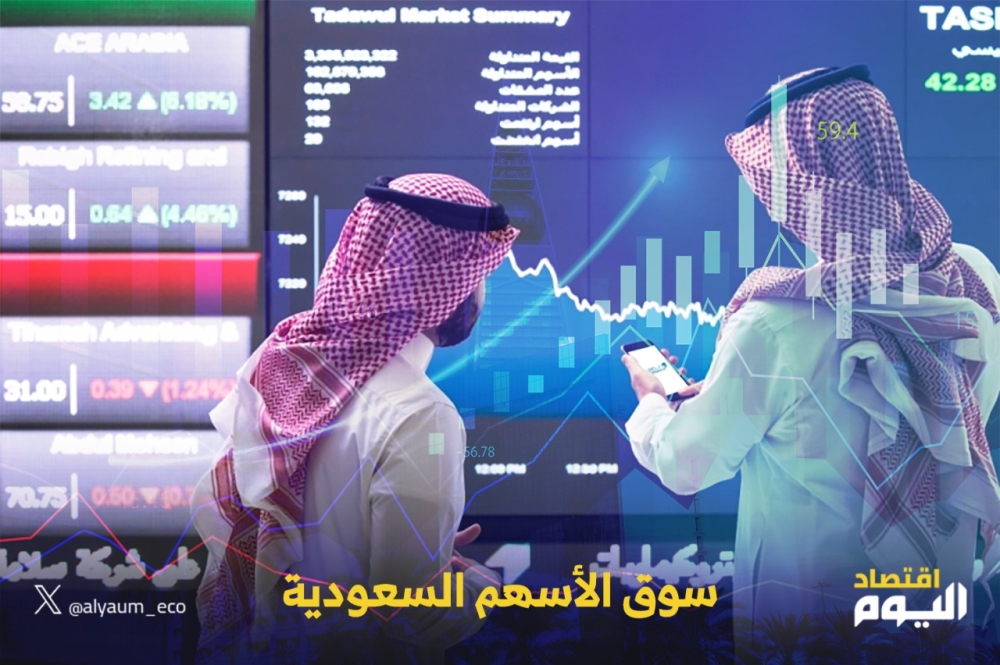
The Saudi Stock Exchange's main index (TASI) closed significantly higher on Monday, gaining 1.3% to close at 10,745 points. The session was characterized by positive sentiment and strong buying activity across most market sectors. Trading was brisk, with total value reaching approximately SAR 5.1 billion, reflecting a return of investor appetite.
According to data issued by the Saudi Stock Exchange (Tadawul), the session witnessed the trading of large quantities of shares amounting to about 261.7 million shares, distributed across various sectors, while the market value of listed shares remained stable at the 8.9 trillion riyal mark, which confirms the position of the Saudi market as one of the largest financial markets in the Middle East and North Africa region in terms of market value.
Company and sector performance
The trading session was dominated by positive territory, with 216 companies seeing their shares rise by the end of trading, indicating a broad rally encompassing leading, mid-cap, and small-cap companies alike. Conversely, only 42 out of the 266 companies listed on the main market experienced a decline in their share prices.
The top performing stocks included Al-Asmak, Naseej, Dar Al-Arkan, Al-Waha, and Al-Amar, which witnessed heavy buying activity. Conversely, the worst performing stocks were Al-Masar Al-Shamel, Paper Manufacturing, Tasheel, Luberef, and Extra, impacted by normal profit-taking or specific technical factors for each stock.
Economic context and market importance
This rise comes within a generally optimistic economic context regarding the growth of Saudi Arabia's non-oil economy, in line with the goals of Vision 2030. The Saudi stock market is a true reflection of this economic dynamism, attracting continuous inflows of both domestic and foreign capital. The index closing above 10,700 points is a positive technical signal for investors, reinforcing confidence in the strength of listed companies and their ability to achieve sustainable growth.
The liquidity volume, which exceeded 5 billion riyals, is a healthy indicator of the market's vitality, as liquidity is the fuel of financial markets, and its increase indicates the existence of attractive investment opportunities and a desire from institutions and individuals to inject more investments.
Parallel market performance (growth)
Meanwhile, the parallel market index (Nomu) bucked the trend of the main market, closing today with a slight decrease of 0.1% at 23,586 points. Trading value in Nomu reached approximately SAR 23.8 million, with 2.6 million shares traded, while the market capitalization of the companies listed on it stood at approximately SAR 42.4 billion.
In detail, regarding the performance of companies in the parallel market, the shares of 42 companies rose, while the shares of 36 companies fell out of a total of 127 listed companies, showing a disparity in performance that reflects the nature of this market, which includes emerging, small and medium-sized companies with promising growth opportunities but with varying risks.