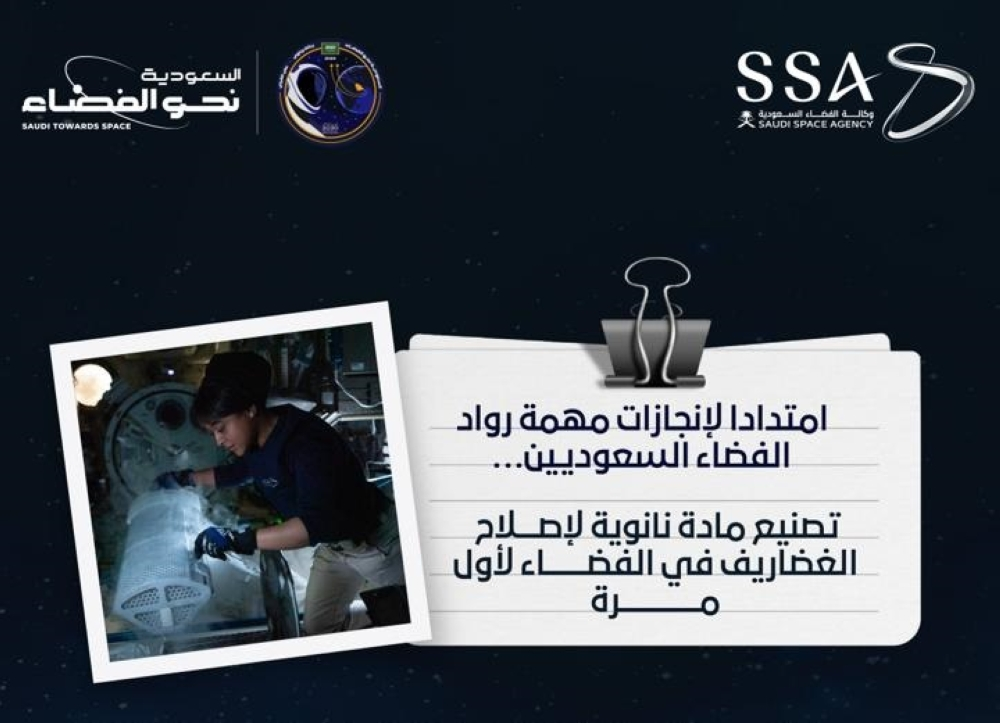
In an unprecedented scientific step that reinforces the Kingdom of Saudi Arabia's position in space exploration and scientific research, the Saudi Space Agency announced a new milestone: the successful manufacturing, for the first time, of a nanomaterial designed for cartilage repair in a microgravity environment (space). This achievement is a direct result of the historic SSA-HSF1 mission undertaken by Saudi astronauts aboard the International Space Station.
Details of the scientific experiment in space
The agency explained that this scientific breakthrough was the result of close international collaboration, with the research led by scientists Yubing Chen and Mary Ann Snow. The research focused on developing advanced biomaterials for tissue engineering. Saudi astronaut Rayana Barnawi conducted this precise experiment within the laboratories of the International Space Station, collecting data and monitoring the interaction of the materials in a near-weightless environment.
This experiment is one of 19 intensive scientific experiments conducted by the Saudi team during their journey, which covered diverse fields including biomedicine, physics, and materials science, with the aim of serving humanity and improving the quality of life on Earth.
Why manufacture in space?
This experiment gains its significance from the unique properties of the space environment. Under microgravity, materials, liquids, and cells behave very differently than they do on Earth. Established scientific facts indicate that the absence of gravity eliminates sedimentation and convection forces, allowing materials to crystallize and tissues to form with extreme precision and three-dimensional structures that cannot be easily replicated in terrestrial laboratories. This was confirmed by research published in the prestigious journal *Nature*, where nanomaterials manufactured in space demonstrated superior quality and precision compared to their counterparts manufactured on Earth.
Future prospects for regenerative medicine
This success represents a significant leap forward in regenerative medicine and tissue engineering. The new nanomaterial opens the door to developing revolutionary treatments for joint injuries and cartilage degeneration, health problems affecting millions worldwide. This development also supports the global trend toward "in-space manufacturing" for producing transplantable human organs and tissues, potentially resolving the organ shortage crisis for patients in the future.
In line with the Kingdom's Vision 2030
The Saudi Space Agency affirmed that these results reflect the complementary roles of scientists and astronauts, and highlight the Kingdom's commitment to maximizing the scientific benefits of manned spaceflights. This achievement is fully aligned with the objectives of Vision 2030 , which aims to transform the Kingdom from a consumer of technology to a producer, actively contributing to global innovation and solidifying Saudi Arabia's position as a key player in the space sector and the knowledge economy.