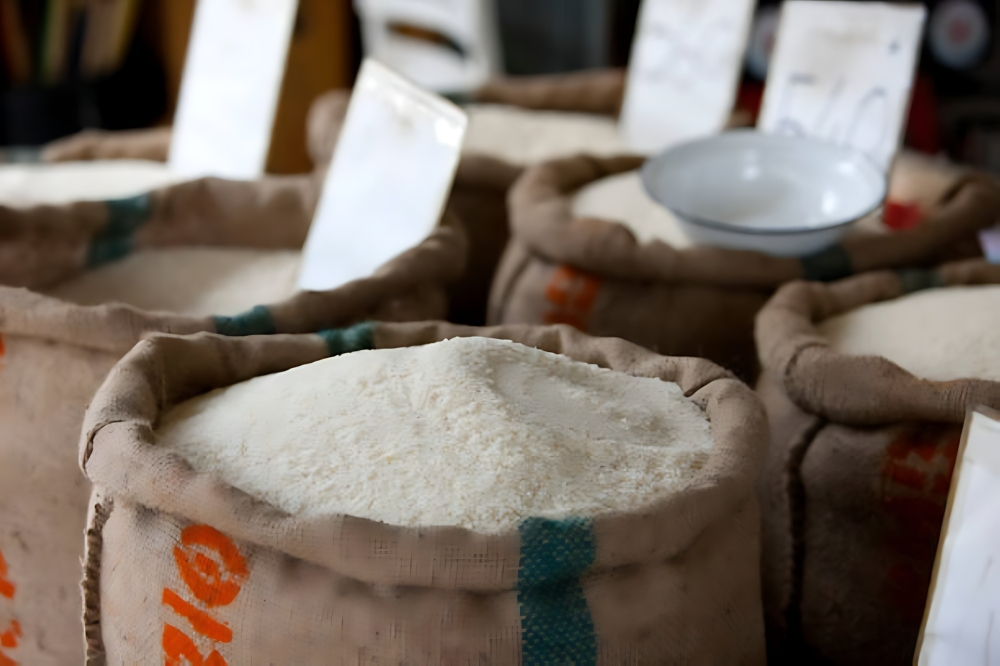
Saudi Arabian markets witnessed a notable variation in the prices of basic food commodities during last December, as basmati rice prices recorded a promising decrease for consumers, while flour and grain products witnessed a slight increase, according to the latest data issued by the General Authority for Statistics.
Details of rice price movements in the markets
The General Authority for Statistics' bulletin on average prices of goods and services showed that the price of basmati rice, a staple food in Saudi Arabia, decreased by 1.2% month-on-month. The average price of a 10 kg bag was recorded at 95.5 riyals, reflecting relative stability that benefits Saudi families.
In contrast, non-basmati Indian rice bucked this trend, registering a slight increase of 0.4% during the same period, bringing the price of 10 kg to SAR 80.9. This variation reflects the different supply and demand dynamics among the various rice varieties in the local market.
Flour and grain prices rise
On another note, the report observed price movements in flour products, with the price of locally produced whole wheat flour rising by 0.3% to reach 3.1 riyals per kilogram. White flour also saw a price increase, rising by 0.2% month-on-month to reach 4.7 riyals for a 2 kg bag.
Regarding grains and animal feed, the price of imported barley rose by 0.6% to reach 67.2 riyals per 50 kg bag. Sorghum also saw an increase of 0.3%, reaching approximately 137 riyals for 40 kg, while millet remained stable at 120.8 riyals for the same weight.
Bread stability and the importance of food security
Among the positive points highlighted in the report was the stability of the price of white flatbread at 1.1 riyals, reflecting the success of government policies in maintaining stable prices for basic and subsidized commodities to ensure food security for citizens and residents. Regarding grain-based products, the price of vermicelli remained stable at 6 riyals, while pasta saw a marginal increase of 0.2%, reaching 6.1 riyals.
Economic and strategic importance
This data is particularly important given the strategic importance of rice and wheat as commodities in Saudi Arabia. The General Authority for Statistics' regular monitoring of these prices is a vital tool for measuring inflation rates and understanding changes in consumer purchasing power. Furthermore, the decline in basmati rice prices, despite global supply chain challenges, indicates ample stocks and the efficiency of local supply chains.
The Kingdom, through the General Authority for Food Security and relevant authorities, is continuously working to monitor global and local markets to reduce the impact of global price fluctuations on the end consumer, especially in goods that are indispensable in daily life.