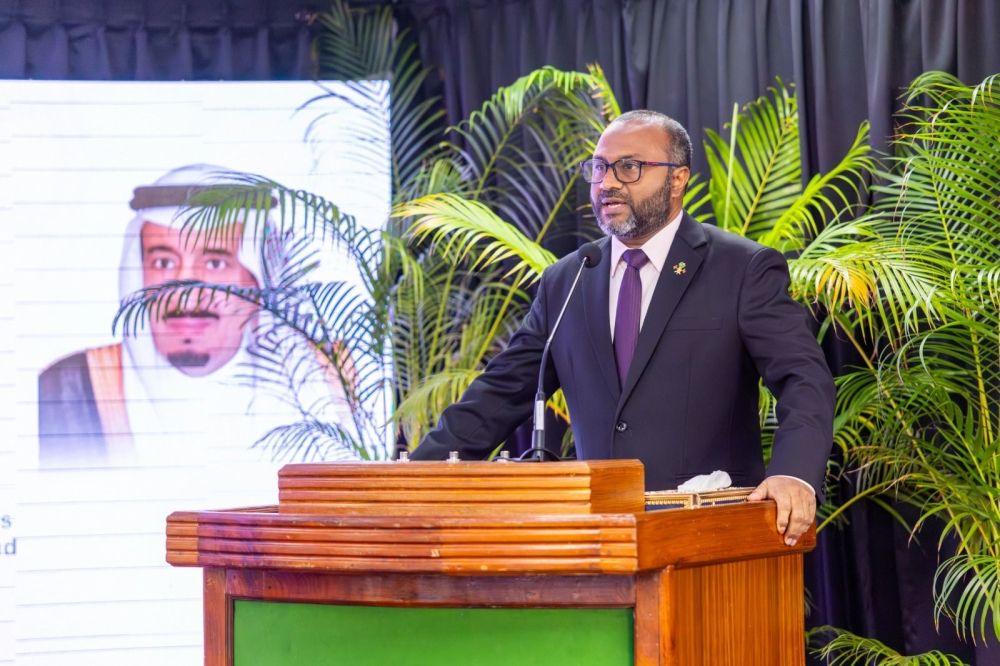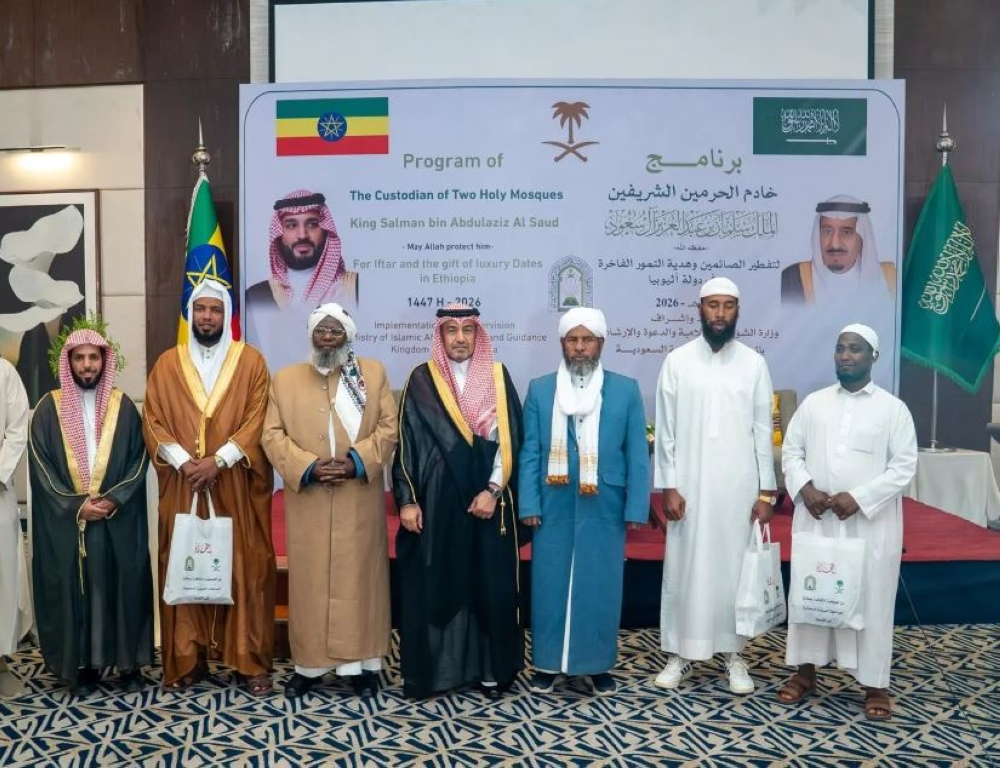
The Ramadan programs launched by the Kingdom of Saudi Arabia in the Federal Democratic Republic of Ethiopia, represented by the "Custodian of the Two Holy Mosques' Gift for the Distribution of Dates and Iftar Meals," have received widespread praise from high-ranking religious and parliamentary figures. This praise came during the inauguration ceremony organized by the Ministry of Islamic Affairs, Dawah and Guidance, underscoring the deep fraternal ties between the two countries and the Kingdom's leading role in serving Islam and Muslims worldwide.
Deep-rooted historical ties
These initiatives do not arise in a vacuum; rather, they are an extension of deep historical ties that stretch back to the dawn of Islam. Ethiopia, or Abyssinia as it was historically known, was the first land to embrace the early Muslims who migrated there at the command of the Prophet Muhammad (peace be upon him), fleeing persecution by the Quraysh in Mecca. They found safety and justice under the protection of its king, the Negus, which established a unique relationship of respect and affection between the peoples of the Arabian Peninsula and Abyssinia. These Ramadan programs today are a contemporary embodiment of that spirit of brotherhood and a reinforcement of the spiritual and cultural bonds that have remained unbroken throughout the ages.
Diplomatic and humanitarian dimensions of the initiative
Dr. Ibrahim Tufa, President of the Supreme Council for Islamic Affairs in Ethiopia, affirmed that the Kingdom of Saudi Arabia represents a wellspring of knowledge and the source of divine revelation from which Muslims in his country derive their values. He said, “Our hearts grow more attached to the Kingdom day by day, and these Ramadan programs are living proof that this blessed land is a hand of benevolence extended to the entire world, and is always loyal to the causes of Muslims and their way of life.”.
For his part, Dr. Ali Mohammed, Chairman of the Council of Senior Scholars, described these initiatives as “bridges of affection that bring joy to Muslim homes,” praising the generous care that the Kingdom’s leadership provides to the Muslim Ummah across the globe. These programs represent an effective tool of the Kingdom’s humanitarian diplomacy, extending beyond direct relief efforts to enhance the Kingdom’s positive image as a leader of the Islamic world and a key supporter of stability and social solidarity at both the regional and international levels.
A unique model of cohesion
In the same vein, Ethiopian Member of Parliament Mohammed Al-Arusi emphasized that these programs represent a unique model of humanitarian diplomacy adopted by the Kingdom. He explained that they reinforce the values of solidarity and brotherhood, affirming that the Kingdom has long been committed to sharing in the joys and celebrations of other nations, thus underscoring the enduring bonds of brotherhood between the two peoples. The implementation of these programs through the Ministry of Islamic Affairs solidifies the Kingdom's humanitarian and outreach presence, reflecting its global mission to serve Islam and Muslims and to spread the values of moderation, tolerance, and compassion among all peoples.