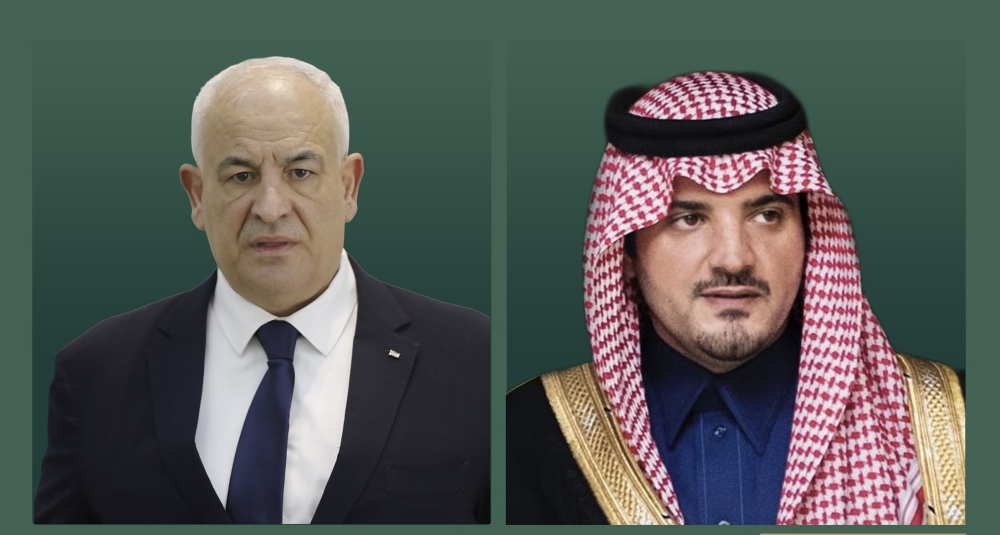
As part of ongoing efforts to enhance stability, His Royal Highness Prince Abdulaziz bin Saud bin Nayef bin Abdulaziz, the Saudi Minister of Interior, held important discussions via telephone with his Palestinian counterpart, Ziad Mahmoud Hab Al-Reeh. The call focused on reviewing security developments in the region and exchanging greetings on the occasion of Eid al-Fitr, reflecting the deep fraternal ties between the two brotherly countries amidst the current challenges facing the region.
Palestinian solidarity in the face of regional threats
During the conversation, the Palestinian Minister of the Interior expressed his country's unwavering support for the Kingdom of Saudi Arabia. He affirmed the State of Palestine's strong condemnation of the repeated Iranian attacks targeting the security and stability of the Kingdom, the Gulf states, and the entire region. He emphasized the solidarity of the Palestinian leadership and people with all the decisive measures taken by Riyadh to preserve its national security, sovereignty, and the safety of its territory and citizens, considering the security of the Gulf an integral part of Arab national security, and any threat to it a threat to the stability of the entire Arab nation.
Historical roots and the impact of security developments in the region
These talks come at a sensitive time, marked by escalating geopolitical tensions in the Middle East. Historically, Saudi Arabia has played a pivotal role in leading diplomatic and security efforts to unify the Arab ranks and counter foreign interference. Saudi-Palestinian relations span decades of mutual support, with the Kingdom consistently standing by the legitimate rights of the Palestinian people. In turn, the Palestinian leadership recognizes the importance of Saudi stability as a cornerstone of regional equilibrium. This ongoing coordination is not a recent development, but rather an extension of a long-standing policy aimed at strengthening the Arab home front against any attempts at destabilization by regional actors seeking to expand their influence through supporting armed militias and fomenting chaos. These periodic meetings and communications serve as a safeguard, ensuring the proactive exchange of strategic perspectives and thus reducing the likelihood of success for any schemes targeting the capabilities of the Arab peoples.
Expected repercussions of enhanced joint coordination
For his part, Prince Abdulaziz bin Saud bin Nayef expressed his appreciation for the sincere brotherly sentiments expressed by his Palestinian counterpart, emphasizing the strength and depth of the historical relations that bind Riyadh and Ramallah. The significance of this event transcends a mere exchange of views, representing a clear message to the international community that joint Arab coordination is the first line of defense against threats. At the local and regional levels, this consensus contributes to strengthening trust among Arab security agencies and opens broader horizons for the exchange of information and expertise in combating terrorism and organized crime. At the international level, unifying visions and positions enhances the standing of Arab states in international forums and underscores the need for the international community to take serious and decisive steps to halt blatant interference in the internal affairs of sovereign states. This cooperation also reflects the commitment of both leaderships to providing a safe and stable environment that supports the development and economic prosperity to which the peoples of the region aspire, free from conflicts and armed disputes.