Strategic partnership to enhance railway infrastructure
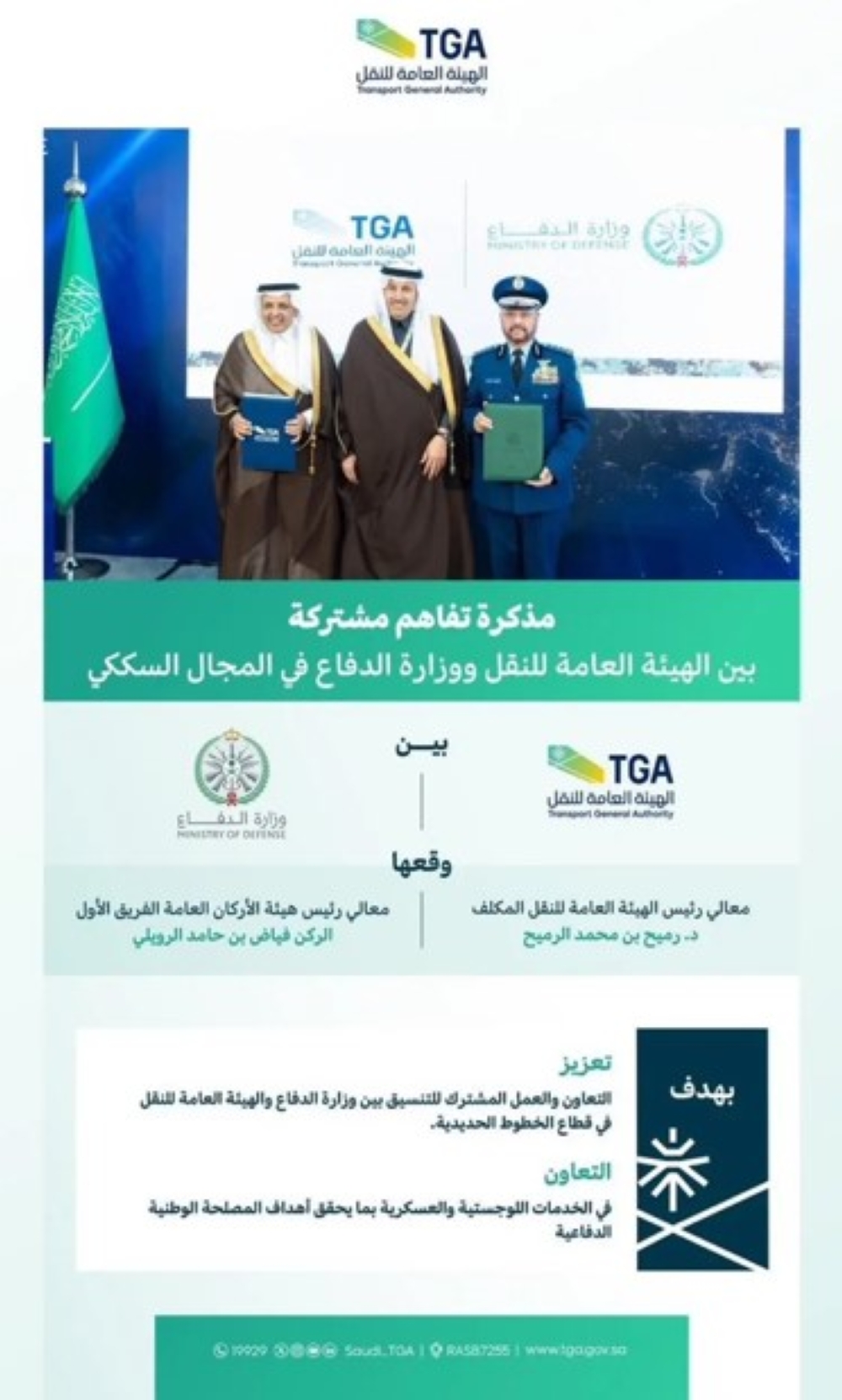
In a move reflecting the growing integration of vital sectors in the Kingdom of Saudi Arabia, the Ministry of Defense and the Public Transport Authority signed a strategic memorandum of understanding aimed at strengthening joint cooperation in the railway sector. The signing took place on the sidelines of the World Defense Show 2024, hosted by Riyadh, a leading global platform showcasing the latest developments in the defense and security industries.
The memorandum was signed by His Excellency the Chief of the General Staff, Lieutenant General Fayyad bin Hamed Al-Ruwaili, and His Excellency the Acting President of the Public Transport Authority, Dr. Rumaih bin Mohammed Al-Rumaih, in the presence of His Excellency the Minister of Transport and Logistics, Engineer Saleh bin Nasser Al-Jasser. This partnership aims to align the requirements of the Kingdom's defense strategy with the objectives of the National Transport and Logistics Strategy, thereby ensuring the achievement of shared goals and enhancing national capabilities.
General context and objectives of Vision 2030
This collaboration comes within the context of the major transformations taking place in the Kingdom as part of Vision 2030, which aims to diversify the national economy and transform the Kingdom into a global logistics hub connecting the three continents of Asia, Europe, and Africa. The National Transport and Logistics Strategy is a key pillar in achieving this vision, targeting the development of an integrated and sustainable infrastructure encompassing all modes of transport, most notably the railway network.
Historically, Saudi Arabia’s railway sector has witnessed remarkable development, from the first lines connecting ports to production areas to modern mega-projects such as the Haramain High-Speed Railway, which serves millions of pilgrims annually, and the North-South Railway, which plays a vital role in transporting minerals and goods. This memorandum builds upon this legacy to ensure the network meets defense and security requirements in addition to its economic role.
Strategic importance and expected impact
The significance of this memorandum lies in its establishment of the concept of “dual-use infrastructure.” Domestically, the upgraded railway network will contribute to enhancing national security by providing an efficient and secure means of transporting troops, equipment, and military logistics supplies when needed, thereby increasing readiness and response times. Economically, this integration supports supply chain efficiency and reduces reliance on road transport, thus lowering costs and carbon emissions.
Regionally, the development of an integrated railway network capable of serving both civilian and military purposes enhances the Kingdom's position as a strategic power in the region. It also paves the way for future rail connectivity projects with the Gulf Cooperation Council (GCC) countries, deepening joint economic and defense integration. Internationally, a robust and reliable logistics infrastructure makes the Kingdom a more attractive partner in global trade and international investment, reflecting its commitment to developing its overall capabilities in line with global standards.