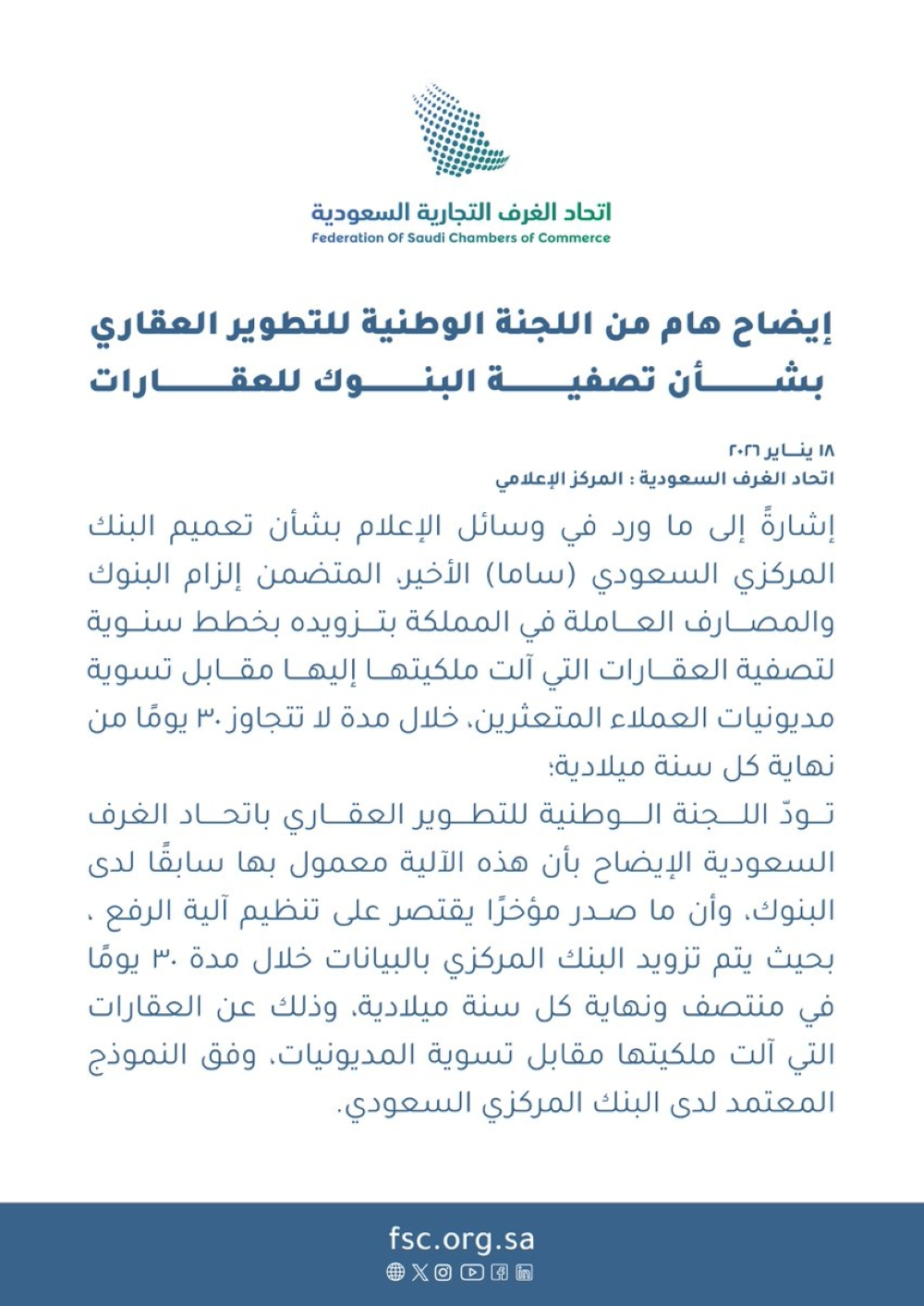
The National Real Estate Development Committee of the Federation of Saudi Chambers issued an important clarification to dispel any doubts surrounding recent discussions in economic circles and on social media platforms regarding a circular issued by the Saudi Central Bank (SAMA). This circular pertains to properties that revert to the ownership of banks and financial institutions as a result of settling the debts of defaulting clients. The committee emphasized that this procedure is not entirely new, but rather an administrative restructuring of an existing mechanism that has been in place for some time.
The reality of the existing mechanism and the organization of procedures
In an official statement published on its X platform, the committee clarified that banks and financial institutions operating in the Kingdom of Saudi Arabia have always applied the property liquidation mechanism as part of debt settlement procedures for defaulting clients. It noted that the recent misunderstanding necessitated clarification that the core of the process remains unchanged, but rather that monitoring and reporting mechanisms have been updated to ensure greater transparency and governance in the financial sector.
Details of the new update from the Central Bank
In a related context, the committee clarified that the recent directives issued by the Saudi Central Bank (SAMA) primarily aim to regulate the procedures for "submitting data." Under these regulations, banks are now obligated to provide SAMA with clear and scheduled annual plans for liquidating these properties. The new update explicitly stipulates that data must be submitted within a period not exceeding 30 days from the middle and end of each calendar year, using the forms officially approved by the Central Bank, and must include all properties whose ownership has been transferred to banks as a result of financial settlements.
The economic context and the importance of governance
This move comes within the framework of the regulatory and supervisory role exercised by the Saudi Central Bank to ensure the safety and stability of the banking sector. It is well-established in banking practice that banks are not real estate institutions, and their holding of real estate assets for extended periods can negatively impact the cash liquidity available for lending and financing. Therefore, regulating the liquidation of these assets ensures the reinvestment of liquidity in the economy and protects banks from the volatility of the real estate market.
Expected impact on the financial and real estate sectors
This regulation reflects the commitment of relevant authorities in the Kingdom to enhancing the efficiency of the financial and real estate markets, in line with the objectives of Vision 2030. By requiring banks to implement transparent and monitored liquidation plans, transparency is strengthened and the risks associated with illiquid assets are mitigated. This measure also indirectly contributes to stimulating real estate trading, as these properties are offered on the market through organized mechanisms, thus preventing the accumulation of assets by financial institutions and safeguarding the rights of both shareholders and depositors.