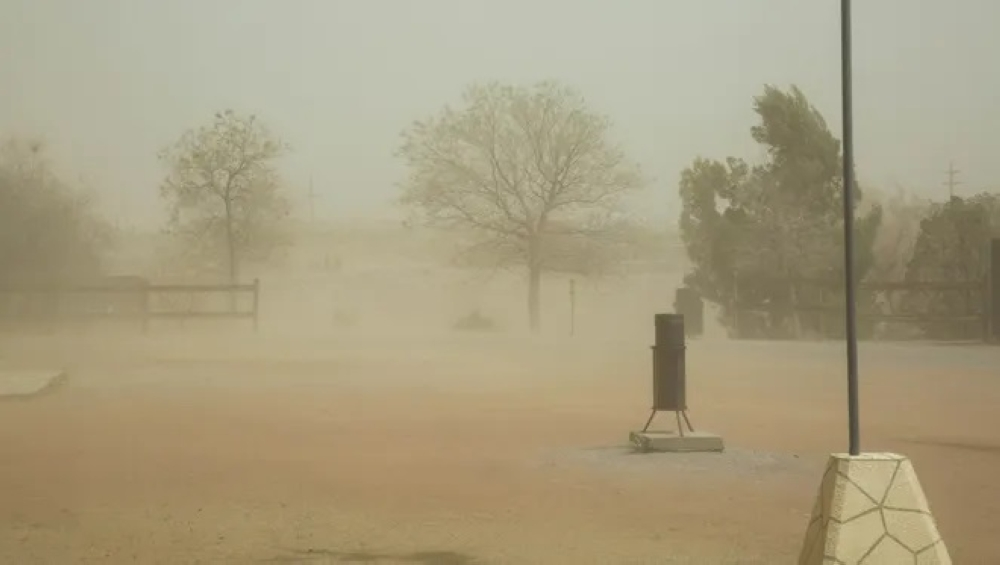
The National Center for Meteorology in Saudi Arabia issued its daily weather report for Monday, warning of continued unstable weather conditions affecting several regions. The report indicated strong surface winds stirring up dust and sand, which are expected to reduce horizontal visibility to near zero, urging citizens and residents to exercise extreme caution.
According to the report, the most affected areas include large parts of the Riyadh, Eastern Province, and Najran regions. These weather conditions also extend to the eastern parts of the southwestern highlands, as well as scattered areas of the Makkah, Madinah, and Tabuk regions. In a related development, the center did not rule out the possibility of light rain and fog formation in parts of the Jazan and Asir regions, further complicating the weather situation in those areas.
The climatic context of dust storms in the Kingdom
Dust and sandstorms are a common weather phenomenon in Saudi Arabia, given its geography, which includes vast desert areas such as the Rub' al Khali and the Great Nafud Desert. These phenomena are particularly active during seasonal transitions or when the region is affected by low-pressure systems that increase surface wind speeds, carrying large quantities of dust and sand into the air and transporting them over long distances, thus affecting air quality and visibility.
Expected effects and safety guidelines
These weather conditions have direct impacts on various aspects of daily life. In terms of health, asthma and respiratory patients are advised to avoid going out unless absolutely necessary and to wear protective masks. Regarding transportation, reduced visibility increases the risk of accidents on highways and may cause delays or cancellations of flights at affected airports. Authorities, such as the General Directorate of Civil Defense and the Road Security Directorate, urge drivers to exercise extreme caution, adhere to safety instructions, and reduce their speed.
Red Sea situation
Regarding maritime traffic, the report indicated that surface winds over the Red Sea will be northwesterly to northeasterly in the northern and central parts at speeds ranging from 10 to 38 km/h, while in the southern part they will be southeasterly to southwesterly at speeds of 10 to 35 km/h, potentially reaching 45 km/h towards the Bab el-Mandeb Strait. Consequently, wave heights will range from half a meter to one and a half meters, with sea conditions ranging from slight to moderate.
Arabian Gulf
In the Arabian Gulf, surface winds are expected to be northwesterly to westerly at a speed of 20-45 km/h, leading to waves of one to two meters high, and the sea state will be moderately rough, which calls for caution by seafarers and fishermen.