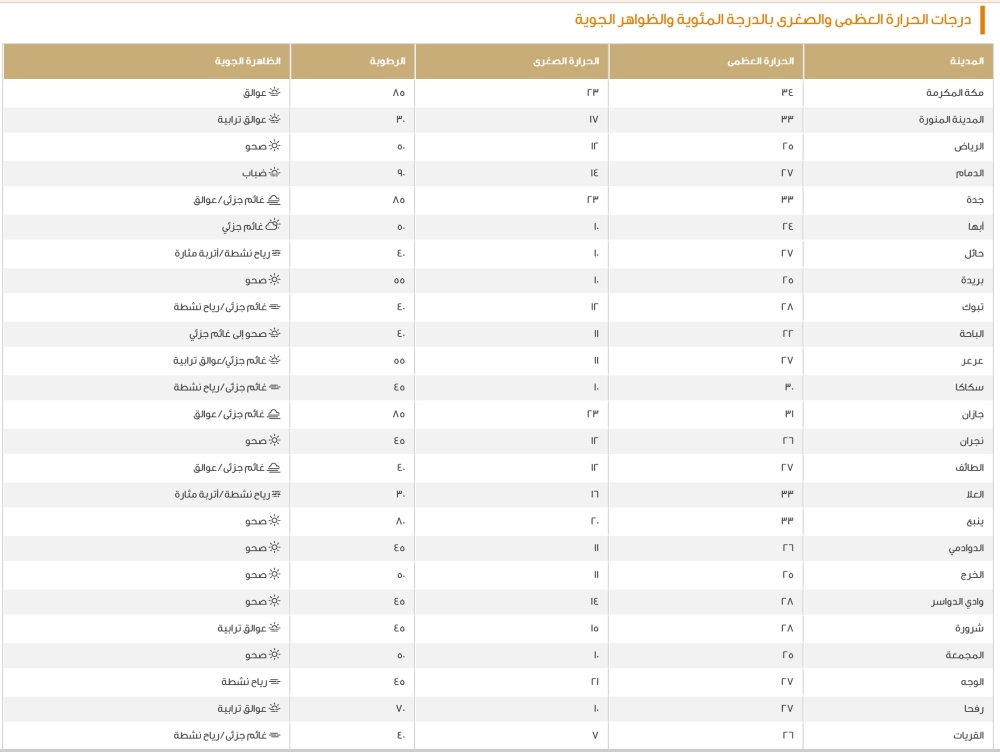
The National Center for Meteorology in Saudi Arabia issued its daily weather report, revealing the expected maximum temperatures for Tuesday across the Kingdom's cities and provinces. Mecca recorded the highest temperature at 34 degrees Celsius, while the capital, Riyadh, experienced more moderate weather at 25 degrees Celsius, and Dammam recorded 27 degrees.
Temperature details in the cities of the Kingdom
According to the center's statement, temperatures varied significantly between regions, reflecting Saudi Arabia's diverse geography and climate. Below is a list of the maximum temperatures recorded in major cities:
- Mecca: 34 degrees Celsius
- Medina: 33 degrees Celsius
- Jeddah: 33 degrees Celsius
- Al-Ula: 33 degrees Celsius
- Yanbu: 33 degrees Celsius
- Jazan: 31 degrees Celsius
- Al Qunfudhah: 31 degrees Celsius
- Sakaka: 30 degrees Celsius
- Bisha: 30 degrees Celsius
- Riyadh: 25 degrees Celsius
- Dammam: 27 degrees Celsius
- Abha: 24 degrees Celsius
- Hafar Al-Batin: 24 degrees Celsius
- Courtyard: 22 degrees Celsius
- Al-Sawda: 18 degrees Celsius (coldest)
The importance of following weather reports and their impact
The weather reports issued by the National Center of Meteorology are of paramount importance, extending far beyond simply knowing the daily temperature. Locally, residents rely on this data to organize their daily activities, from choosing appropriate clothing to planning trips and commutes, especially given the significant temperature variations between day and night in some desert regions. These reports also directly impact vital sectors such as agriculture, helping farmers determine irrigation schedules and protect crops, and the construction sector, which requires suitable weather conditions to ensure worker safety and project continuity. Regionally, this data is part of a broader climate monitoring network that contributes to understanding weather changes that may affect air and maritime navigation in the region.
Climatic diversity in Saudi Arabia and its historical background
Thanks to its vast area and diverse topography, the Kingdom of Saudi Arabia boasts a variety of climatic regions. While a hot, arid desert climate prevails across most of the central and northern regions, the coastal areas along the Red Sea and the Arabian Gulf enjoy a more humid and warmer climate. In contrast, the southwestern highlands, such as Asir and Al-Baha, offer a temperate climate in summer and a cool climate in winter, making them a major tourist destination. This diversity is the result of complex geographical factors and has historically played a significant role in shaping lifestyles and population distribution across the Arabian Peninsula. The National Center of Meteorology, established to develop meteorological services in the Kingdom, continues its pivotal role in monitoring these complex climatic systems and providing accurate forecasts that support the Sustainable Development Goals and the Kingdom's Vision 2030.