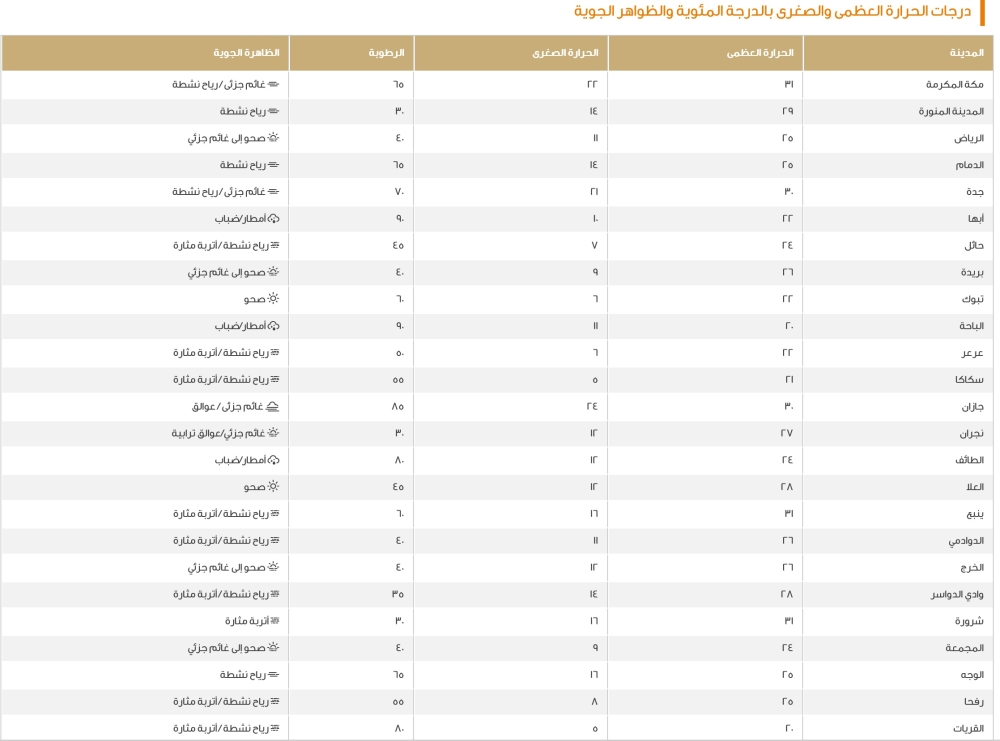
The National Center for Meteorology in Saudi Arabia issued its daily weather report, revealing the expected maximum temperatures in various cities and provinces across the Kingdom. Both Dammam and the capital, Riyadh, recorded a moderate temperature of 25 degrees Celsius, reflecting relatively stable weather conditions in the central and eastern regions.
Background on weather monitoring in the Kingdom
The National Center for Meteorology plays a vital role in monitoring weather phenomena and providing accurate data to citizens, residents, and vital sectors. Established as the official meteorological authority in the Kingdom, the center utilizes state-of-the-art technologies, including radar, satellites, and numerical models, to forecast weather conditions. This contributes to supporting the goals of Vision 2030 by protecting lives and property and promoting sustainable development in sectors such as agriculture, aviation, tourism, and water resource management.
Temperature details in Saudi cities
The report showed a clear variation in temperatures between regions, reflecting the Kingdom's diverse geography and climate. Below is a list of the maximum temperatures recorded in major cities:
- Main cities: Mecca (31°C), Medina (29°C), Jeddah (30°C), Riyadh (25°C), Dammam (25°C).
- Northern regions: Hail (24°C), Tabuk (22°C), Arar (22°C), Sakaka (21°C), Tarif (18°C).
- Southern regions: Abha (22°C), Al-Baha (20°C), Jazan (30°C), Najran (27°C).
- Al-Qassim region: Buraidah (26°C).
- Other cities: Taif (24°C), Yanbu (31°C), Al-Ahsa (26°C), Hafr Al-Batin (24°C), Sharurah (31°C), Al-Qunfudhah (30°C), and Al-Soudah, which recorded the lowest maximum temperature at 15 degrees Celsius.
The importance of the report and its expected impact
This daily data is of paramount importance both locally and regionally. Locally, these reports help residents plan their daily activities, choose appropriate clothing, and take necessary precautions, especially in areas experiencing unpredictable weather. They are also essential for vital sectors such as agriculture, where farmers rely on weather forecasts to determine irrigation and harvesting times. Regionally, accurate weather data from the Kingdom serves as a crucial reference for air and sea navigation in the Arabian Gulf and the Red Sea, two of the world's most important waterways and trade routes.
This variation in temperatures reflects the diverse climate of the Kingdom. While coastal areas such as Jeddah and Jazan experience hot and humid weather, the southern highlands, including Abha and Al-Baha, enjoy cooler and more temperate conditions. The central and northern regions are characterized by a dry desert climate. It is always advisable to follow the National Center of Meteorology's continuous updates for the latest weather information and warnings.