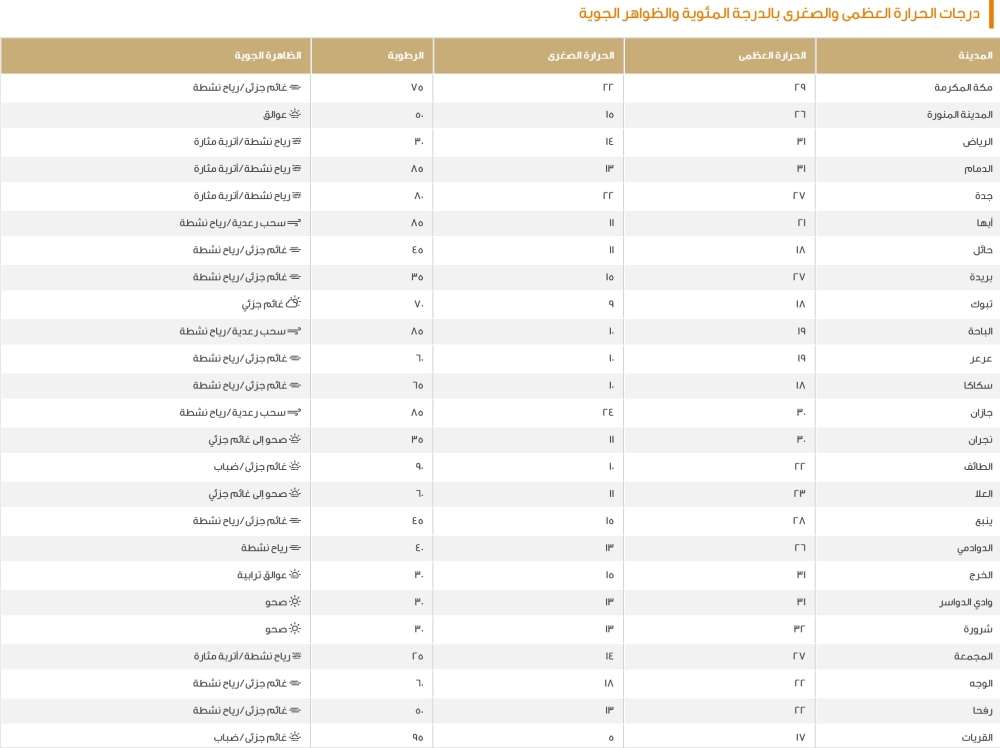
The National Center for Meteorology in Saudi Arabia issued its daily weather report, revealing the expected maximum temperatures for Tuesday across the Kingdom's cities and provinces. Dammam recorded a high of 31 degrees Celsius, similar to the capital, Riyadh, while Al-Ahsa and Rawdat Al-Tanha recorded the highest temperatures at 33 degrees Celsius, reflecting the warm weather prevailing in the eastern and central regions.
Details of maximum temperatures in the cities of the Kingdom
The report showed a significant variation in temperatures across different regions of the Kingdom, reflecting the country's diverse geography and climate. The following is a list of the maximum temperatures recorded:
- Eastern and Central Regions: Al-Ahsa (33°), Rawdat Al-Tanha (33°), Sharurah (32°), Dammam (31°), Riyadh (31°), Al-Kharj (31°), Wadi Al-Dawasir (31°).
- Western regions: Mecca (29°), Medina (26°), Jeddah (27°), Yanbu (28°), Al Qunfudhah (30°).
- Northern regions: Hail (18°), Tabuk (18°), Sakaka (18°), Arar (19°), Tarif (15°), Al Qurayyat (17°).
- Southern regions: Abha (21°), Al-Baha (19°), Jazan (30°), Najran (30°), Bisha (29°), Taif (22°).
- Other areas: Buraidah (27°), Hafr Al-Batin (29°), Al-Majma'ah (27°), Al-Dawadmi (26°), Rafha (22°).
The climatic context and the importance of weather monitoring in Saudi Arabia
The Kingdom of Saudi Arabia is characterized by its vast area and diverse topography, resulting in multiple climatic regions. While a hot, dry desert climate prevails in most of the central and eastern regions, the southwestern highlands, such as Asir and Al-Baha, enjoy a more temperate and cooler climate, while the coastal areas along the Red Sea and the Arabian Gulf are influenced by humidity. This diversity makes monitoring weather forecasts essential for the population and various sectors.
This daily data is vital for several key sectors. In agriculture, temperature forecasts help farmers determine irrigation schedules and protect crops. In transportation and logistics, they contribute to travel planning and mitigating risks associated with extreme weather conditions. On an individual level, this information helps people plan their daily activities and take necessary health precautions, especially during periods of extreme heat or cold, which impact energy consumption for cooling and heating.