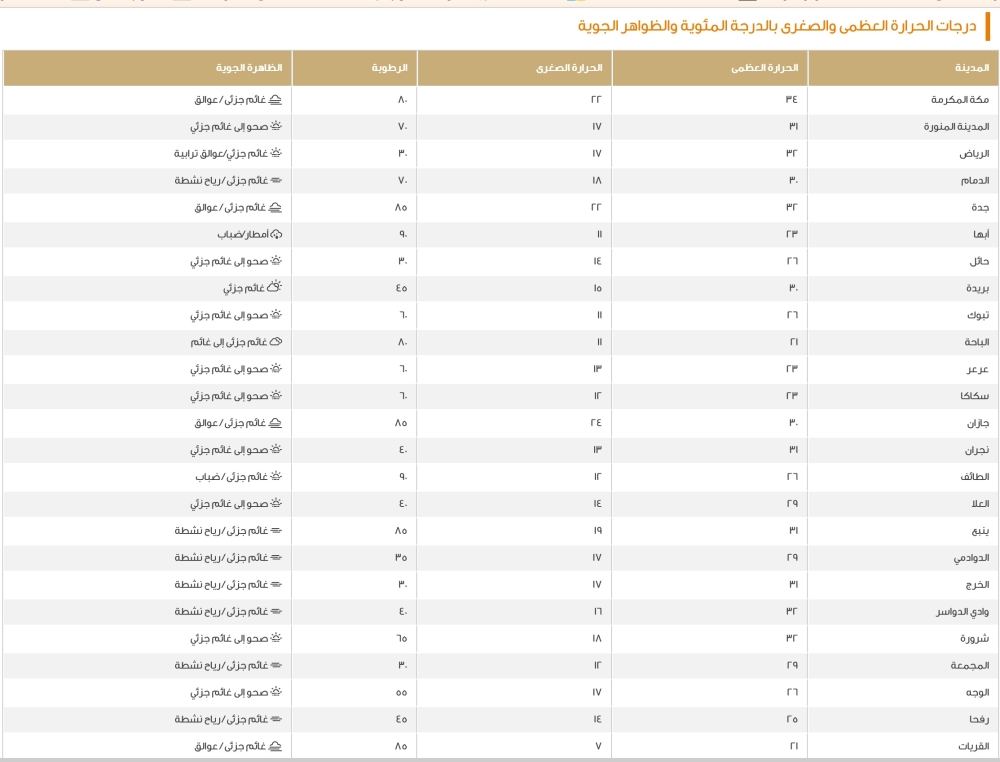
The National Center for Meteorology in Saudi Arabia issued its daily weather report, revealing a noticeable variation in minimum temperatures recorded across the Kingdom's cities and provinces. The city of Dammam, located on the Arabian Gulf coast, recorded a minimum temperature of 18 degrees Celsius, reflecting relatively mild weather typical for this time of year.
General context and climatic diversity in the Kingdom
The Kingdom of Saudi Arabia boasts a unique geographical and climatic diversity due to its vast area spanning most of the Arabian Peninsula. This diversity ranges from the humid coasts of the Red Sea and the Arabian Gulf, to the arid deserts of the Empty Quarter and the Great Nafud Desert, and the cold mountain highlands of the southwest. The National Center of Meteorology (NCM) is the official body responsible for monitoring these weather phenomena and providing accurate forecasts that serve all vital sectors, including aviation, navigation, and agriculture, in addition to providing crucial information for the safety of citizens and residents.
Temperature details in major cities
The center's report revealed a clear contrast reflecting this climatic diversity. While coastal cities like Jeddah (22 degrees) and Jazan (24 degrees) recorded warm temperatures, the capital Riyadh, Al-Kharj, and Dawadmi experienced relatively cooler weather, recording 17 degrees Celsius. The northern regions and highlands, however, recorded remarkably low temperatures, reaching as low as 7 degrees Celsius in Tarif and Al-Qurayyat, and only 6 degrees in As-Sawda, making them among the coldest areas in the Kingdom during this period.
The following is a list of minimum temperatures recorded in some other cities:
- Mecca: 22 degrees Celsius
- Medina: 17 degrees Celsius
- Abha: 11 degrees Celsius
- Tabuk: 11 degrees Celsius
- Hail: 14 degrees Celsius
- Buraidah: 15 degrees Celsius
- Najran: 13 degrees Celsius
- Taif: 12 degrees Celsius
Importance and expected effects
These temperature variations directly impact the daily lives of residents, requiring different preparations in terms of clothing and daily activities. They also have a significant impact on the agricultural sector, as farmers rely on this data to determine planting and harvesting times and to protect their crops from potential frost in northern regions. Regionally, this data contributes to understanding broader climatic patterns in the Gulf and Middle East. Internationally, this meticulous weather monitoring is part of the Kingdom's efforts to address climate change, which are reflected in ambitious initiatives such as the Saudi Green Initiative and Vision 2030, aimed at achieving environmental sustainability and diversifying energy sources.