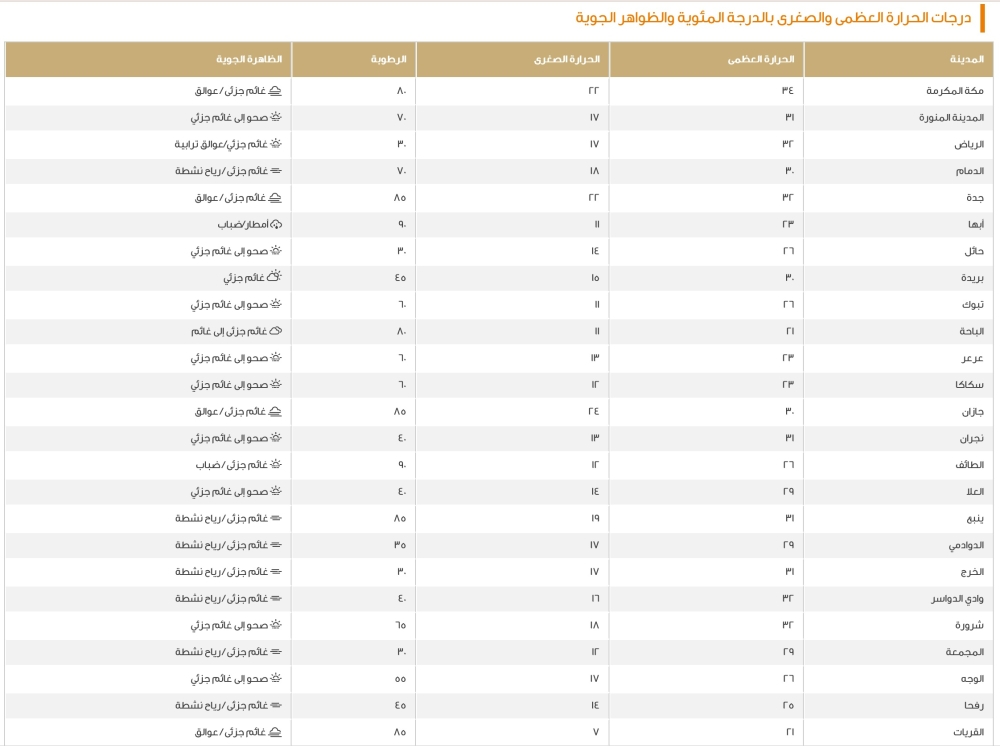
The National Center for Meteorology in Saudi Arabia released its daily report on expected maximum temperatures for Thursday across the Kingdom's cities and regions. The report showed a significant variation in temperatures between regions, with the coastal city of Dammam recording 30 degrees Celsius, while Mecca reached 34 degrees Celsius, making it one of the hottest cities in the Kingdom that day.
The general climatic context in the Kingdom
This temperature variation reflects the diverse climate of Saudi Arabia, which spans a vast geographical area exceeding two million square kilometers. While a hot, arid desert climate prevails in most regions, particularly in the central, eastern, and Empty Quarter (Rub' al Khali) areas, the southwestern highlands, such as Abha and Al-Baha, enjoy a more temperate and cooler climate due to their higher altitude. This is evident in Abha's record-breaking high of 23 degrees Celsius and As-Soudah's low of only 17 degrees. Historically, the Kingdom experiences distinct seasons. Summers are characterized by record-breaking high temperatures that can exceed 50 degrees Celsius in some inland areas, making them among the hottest summers in the world. Winters are generally mild, with a noticeable drop in temperature and rainfall, although temperatures can fall below freezing in the northern regions and highlands.
The importance of monitoring the weather and its impact
Weather reports are of paramount importance at both the local and national levels. On a daily basis, residents rely on this data to plan their activities and avoid the risks of heat stress and sunstroke, especially during the Hajj and Umrah seasons in Mecca and Medina, where relevant authorities work to provide all means of comfort and safety for pilgrims based on weather forecasts. Weather conditions also directly affect vital sectors such as agriculture, which depends on temperature and humidity levels, and the construction sector, where working hours are affected by severe weather. At the national level, this information is essential for the safety of air and sea navigation and helps in planning for emergency weather phenomena such as sandstorms or heavy rainfall.
List of maximum temperatures in the cities of the Kingdom:
The maximum temperatures recorded in the major cities were as follows:
- Mecca: 34 degrees Celsius
- Riyadh: 32 degrees Celsius
- Jeddah: 32 degrees Celsius
- Wadi Al-Dawasir: 32 degrees Celsius
- Sharurah: 32 degrees Celsius
- Medina: 31 degrees Celsius
- Najran: 31 degrees Celsius
- Yanbu: 31 degrees Celsius
- Al-Kharj: 31 degrees Celsius
- Al Qunfudhah: 31 degrees Celsius
- Al-Ahsa: 31 degrees Celsius
- Bisha: 31 degrees Celsius
- Dammam: 30 degrees Celsius
- Buraidah: 30 degrees Celsius
- Jazan: 30 degrees Celsius
- Al-Ula: 29 degrees Celsius
- Hafar Al-Batin: 28 degrees Celsius
- Hail: 26 degrees Celsius
- Tabuk: 26 degrees Celsius
- Taif: 26 degrees Celsius
- Abha: 23 degrees Celsius
- Arar: 23 degrees Celsius
- Sakaka: 23 degrees Celsius
- Courtyard: 21 degrees Celsius
- Tarif: 18 degrees Celsius
- Al-Sawda: 17 degrees Celsius