The National Center for Meteorology in Saudi Arabia announced on Monday the details of the maximum temperatures recorded in various regions and cities of the Kingdom, in a statement reflecting the natural climatic variations the country experiences due to its vast geographical area. Dammam recorded 24 degrees Celsius, while Jazan topped the list with 31 degrees Celsius, and Tarif recorded the lowest maximum temperature at only 11 degrees Celsius.
List of maximum temperatures in the cities of the Kingdom
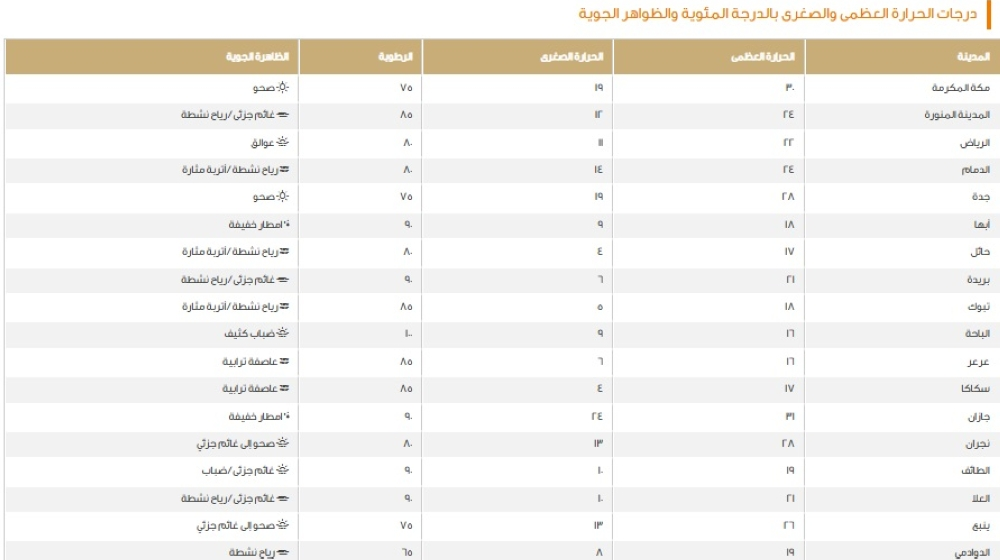
The official readings from the National Center for Meteorology were as follows, showing the temperature differences between the coastal, central, and northern regions:
- Dammam: 24 degrees Celsius.
- Mecca: 30 degrees Celsius.
- Medina: 24 degrees Celsius.
- Riyadh: 22 degrees Celsius.
- Jeddah: 28 degrees Celsius.
- Abha: 18 degrees Celsius.
- Hail: 17 degrees Celsius.
- Buraidah: 21 degrees Celsius.
- Tabuk: 18 degrees Celsius.
- The courtyard: 16 degrees Celsius.
- Arar: 16 degrees Celsius.
- Sakaka: 17 degrees Celsius.
- Jazan: 31 degrees Celsius.
- Najran: 28 degrees Celsius.
- Taif: 19 degrees Celsius.
- Al-Ula: 21 degrees Celsius.
- Yanbu: 26 degrees Celsius.
- Al-Dawadmi: 19 degrees Celsius.
- Al-Kharj: 22 degrees Celsius.
- Wadi Al-Dawasir: 27 degrees Celsius.
- Sharurah: 22 degrees Celsius.
- Combined: 19 degrees Celsius.
- Face: 24 degrees Celsius.
- Rafha: 16 degrees Celsius.
- Al Qurayyat: 17 degrees Celsius.
- Tarif: 11 degrees Celsius.
- Al Qunfudhah: 29 degrees Celsius.
- Al-Ahsa: 24 degrees Celsius.
- Hafar Al-Batin: 19 degrees Celsius.
- Bisha: 27 degrees Celsius.
- Al-Sawda: 12 degrees Celsius.
- Rawdat Al-Tanhat: 20 degrees Celsius.
- Al-Dahna desert: 19 degrees Celsius.
- Al-Saman: 19 degrees Celsius.
Geographical diversity and its impact on climate
These figures reflect the great geographical diversity of Saudi Arabia. While northern regions like Tarif and Qurayyat are experiencing a significant drop in maximum temperatures, reaching as low as 11 degrees Celsius, necessitating precautions against the cold, coastal and southern regions such as Jazan, Mecca, and Al Qunfudhah continue to enjoy warmer weather, with relative temperatures approaching 30 degrees Celsius. This variation underscores the importance of monitoring daily weather forecasts to determine appropriate clothing and plan outdoor activities.
The role of the National Center for Meteorology and the importance of data
The National Center for Meteorology is the official body authorized to issue weather forecasts and early warnings in the Kingdom. This data is of paramount importance not only to individuals but also to vital and economic sectors. Determining temperatures and weather conditions directly impacts air and sea navigation, the agricultural sector, and the management of tourism and entertainment events throughout the Kingdom. The accuracy of this data relies on a vast network of radars and advanced monitoring stations deployed across the country, contributing to enhanced public safety and quality of life, in line with the Kingdom's Vision 2030 objectives for environmental protection and public safety.