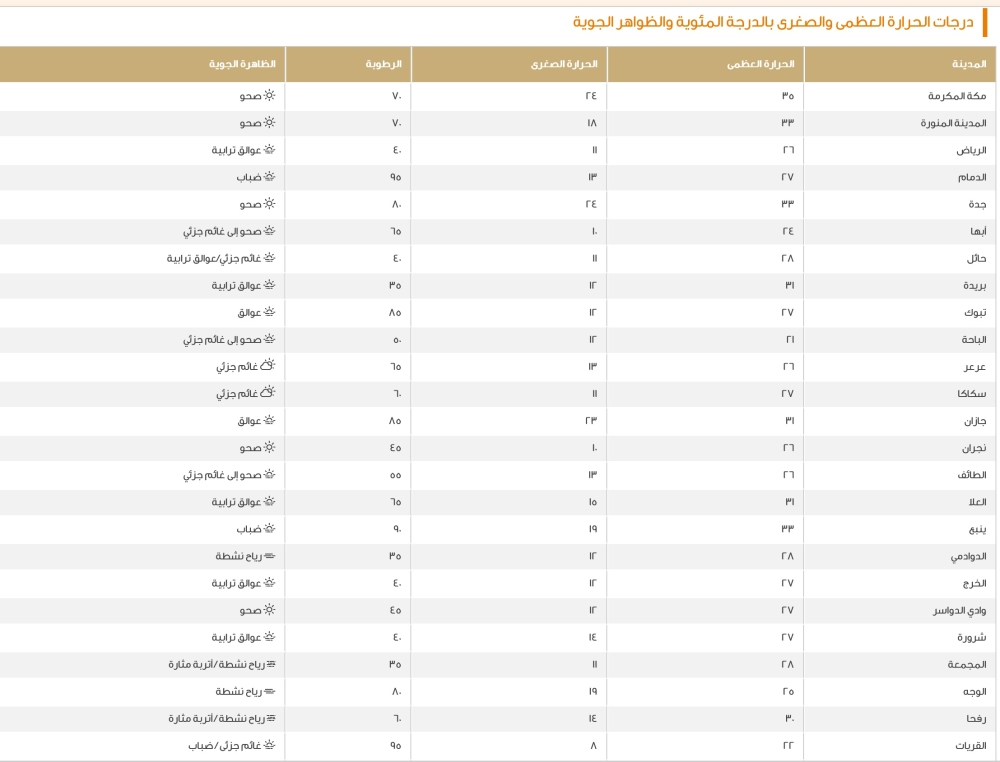
The National Center for Meteorology in Saudi Arabia issued its daily weather report, revealing a significant variation in maximum temperatures recorded across the Kingdom's cities and regions. While Dammam recorded a moderate temperature of 27 degrees Celsius, Mecca reached 35 degrees, reflecting the wide climatic diversity characteristic of the Kingdom's vast geography.
Temperature map in the cities of the Kingdom
According to the center's report, the expected maximum temperatures for Wednesday are as follows:
- Mecca: 35 degrees Celsius
- Medina: 33 degrees Celsius
- Jeddah: 33 degrees Celsius
- Yanbu: 33 degrees Celsius
- Al Qunfudhah: 32 degrees Celsius
- Buraidah: 31 degrees Celsius
- Jazan: 31 degrees Celsius
- Al-Ula: 31 degrees Celsius
- Rafha: 30 degrees Celsius
- Hafar Al-Batin: 30 degrees Celsius
- Bisha: 30 degrees Celsius
- Riyadh: 25 degrees Celsius
- Dammam: 27 degrees Celsius
- Hail: 28 degrees Celsius
- Tabuk: 27 degrees Celsius
- Al-Ahsa: 28 degrees Celsius
- Abha: 24 degrees Celsius
- Courtyard: 21 degrees Celsius
- Taif: 26 degrees Celsius
- Najran: 26 degrees Celsius
The climatic and geographical context of weather diversity in Saudi Arabia
This wide variation in temperatures is due to the vast geographical area and diverse topography of Saudi Arabia. While coastal areas on the Arabian Gulf and the Red Sea, such as Dammam and Jeddah, enjoy more humid and relatively mild weather during certain times of the year, inland and desert regions, such as Riyadh, experience greater temperature fluctuations between day and night. The southwestern highlands, including cities like Abha and Al-Baha, enjoy cooler temperatures thanks to their higher altitude, making them popular tourist destinations for those seeking milder weather.
The importance of following weather reports and their impact
The National Center for Meteorology's reports play a vital role in the daily lives of citizens and residents, helping them plan various activities and avoid potential risks associated with severe weather conditions. This data is also of strategic importance to vital sectors such as agriculture, which relies on temperature and rainfall levels, and the transportation and aviation sectors to ensure the safety of land and air navigation. Furthermore, this information is essential for serving pilgrims in Mecca and Medina, contributing to the development of operational plans for the Hajj and Umrah seasons to ensure the comfort and safety of pilgrims and Umrah performers amidst the high temperatures that these regions often experience.