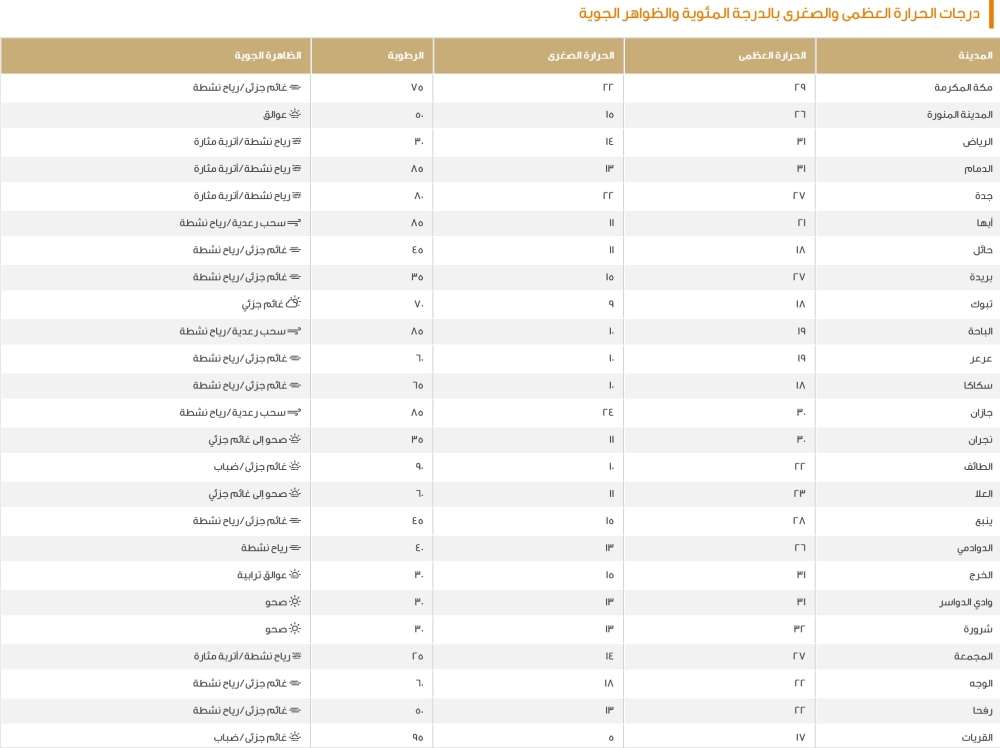
The National Center for Meteorology in Saudi Arabia issued its daily weather report, forecasting continued weather fluctuations across most of the Kingdom on Tuesday. The forecast indicates continued surface wind activity stirring up dust and sand, leading to reduced horizontal visibility, with a chance of scattered rain in some southern and northern regions.
Details of the expected weather conditions
According to the center's report, large parts of the Tabuk, Madinah, and Makkah regions, especially their coastal areas, are expected to be affected by active winds stirring up dust and sand. This impact will also extend to the Northern Borders, Al-Jawf, Hail, Al-Qassim, Riyadh, and Eastern Province regions. Conversely, there is a chance of scattered rain and fog formation in parts of the Jazan, Asir, and Al-Baha regions, as well as parts of northern Saudi Arabia.
The climatic context of weather fluctuations in Saudi Arabia
These weather fluctuations are part of the Arabian Peninsula's climatic nature, characterized by a predominantly arid desert climate. Dust storms and strong winds are frequent weather phenomena, particularly during seasonal transitions, when the region is affected by the passage of low-pressure systems and various upper-level air currents. The National Center of Meteorology monitors these phenomena around the clock to issue necessary warnings and alerts, utilizing the latest technologies and numerical weather prediction models to ensure the accuracy of information provided to the public and relevant authorities.
Expected effects and the importance of taking precautions
These weather conditions have a direct impact on daily life and public safety. Dust-laden winds can cause health problems, especially for those with asthma and respiratory conditions. In such weather, it is advisable to stay indoors as much as possible and keep windows closed. Reduced horizontal visibility also increases the risk of driving on highways, requiring drivers to exercise extreme caution and reduce their speed. Air and sea traffic may also be affected, potentially leading to delays. Therefore, relevant authorities, such as Civil Defense and Highway Patrol, emphasize the importance of following official warnings and instructions to ensure everyone's safety.
State of the Red Sea and the Arabian Gulf
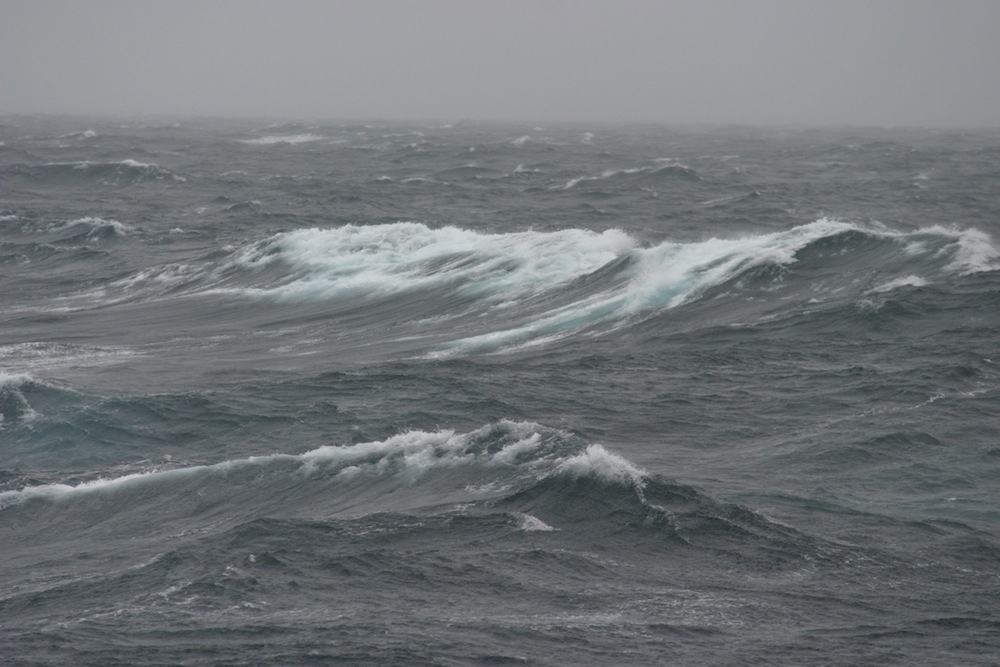
Red Sea: Surface winds will be northwesterly to northerly at speeds of 20-42 km/h in the northern and central parts, and southeasterly to southwesterly at speeds of 16-25 km/h in the southern part. Wave heights will range from 1 to 2 meters in the northern and central parts, and from half a meter to 1 meter in the southern part. Sea conditions will be slight to moderate.
Arabian Gulf: Surface winds will be northwesterly to westerly at a speed of 13-25 km/h, with wave heights ranging from half a meter to one meter, and the sea state will be slight.