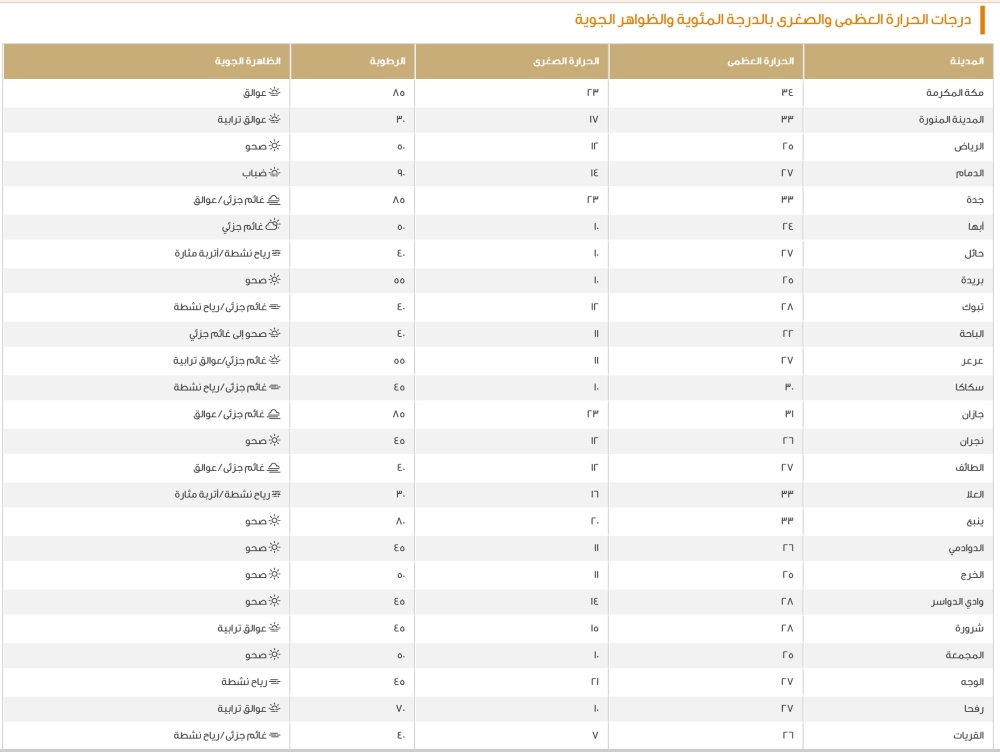
The National Center for Meteorology in Saudi Arabia issued its daily weather report, forecasting the continuation of the current weather fluctuations across the country. According to the report, the impact of active surface winds stirring up dust and sand is expected to persist, leading to reduced horizontal visibility in large parts of the Northern Borders, Al-Jawf, Tabuk, and Hail regions. This effect also extends to the eastern parts of the Madinah and Makkah regions.
The climatic context of weather fluctuations in the Kingdom
These weather phenomena are common in Saudi Arabia, especially during seasonal transitions. Due to its predominantly desert geography, the Kingdom is prone to dust and sandstorms, sometimes known locally as "Shamal" winds. These winds often arise from differences in atmospheric pressure and carry large quantities of sand and dust from vast deserts such as the Rub' al Khali and the Nafud al-Kabir, affecting air quality and visibility in cities and residential areas.
Expected effects and preventive guidelines
These weather fluctuations have direct impacts on daily life and public safety. From a health perspective, asthma and respiratory patients are advised to take precautions and stay indoors as much as possible during periods of heavy dust. Regarding transportation, reduced visibility poses a hazard on highways, requiring drivers to reduce speed and use hazard lights. Air traffic at airports located in these areas may also be affected, potentially leading to delays or rescheduling of some flights to ensure flight safety.
Chances of fog and rain
In a related context, the center indicated that conditions remain favorable for fog formation during the night and early morning hours along the coastal areas of Makkah, Asir, and Jazan regions, as well as parts of the Eastern Province. The report also did not rule out the possibility of light rain in the northern parts of the Kingdom.
State of the Red Sea and the Arabian Gulf
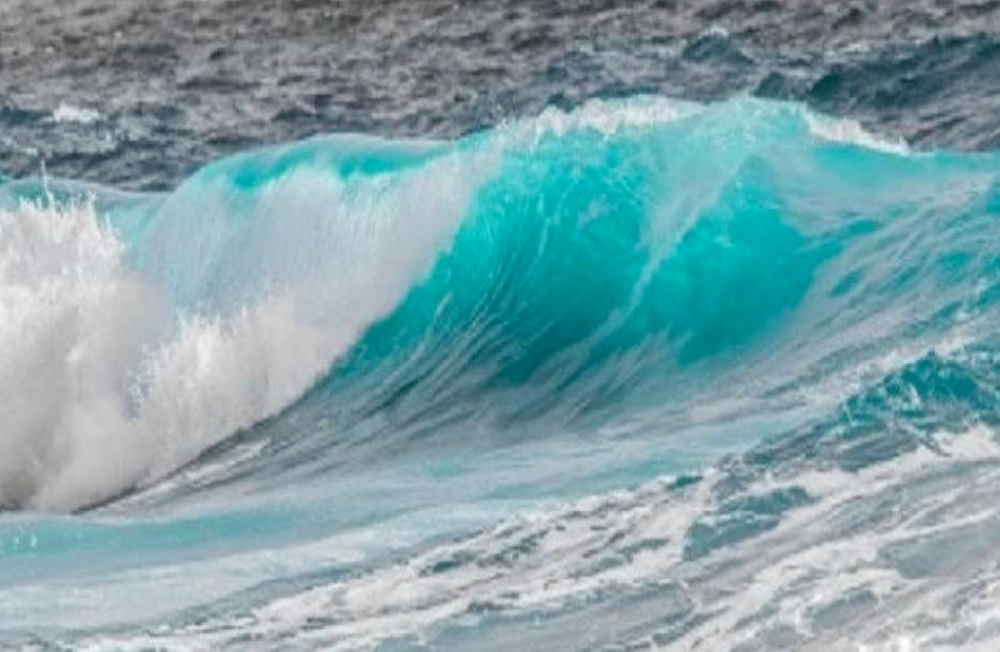
Red Sea: Surface winds are expected to be southwesterly to northwesterly in the northern part, and southeasterly to southwesterly in the central and southern parts, with speeds ranging from 15 to 32 km/h. Wave height will be between half a meter and one and a half meters, and sea conditions will be slight to moderate.
Arabian Gulf: Surface winds will be northwesterly to northerly at a speed of 16-30 km/h, with wave heights of half a meter to one and a half meters, making the sea state slight to moderate.
The official end of winter
These forecasts coincide with the National Center for Meteorology's announcement that winter will officially end in the Kingdom in 12 days. The center's spokesperson explained that this year's winter was warmer than usual, with cold air masses concentrated more heavily on the central and northern regions. A gradual rise in temperatures is expected in the coming days, particularly along the coasts, signaling the beginning of spring.