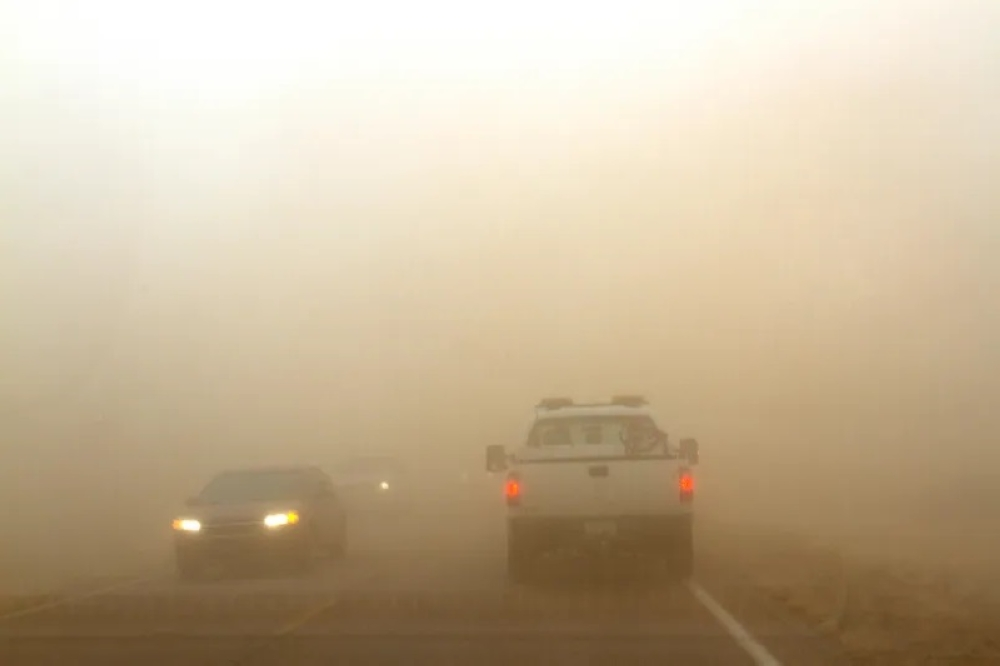
The National Center for Meteorology in Saudi Arabia issued its daily report on the expected weather conditions for Saturday, warning of continued weather fluctuations that include active winds stirring up dust and sand, in addition to the formation of fog in scattered parts of eight regions, which calls for taking precautions.
Weather details and affected areas
According to the report, the impact of active surface winds, which may reach speeds that stir up dust and sand, is expected to continue, leading to reduced horizontal visibility. The areas affected by this phenomenon include parts of the Northern Borders, Al-Jawf, Tabuk, Hail, Madinah, and Makkah regions. The center also indicated that the possibility of fog formation remains during the night and early morning hours along the coastal areas of the Makkah and Eastern regions, further reducing visibility on the roads.
The climatic context of weather phenomena in the Kingdom
These weather phenomena are common in Saudi Arabia due to its vast area and diverse geography, which includes expansive deserts such as the Empty Quarter and the Great Nafud. These deserts act as a primary source of dust and sand. During the transitional periods between seasons, low-pressure systems and various air masses become active, generating strong winds capable of carrying enormous quantities of dust over long distances, affecting large areas of the country. Some of these winds are known locally by different names depending on their direction and season, and they are considered part of the region's climatic system.
Expected effects and the importance of following warnings
These weather fluctuations have a direct impact on various aspects of daily life. From a health perspective, those with asthma, allergies, and respiratory conditions are advised to avoid going out in such weather unless absolutely necessary. Regarding transportation, reduced horizontal visibility due to dust or fog poses a risk to road safety and may cause delays or rescheduling of some flights at affected airports. Relevant authorities, such as Civil Defense and Highway Patrol, emphasize the need for caution and to follow updates issued by the National Center of Meteorology to ensure everyone's safety.
Sea conditions and maritime navigation
Red Sea
- Surface wind direction: Northwesterly to northerly on the northern and central parts, and southeasterly to southwesterly on the southern part, with speeds ranging between 15-35 km/h, and may reach 45 km/h towards the Gulf of Aqaba and the Bab al-Mandab Strait.
- Wave height: from half a meter to one and a half meters, reaching two meters towards the Gulf of Aqaba and the Bab al-Mandab Strait.
- Sea state: Light to moderate waves.
Arabian Gulf
- Surface wind direction: Northwesterly to westerly at a speed of 10-28 km/h.
- Wave height: from half a meter to one meter.
- Sea state: Light waves.