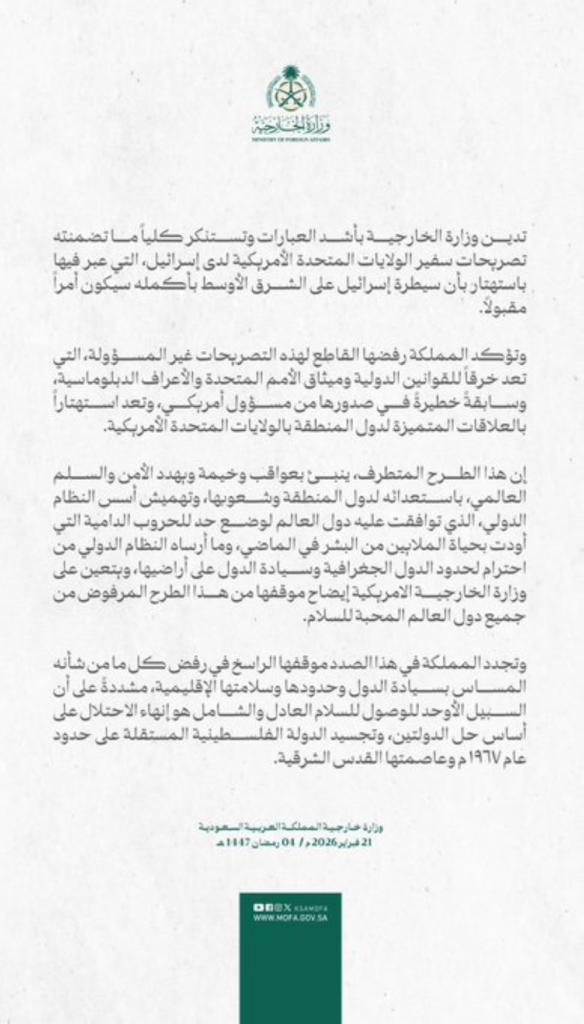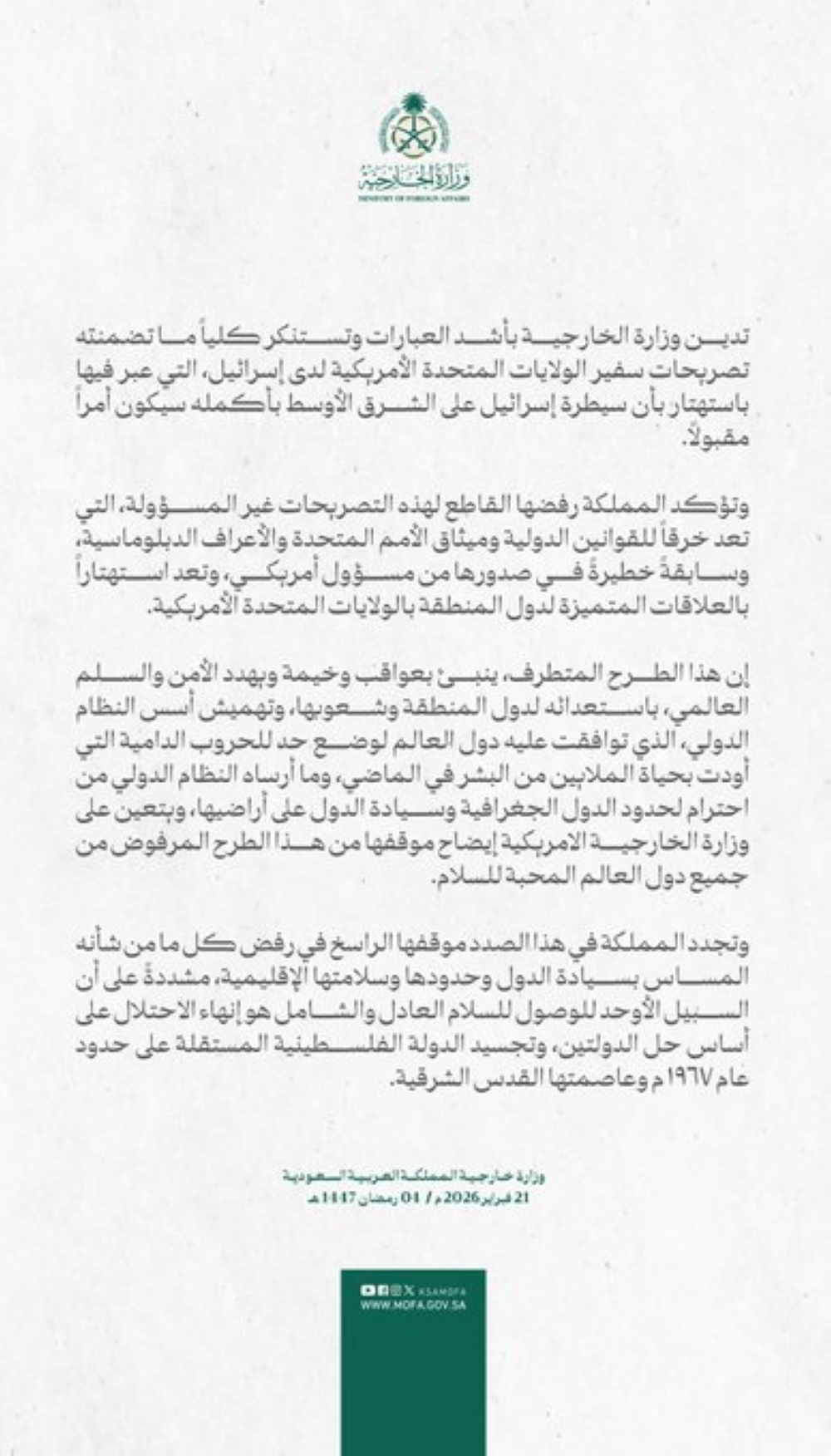
The Saudi Ministry of Foreign Affairs expressed the Kingdom of Saudi Arabia’s categorical rejection and strong condemnation of the statements made by the US Ambassador to Israel, which included insinuations that Israeli control over the Middle East might be acceptable. In an official statement, the Ministry described these statements as “irresponsible” and in blatant contradiction of diplomatic norms, the principles of international law, and the UN Charter.
The statement emphasized that the Kingdom considers these remarks a dangerous precedent, especially as they were made by an official representing the United States. It noted that they demonstrate a disregard for the distinguished relations that bind the countries of the region to the United States. The Saudi Ministry of Foreign Affairs warned that such extremist rhetoric threatens to undermine the foundations of security and stability in the region and the world, fuels hate speech and hostility, and ignores the fundamental principles upon which the modern international order is based, namely respect for the sovereignty and territorial integrity of states.
The historical context of the Saudi position
This Saudi stance is consistent with its longstanding and unwavering foreign policy toward the Palestinian cause and the Arab-Israeli conflict. The Kingdom has always been a staunch supporter of legitimate Palestinian rights, as clearly demonstrated in the Arab Peace Initiative launched by King Abdullah bin Abdulaziz (then Crown Prince) at the Beirut Summit in 2002. This initiative presented a comprehensive vision for peace based on the principle of “land for peace,” offering full normalization of relations between Arab states and Israel in exchange for Israel’s withdrawal from all Arab territories occupied in 1967, the establishment of an independent Palestinian state with East Jerusalem as its capital, and a just solution to the refugee issue. Therefore, the current rejection is not a fleeting reaction, but rather a reaffirmation of deeply rooted diplomatic principles.
Importance and potential impacts
Regionally, these statements send worrying messages that could encourage further unilateral actions, undermining the prospects for peace and exacerbating tensions. The decisive Saudi response puts an end to these speculations and affirms to influential countries in the region and the world that the path to stability inevitably lies in respecting international law. Internationally, the Saudi position reinforces the global consensus rejecting any solutions that are not based on the two-state solution and reminds the US administration of the importance of maintaining neutrality and objectivity in its role as a mediator in the peace process. This statement also clarifies for the United States that its strategic relations with its allies in the region, foremost among them the Kingdom, are based on mutual respect and shared interests, and that any infringement upon Arab and Islamic principles is a red line.
In closing its statement, the Ministry of Foreign Affairs reiterated that the only way to achieve a just, comprehensive and lasting peace in the Middle East is to end the Israeli occupation and establish an independent and sovereign Palestinian state on the 1967 borders, with East Jerusalem as its capital, in accordance with international law and the Arab Peace Initiative.