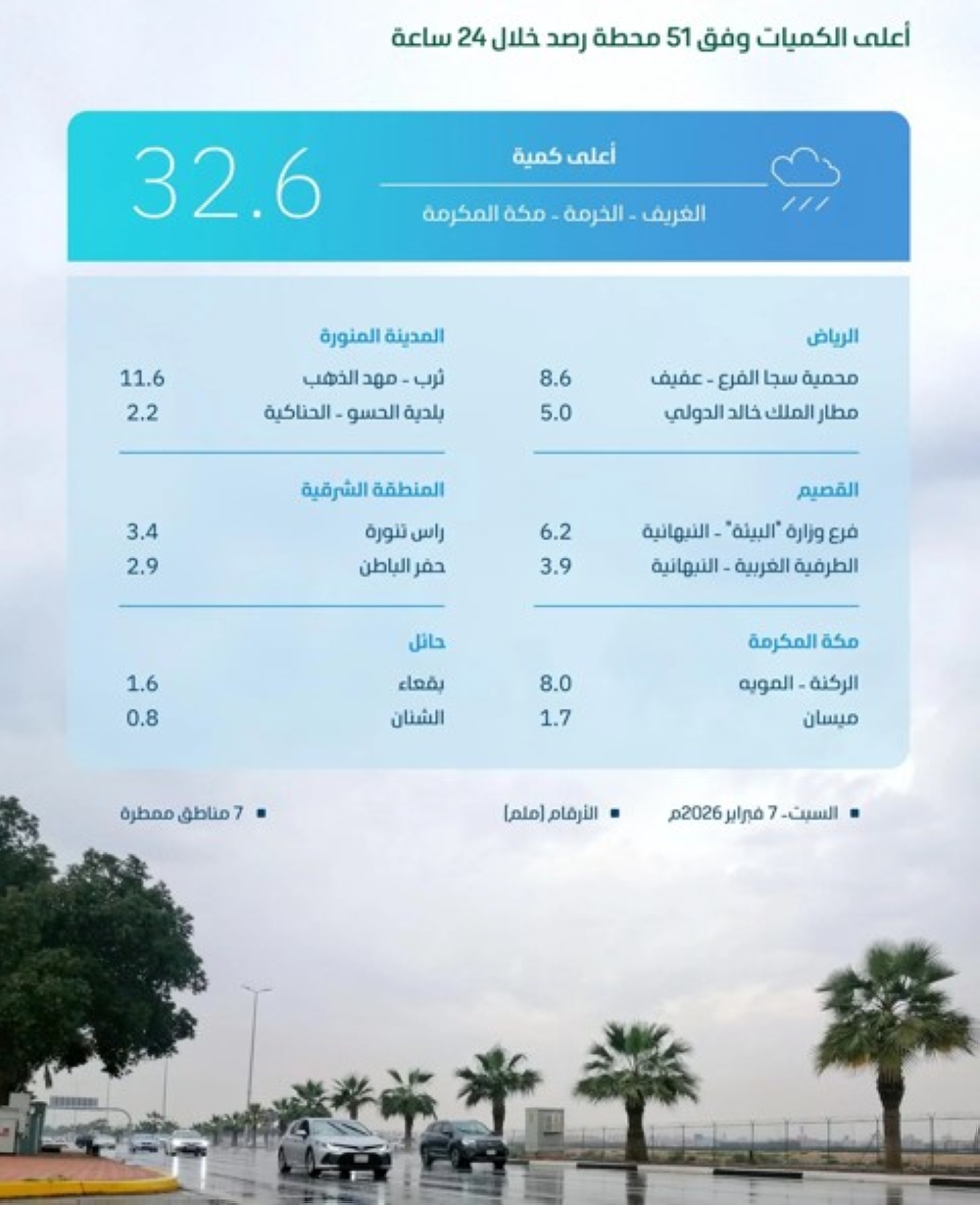
The Saudi Ministry of Environment, Water and Agriculture announced details of rainfall amounts recorded in various regions of the Kingdom over the past 24 hours. Its 51 hydrological and meteorological stations recorded varying intensities of rainfall. The Ministry's daily report indicated that the Makkah region recorded the highest rainfall, specifically in the Al-Gharif area of Al-Khurmah Governorate, reaching 32.6 mm, the highest recorded in the Kingdom during the monitoring period.
Rainfall details in the Kingdom's regions
According to the Ministry's report, covering the period from Friday morning to Saturday morning, rainfall amounts varied significantly across different regions. In the Makkah region, Al-Ruknah in Al-Muwayh recorded 8.0 mm, Maysan 1.7 mm, and Haddad Bani Malik in Taif 0.5 mm. In the Madinah region, the Tharb station in Mahd Al-Dhahab governorate recorded 11.6 mm. In the Riyadh region, the amount reached 8.6 mm in the Saja and Al-Fari'a reserves in Afif, and 5.0 mm at King Khalid International Airport.
Rainfall also affected other areas, with the Qassim region recording 6.2 mm in the Ministry's branch in Al-Nabhania, and the Eastern Province recording 3.4 mm in Ras Tanura and 2.9 mm in Hafr Al-Batin. The Hail and Northern Borders regions experienced light rainfall ranging between 0.6 and 1.0 mm.
The climatic context and the importance of rainfall for the Kingdom
These rains come in a climate characterized by aridity and scarcity of water resources across most of Saudi Arabia. Historically, the Arabian Peninsula has relied heavily on seasonal rains, known locally as "al-Wasam," to replenish groundwater, support agriculture, and provide natural grazing for livestock. Therefore, rainfall is a pivotal event of great economic, environmental, and social importance, welcomed with joy and celebration and considered a harbinger of good fortune for the agricultural and pastoral seasons.
Expected impacts and sustainable management efforts
Locally, these rains directly contribute to raising water levels in dams, which play a vital role in the Kingdom's water security. They also improve air quality, reduce dust storms, and contribute to the flourishing of vegetation and the support of biodiversity. These benefits align with the ambitious national efforts within Vision 2030 and initiatives such as "Green Saudi Arabia," which aim to combat desertification and increase green spaces. Relevant authorities, such as the Ministry of Environment and the National Center for Meteorology, closely monitor weather phenomena to issue necessary warnings, particularly regarding the risk of flash floods in valleys and low-lying areas, to ensure the safety of lives and property and maximize the benefits derived from the rainwater.