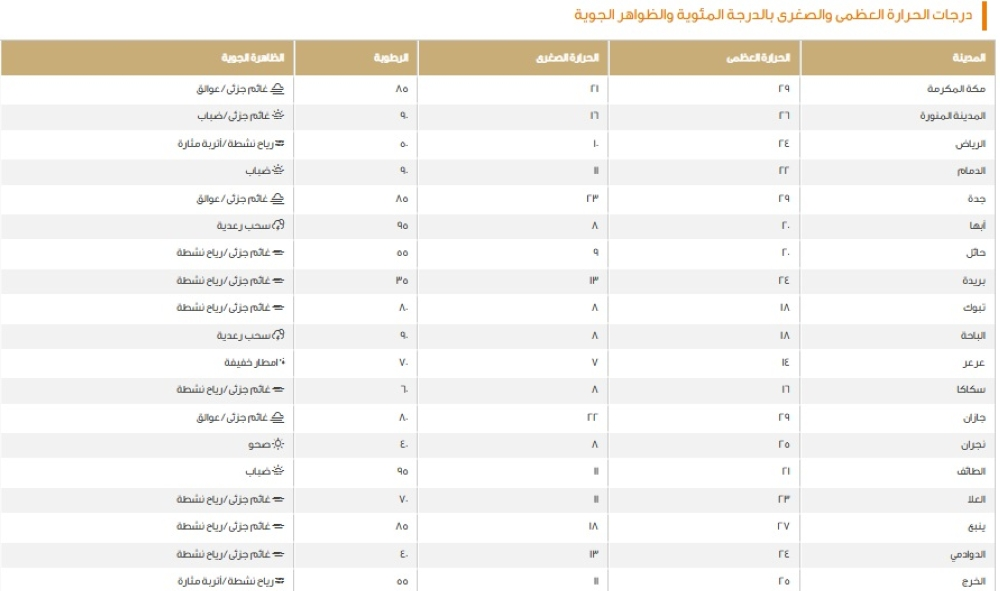
The National Center for Meteorology in Saudi Arabia announced on Tuesday details of the maximum temperatures recorded in various cities and provinces across the Kingdom. The data revealed a clear climatic variation reflecting the country's significant geographical diversity. The city of Dammam recorded 22 degrees Celsius, while temperatures varied between the northern regions, which experienced a noticeable drop, and the coastal areas, which maintained warmer levels.
List of maximum temperatures in the cities of the Kingdom
According to the report issued, the maximum temperatures recorded today were as follows:
- Eastern and Central Region: Dammam recorded 22 degrees Celsius, Riyadh 24 degrees, Al-Ahsa 25 degrees, while Al-Kharj and Wadi Al-Dawasir recorded 25 degrees Celsius, Al-Majma’ah and Hafr Al-Batin 24 degrees, and Al-Dawadmi 24 degrees.
- Western and coastal region: The temperature in Mecca and Jeddah reached 29 degrees Celsius, Medina 26 degrees, Yanbu 27 degrees, and Al-Qunfudhah recorded the highest temperature at 30 degrees Celsius.
- Northern regions: witnessed a clear decrease, with Tarif recording only 11 degrees Celsius, Al Qurayyat 13 degrees, Arar 14 degrees, Sakaka 16 degrees, and Rafha and Tabuk 18 degrees Celsius.
- Highlands and the South: Abha and Hail recorded 20 degrees Celsius, Al-Baha 18 degrees, Al-Soudah 14 degrees, while Jazan recorded 29 degrees, Najran 25 degrees, and Taif 21 degrees.
Geographical diversity and its impact on the climate in the Kingdom
This report reflects the unique environmental and geographical diversity of the Kingdom of Saudi Arabia. While coastal areas such as Jeddah, Al Qunfudhah and Jazan enjoy a relatively warm and humid climate due to the influence of the Red Sea, northern areas such as Tarif and Al Qurayyat experience significantly lower temperatures, due to their proximity to climatic influences coming from the Mediterranean basin and the Levant, in addition to their altitude above sea level.
In the same context, topography plays a crucial role in determining temperatures, as we note that the mountainous highlands in Asir and Al-Baha (such as Al-Soudah and Abha) record moderate to cold temperatures during the day compared to the low or desert areas, making them preferred tourist destinations, especially with the moderate weather.
The role of the National Center for Meteorology and the importance of data
These daily reports are of paramount importance to citizens and residents, as they help in planning daily activities and determining appropriate clothing, especially given the weather fluctuations that some areas may experience during seasonal transitions. The National Center of Meteorology utilizes the latest technologies and weather monitoring systems to provide accurate data that contributes to enhancing public safety and supporting vital sectors such as agriculture, transportation, and tourism by forecasting weather conditions and their potential impacts.