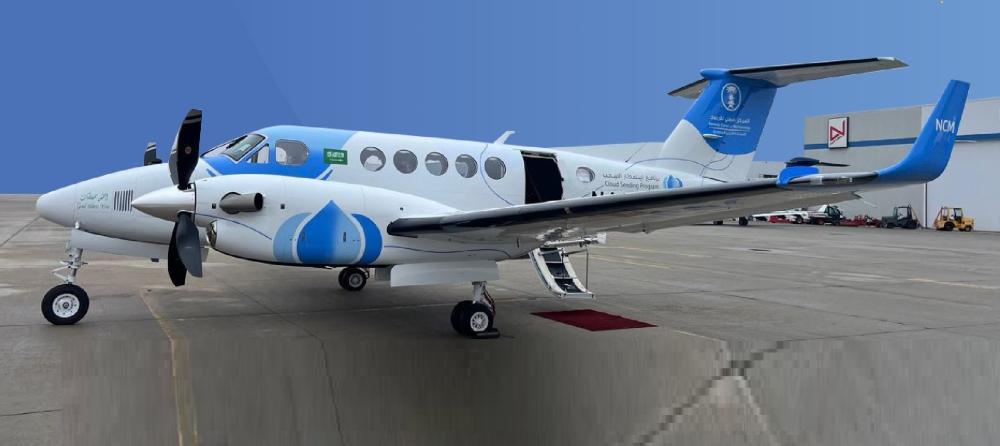
The Kingdom of Saudi Arabia, through its National Center for Meteorology, announced the launch of the “Flying Laboratory,” the world’s most advanced research aircraft specializing in cloud seeding operations, and the first of its kind in the region. This step represents a qualitative leap in the Kingdom’s efforts to enhance its water resources and address climate challenges, and comes as part of a broader strategy aimed at achieving environmental sustainability within the objectives of Saudi Vision 2030.
What is a “flying laboratory” and what are its capabilities?
The “flying laboratory” is not just an aircraft; it is a fully integrated aerial platform for advanced scientific research. The aircraft is equipped with state-of-the-art technology and equipment that allows scientists and researchers to study atmospheric properties with unprecedented precision. Its most prominent features include:
- Specialized research platforms: The aircraft contains 18 aerial research platforms specifically designed to measure cloud properties, the size and distribution of water droplets, and fine particles in the air according to the highest international scientific standards.
- High-precision measurements: The aircraft provides accurate data on cloud formation and rainfall stages, which helps in assessing cloud suitability for rainmaking and determining the ideal timing and location for operations.
- A deeper understanding of the atmosphere: It contributes to the study of the entire cloud life cycle, from its formation to its dissipation, and the analysis of condensation and freezing mechanisms within cumulus clouds.
Strategic context: The Saudi cloud seeding program
The launch of the “Flying Laboratory” comes within the framework of the regional cloud seeding program launched by the Kingdom as one of the outcomes of the Green Middle East Summit. Saudi Arabia, like other countries in the region, faces significant challenges related to water scarcity and desertification, making weather modification technologies such as cloud seeding a strategic option for increasing rainfall. The program aims to increase rainfall by up to 20% above the current average, contributing to strengthening water resources, supporting agriculture, combating desertification, and mitigating the effects of drought.
The importance and expected impact of the project
The “flying laboratory” represents a strategic addition to the scientific infrastructure in the Kingdom, and is expected to have wide-ranging effects on several levels:
- At the local level, it will contribute to expanding the geographical scope of cloud seeding operations to include new areas in the Kingdom, thus enhancing water security and supporting sustainable development. It will also provide a platform for training national cadres of Saudi researchers and scientists, and building local expertise in this specialized field.
- At the regional level: The “Flying Laboratory” enhances the Kingdom’s position as a regional leader in water technologies and weather sciences, and opens the door to scientific and research cooperation with neighboring countries facing similar climate challenges.
- At the international level: The project places the Kingdom among the leading countries in atmospheric research and weather modification, and the data that will be collected will contribute to enriching global scientific knowledge about cloud physics and climate in arid and semi-arid regions.
In conclusion, the “Flying Laboratory” is not just a tool to increase rainfall, but a long-term investment in knowledge and innovation, and a symbol of the Kingdom’s commitment to finding scientific and sustainable solutions to address one of the biggest challenges of the 21st century: climate change and the security of natural resources.