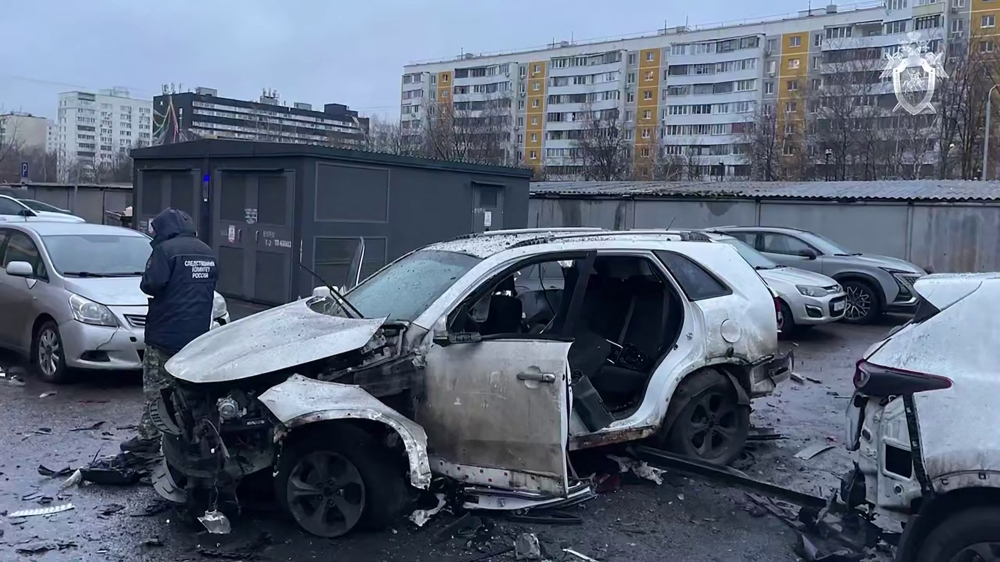
On Monday morning, Moscow witnessed a serious security incident in which a high-ranking general in the Russian General Staff was killed by a car bomb in the southern part of the city. The Russian Investigative Committee officially announced that the deceased was General Fanil Sarfarov, head of the operational training department of the General Staff, who died from severe injuries sustained in the attack.
According to a statement from the Investigative Committee, the explosion was caused by an improvised explosive device (IED) carefully planted under the car on Iasenieva Street, suggesting a meticulously planned assassination. Russian authorities have launched a full criminal investigation under the charges of "murder" and "transportation of explosives," asserting that the primary hypothesis currently being pursued by investigators is the involvement of Ukrainian intelligence in planning and executing the attack, further escalating already heightened tensions between the two countries.
A series of security assassinations deep inside Russia
This incident is not isolated, but rather comes as part of a series of security operations and assassinations that have targeted prominent Russian figures since the start of the Russian military operation in Ukraine in February 2022. These operations demonstrate a qualitative shift in the course of the conflict, as the confrontation has moved from traditional battlefronts to the heart of relatively safe Russian cities, posing a major challenge to the security services in Moscow.
Observers recalled similar past incidents, most notably the assassination of Darya Dugin, daughter of the philosopher and nationalist thinker Alexander Dugin, in August 2022, in a car bombing that rocked the Russian political scene. This was followed by the murder of the prominent military blogger Maxim Fomin (also known as Vladlin Tatarsky) in April 2023 inside a cafe in St. Petersburg, in a remarkable security breach.
Targeting military leaders and the evolution of tactics
The successive reports indicate a clear focus on targeting military and technical leaders in the Russian army. In addition to General Sarfarov, General Yaroslav Moskalik, deputy head of the Main Operations Directorate of the General Staff, was killed in a similar explosion near Moscow last April. Furthermore, in December 2024, Igor Kirillov, commander of the Radiation and Chemical Defense Forces, was killed by an electric bicycle explosion, an operation explicitly claimed by the Ukrainian Security Service.
This escalation carries profound strategic implications, aiming to undermine the morale of the Russian military leadership and demonstrate the adversary's ability to strike high-value targets within the capital. These incidents place the Kremlin under increasing pressure to bolster the home front and tighten security measures to protect officials, amidst an open intelligence war no less fierce than the battles raging on the ground.